


As late October chills settle over the Northern Hemisphere, the garden undergoes a quiet, profound transition. Trees shed their final solar canopies, exposing the underlying architecture of branches and soil, while frost paints subtle white margins along the edges of remaining perennial foliage. It is a moment in the seasonal cycle when nature invites us to slow down, look beneath the surface, and appreciate both the grand cosmic rhythms and the invisible micro-processes that sustain life outdoors.
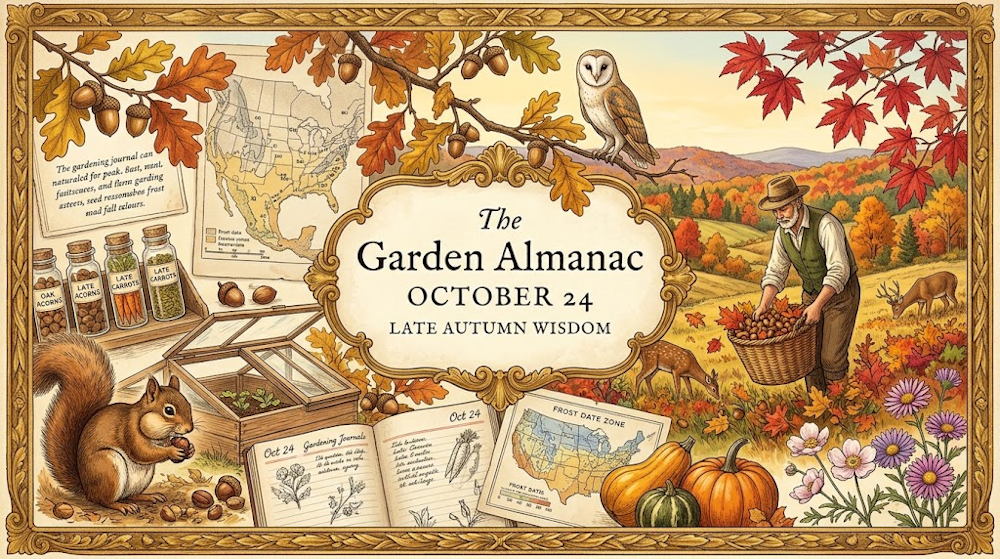
October 24 marks a unique crossroads in human history where astronomy, urban greening, and international land stewardship intersect. Looking back through the centuries on this day reveals how deeply our modern understanding of soil vitality, turf management, and microclimates is rooted in pivotal historical turns. By exploring these stories, today’s gardeners gain far more than historical lore – they unlock fresh perspectives on how we nurture our own plots before winter sets in.
October 24, 1601 – Starry Nights and the Birth of Garden Microclimates
On October 24, 1601, the legendary Danish astronomer Tycho Brahe passed away, leaving behind a legacy that transformed how humanity reads the heavens. Yet, few realize that his revolutionary observatory, Uraniborg on the island of Hven, was as much an advanced botanical station as an astronomical powerhouse. Brahe understood that observing celestial bodies required precise seasonal tracking, leading him to design intricate Renaissance gardens configured specifically to monitor wind directions, temperature shifts, and localized humidity changes surrounding his instruments.
In designing Uraniborg’s grounds, Brahe laid out symmetric parterres sheltered by sunken earthen ramparts, effectively creating one of Europe’s earliest documented artificial microclimates. He noticed that tender medicinal plants thrived within these recessed geometric garden zones despite the harsh Baltic winds sweeping across the island. By meticulously correlating planetary movements with plant growth rates and local frost patterns, Brahe proved that subtle physical barriers could alter growing conditions dramatically within a matter of yards.
For contemporary growers, Brahe’s legacy shifts our perspective on garden design from purely aesthetic layout to microclimatic physics. The windbreaks, stone walls, and gentle slopes in our backyards are not static backdrop elements; they are active thermal engines. Recognizing how shelter belts trap radiant heat or how low-lying spots gather cold air enables gardeners to strategically place sensitive species, extend harvest windows, and prepare sensitive perennials for incoming sub-zero temperatures.
Garden Science: How Microclimates Protect Your Soil
Why does ground freeze unevenly across a single backyard?
Microclimates are localized atmospheric zones created by structural wind barriers, topography, thermal mass, and canopy cover. Brick walls and dark garden paving act as thermal batteries, absorbing shortwave solar radiation during clear autumn days and re-radiating it as longwave infrared warmth at night. This radiant heat can elevate ambient root-zone temperatures by 2°C to 5°C compared to exposed lawn turf. Position cold-sensitive perennials near south-facing masonry, and avoid planting early-blooming shrubs in low-lying “frost pockets” where cold, dense air naturally settles on quiet autumn nights.
What to Observe Right Now
Take a quiet walk through the garden during late afternoon sun to observe these seasonal markers:
- Thermal draft zones: Feel for warm air rising near south-facing brick walls compared to open lawn edges.
- Soil crusting: Check whether unmulched soil beds are forming hard crusts under autumn rain, indicating a need for organic cover.
- Deciduous drop order: Note which tree species shed leaves first (such as birches and walnuts) versus those holding canopy late (like oaks).
October 24, 1857 – The World’s Oldest Football Club and the Invention of Civic Turf
When enthusiasts assembled in Yorkshire on October 24, 1857, to found Sheffield Football Club – recognized as the oldest active football club in the world – their primary challenge was not tactic formulation, but locating a reliable, hard-wearing green sward. Victorian industrialization had rapidly devoured open countryside, replacing natural meadows with cobblestones and iron foundries. The establishment of organized field sports forced nineteenth-century horticulturists to pioneer entirely new methods for cultivating resilient, heavily trafficked turf that could survive damp English winters.
Prior to this era, grass was managed primarily for agricultural grazing or ornamental estate lawns maintained by scythes. The demand for civic athletic grounds sparked an agricultural revolution in turfgrass selection, drainage engineering, and soil compaction management. Horticultural pioneers began testing dwarf perennial ryegrass (Lolium perenne) blends and deep-laid gravel drainage beds to create resilient green carpets that stood up to constant foot traffic, heavy downpours, and frost heave without turning into standing mud baths.
This historical shift reshaped the relationship between suburban populations and open grass. Today’s lawn care is direct heir to these Victorian turf innovations. When we core-aerate compacted pathways, overseed worn lawn patches with deep-rooting cold-season grasses, or top-dress turf with organic compost before winter dormancy, we practice soil aeration and root-zone architecture techniques developed over a century ago to keep civic spaces vibrant, green, and permeable.
Seasonal Tips: Autumn Turf and Bed Maintenance
- Aerate compacted pathways: Spike heavy traffic zones with a hollow-tine aerator to improve oxygen exchange before winter rains arrive.
- Apply late-season top dressing: Spread a thin 5 mm layer of well-rotted compost over lawns to feed soil microbes and protect grass crowns from frost.
- Clear drainage channels: Remove fallen leaves from garden runoffs and swales to prevent standing water from suffocating underlying root structures.
- Leave seed heads intact: Allow ornamental grasses and coneflowers to stand untrimmed; their structure provides winter interest and essential bird forage.
October 24, 1945 – The Birth of the UN and the Global Charter for Living Soil
On October 24, 1945, the United Nations Charter officially came into force, signaling a world rebuilding from global catastrophe. Amidst the political reconfigurations, international leaders recognized that long-term global peace was impossible without agricultural stability and soil conservation. This realization birthed specialized international bodies, such as the Food and Agriculture Organization (FAO), dedicated explicitly to mapping topsoil degradation, preventing dust bowl desertification, and protecting plant genetic diversity across international borders.
For the first time in modern governance, healthy soil was acknowledged not merely as private property or agricultural commodity, but as vital global infrastructure underpinning human survival. The post-war era initiated comprehensive global research into compost dynamics, nitrogen fixation, wind erosion control, and seed preservation. Scientists documented how industrial over-tilling destroyed living soil food webs, setting off movements toward regenerative agriculture, shelterbelt tree planting, and localized organic soil care that continue to gain momentum today.
This global watershed moment offers a powerful grounding insight for every individual gardener tending a backyard plot. National security and global ecological health ultimately reduce to living topsoil – a complex ecosystem composed of beneficial fungi, earthworms, and humic matter. When we refrain from over-tilling bed structures, apply autumn leaf mulch, and cultivate cover crops like crimson clover over bare earth, we participate directly in the global tradition of soil stewardship that began expanding worldwide on this very date eight decades ago.
Furthermore, caring for living soil transforms our daily garden decisions from isolated chores into active contributions to regional biodiversity. Protecting beneficial soil microbes against winter freeze through protective mulching preserves the foundational food web that feeds soil fauna, songbirds, and beneficial predatory insects come spring. A healthy backyard garden bed is a microscopic sanctuary, echoing the global ecological network envisioned in 1945.
Wildlife Note: Winterizing Garden Habitats
- Build deadwood hibernacula: Pile fallen branches, logs, and twigs in a secluded corner to shelter overwintering beetles, amphibians, and solitary bees.
- Leave leaf litter under hedges: Allow autumn leaves to accumulate around shrub bases, creating vital thermal insulation for foraging hedgehogs and ground-nesting insects.
- Maintain clean water sources: Float a small wooden ball in garden ponds or shallow birdbaths to prevent complete ice sealing during early autumn night frosts.
Looking Ahead
The historical threads tied to October 24 reminder us that a garden is never isolated from history, science, or global ecology. From Tycho Brahe’s atmospheric microclimates to Victorian turf breakthroughs and world-scale soil conservation charters, human progress has always been deeply intertwined with how we manage living landscapes. As autumn deepens, taking time to understand these historical connections enriches every seasonal garden task we undertake. Looking forward, our gardens stand as vital sanctuaries of resilience, where thoughtful soil care today promises vibrant growth, biodiversity, and renewal when spring returns.