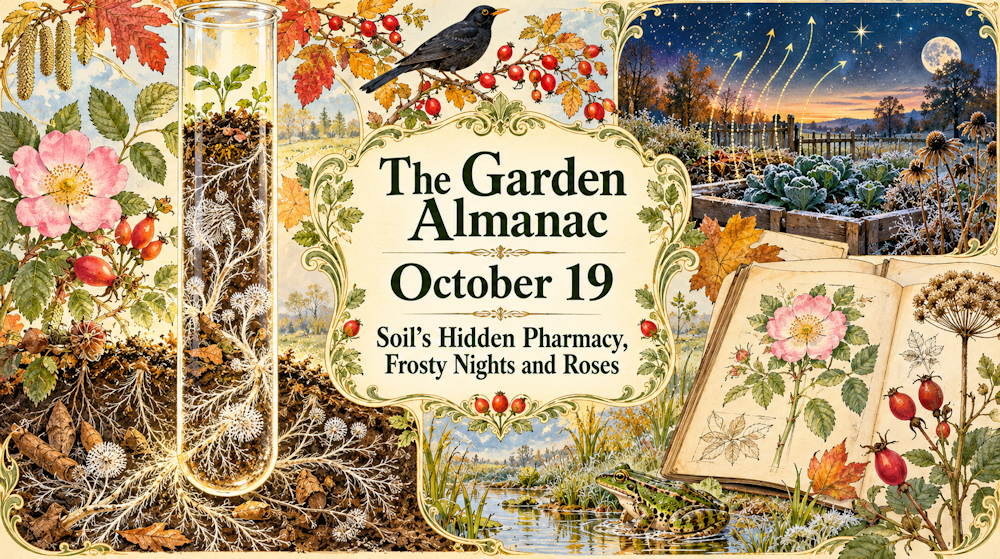

By mid-October, the garden seems to be drawing inward. Seed heads replace flowers, the scent of damp leaves rises after rain, and a clear evening can turn unexpectedly sharp before dawn. Yet October 19 opens onto worlds far larger than the season’s last harvests.
On this date, a young researcher found a medicine in a soil-dwelling microbe, a physicist described the invisible energy leaving every leaf after sunset, and a naturalist whose life was spent naming animals eventually turned his close attention to roses. Three very different stories – each a reminder that a garden is never only what we have planted.
October 19, 1943 – The Soil Organism That Changed Medicine
In a basement laboratory at Rutgers University, 23-year-old Albert Schatz was working with Streptomyces griseus, a soil bacterium. On October 19, 1943, he realised that one of his cultures was producing a new antibiotic. He called it streptomycin.
The discovery mattered urgently. Tuberculosis was still a devastating disease, and penicillin could not solve every bacterial infection. Streptomycin became the first effective antibiotic treatment for tuberculosis, saving lives around the world. Its story also carried a difficult human note: Schatz’s role was initially overshadowed by that of his laboratory head, and recognition came only much later.
For gardeners, the striking detail is where the breakthrough began: ordinary soil. A teaspoon of healthy soil contains an astonishingly busy community of bacteria, fungi, tiny animals and roots, each competing, recycling and exchanging chemical signals. Members of the Streptomyces group help break down tough plant material and are among the organisms responsible for the earthy scent that rises after rain.
That does not make every patch of garden soil a medicine cabinet, but it should change how we see it. Repeatedly stripping beds bare, compacting wet ground or relying on unnecessary chemical treatments can reduce the complexity of that underground community. Autumn compost, leaf mould and a light organic mulch do more than make a border look cared for – they feed the quiet biological work beneath it.
Garden Science – Why does soil smell so good after rain?
The familiar earthy fragrance is often linked to geosmin, a compound produced by soil microorganisms including Streptomyces. Raindrops help release these scent molecules into the air. In autumn, when warm soil meets cool rain and fallen leaves begin to break down, the effect can be especially noticeable.
October 19, 1900 – The Physics Behind a Frosty Morning
A gardener may notice that two nights with the same forecast minimum can leave very different marks on the garden. One passes quietly; the other blackens tender leaves, silvers the lawn and turns a bucket of water to ice. The difference is often written in the sky.
On October 19, 1900, Max Planck presented a new law describing thermal radiation. It was a landmark in physics, though its immediate subject was not the garden but the way hot objects emit energy. More than a century later, its everyday relevance is easy to find outdoors after sunset: soil, walls, plants and people are all continually giving off heat.
On clear, calm nights, leaves and open soil can lose heat to the sky so efficiently that their surfaces become colder than the air measured nearby. A layer of cloud acts rather like a blanket, returning some thermal radiation downward. This is why a cloudless autumn night can be more dangerous for tender plants than a slightly colder but overcast one.
Garden Reminder – How can you protect plants on a clear autumn night?
- Check the forecast for calm, cloudless conditions as well as the predicted air temperature.
- Move containers close to a wall, where stored daytime warmth can soften the chill.
- Cover vulnerable plants with horticultural fleece before sunset, keeping the cover from crushing foliage.
- Water dry soil earlier in the day if conditions allow – moist soil holds more daytime heat than dusty, dry ground.
- Remove covers in the morning once temperatures rise, so plants receive light and air.
The lesson is not to fight every cold night. Hardy plants need seasonal signals, and a little chill can help many perennials settle into dormancy. The useful distinction is between a natural autumn slowdown and a sudden radiative frost that catches tender dahlias, basil, salvias or late flowering containers before they are ready.
October 19, 1858 – A Naturalist Who Turned from Reptiles to Roses
George Albert Boulenger, born in Brussels on October 19, 1858, spent much of his working life surrounded by museum specimens. At London’s Natural History Museum, he became one of the great cataloguers of fishes, amphibians and reptiles, describing more than 2,000 species during his career.
It is easy to imagine taxonomy as a dry exercise in labels. In fact, careful naming changes what people are able to notice. A frog is no longer merely a frog once its particular habitat, life cycle and vulnerability come into focus. Boulenger’s work helped make the living world more legible at a time when museum collections were expanding rapidly through global exploration.
After his retirement, he did not simply put down the notebook. He became absorbed in roses, publishing botanical papers and substantial studies of European species. The shift is wonderfully fitting: a scientist known for reptiles and amphibians turned to a genus whose wild forms, cultivated varieties, thorns, hips and hybrid histories contain an equally tangled story of diversity.
A rose border can offer the same invitation to look closely. Leave a few hips on species roses and single-flowered varieties, rather than deadheading every last bloom. Their fruit feeds birds, their open flowers can serve pollinators, and their changing foliage records the season. A garden gains depth when its plants are not only chosen for the moment of flowering, but also for the lives they support before and after it.
Wildlife Note – What can a less tidy October garden offer?
- A shallow pile of dry leaves can shelter beetles, spiders and overwintering insects.
- Seed heads of teasels, asters and ornamental grasses provide structure and food.
- A pond with a gently sloping edge gives amphibians a safe route in and out.
- Fallen fruit is valuable for blackbirds and thrushes, but remove badly diseased fruit from beneath susceptible trees.
What to Observe Right Now
Rather than treating October as a month of garden closure, take a few minutes to notice its rearrangements.
- Look beneath leaf litter for the fine white threads of fungal growth beginning to bind it into future soil.
- Compare a sheltered border with an exposed one after a cool night – frost often reveals the garden’s tiny climate zones.
- Watch which birds visit rose hips, seed heads and remaining fruit.
- Notice which plants hold their form after flowering. These are often the plants that make a winter garden feel intentional rather than empty.
Looking Ahead
October 19 offers no single instruction for every garden. Instead, it points to three useful habits: protect the living soil, learn the small patterns of weather around your own plot, and look more carefully at the species sharing it. The next season’s garden is already taking shape in the leaf litter, in the cooling ground and in the seeds left standing. A little attention now can make spring feel less like a restart and more like the visible return of work that never truly stopped.