
On October 8, the garden often feels as if it is holding two seasons at once. There may still be a few late flowers, a tired tomato vine, a bee working slowly in the mildest hour of the day – but underfoot, the year is already changing texture.
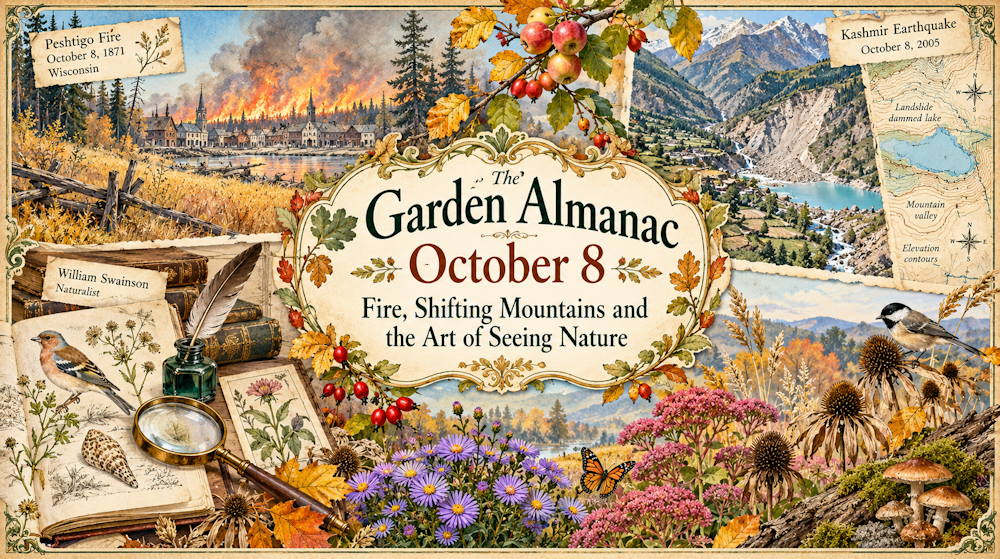
Today’s almanac moves through three very different landscapes: a night of fire in the forests and towns of the American Midwest, a mountain earthquake that rearranged slopes and streams, and the birthday of a naturalist who helped turn close observation into an art. Together, they remind us that gardens are never separate from the larger world. They are small places where weather, soil, disturbance, memory and attention all meet.
October 8, 1871 – The Night Fire Rewrote the Landscape
On the evening of October 8, 1871, fire broke out in more than one place across the Upper Midwest. The Great Chicago Fire became the most famous of these disasters, but farther north, the Peshtigo Fire in Wisconsin became the deadliest wildfire in recorded United States history. Dry weather, strong winds, wooden buildings, logging debris and parched forests turned a dangerous autumn night into a catastrophe.
The lesser-known detail is just how much of this disaster belonged not only to weather, but to land use. In logging regions, branches, bark, sawdust and discarded wood often lay in great quantities around settlements and mills. What looked like waste became fuel. What seemed like an economic landscape of timber and expansion also became a landscape primed for flame.
For today’s gardener, the story is not simply “fire is dangerous.” It is more precise than that: dryness plus fuel plus wind changes everything. The same principle applies at garden scale. A heap of dry stems beside a shed, dead grasses against a fence, or conifer prunings left to brown near a wall may seem harmless in cool weather, but in a dry spell they become part of the garden’s fire behavior.
The hopeful side is that landscapes can be redesigned. After major fires, towns began to think differently about building materials, open space and emergency planning. In gardens, too, resilience often starts with small, visible choices: keeping dry debris away from structures, pruning for air flow, watering young trees deeply before winter drought, and choosing mixed planting rather than relying on a single highly flammable screen.
Garden Reminder – Reduce Autumn Fire Risk Around the Garden
October is a good month to look at the garden as fuel, not only as beauty.
- Clear dry leaves, straw and dead stems away from wooden sheds, fences and house walls.
- Move stacked firewood, dry brush and prunings away from buildings where possible.
- Keep gutters free of dry leaves, especially near overhanging trees.
- Water newly planted shrubs and trees well before dry, windy weather.
- Avoid leaving conifer clippings or resinous prunings in dense piles beside structures.
This does not mean stripping the garden bare. Leaf litter is valuable for soil life and overwintering insects. The key is placement: keep habitat where it is useful, but reduce dry fuel where it could become dangerous.
October 8, 2005 – When the Kashmir Earthquake Moved the Slopes
On October 8, 2005, a major earthquake struck Kashmir and northern Pakistan. The human loss was immense, but the event also revealed something that gardeners, farmers and landscape managers sometimes forget: slopes are living systems, not static backdrops. The quake triggered thousands of landslides across steep mountain terrain, blocking streams, damaging roads and creating unstable new lakes behind debris.
One of the most striking lessons was that instability did not appear randomly. Landslides were concentrated where geology, slope angle, river cutting, road building and previous fractures had already made the land vulnerable. The earthquake was the trigger, but the landscape had been storing weakness for a long time.
Gardeners working on smaller slopes face a gentler version of the same truth. A bank does not fail only because of one storm. It may fail because soil has been left bare, water has been allowed to rush down one channel, roots have been removed, or a retaining edge has slowly weakened. The final collapse may look sudden, but the conditions were often assembled over months or years.
A stable garden slope usually depends on three things: roots, drainage and patience. Deep-rooted shrubs, grasses and groundcovers help hold soil. Mulch softens the impact of heavy rain. Terracing, contour planting and slow-release drainage prevent water from becoming a cutting tool. After a wet autumn storm, the most useful thing a gardener can do is not only admire what survived, but notice where water actually travelled.
Garden Science – Why Bare Soil Moves So Easily
Bare soil is vulnerable because raindrops hit it directly. Each impact breaks apart small soil aggregates, loosens particles and can form a crust that sheds water instead of absorbing it.
Roots change the physics of the soil. Fine roots bind particles together, larger roots create channels for water and air, and decaying roots leave pathways that improve infiltration. A planted slope is not held only by visible stems above ground. Much of its strength is underground.
That is why autumn mulching and planting matter. A layer of leaves, composted bark or straw can reduce erosion, while autumn-planted perennials and shrubs begin root growth before winter dormancy. Even when the top of the plant looks quiet, the soil may be becoming more stable.
October 8, 1789 – William Swainson and the Discipline of Looking Closely
Born in London on October 8, 1789, the English naturalist and illustrator William John Swainson belonged to a generation that made the living world visible not only by collecting specimens, but by drawing them with unusual care. He studied birds, shells, insects and plants, and became known for natural history illustration at a time when printed images could open the cabinet of nature to readers who would never travel to distant coasts or forests.
What makes Swainson interesting is not that he was always right. Like many energetic naturalists of his age, he sometimes embraced classification systems and botanical claims that later science left behind. But his larger importance lies in the act of attention. He understood that representing a bird, shell or plant required more than copying an outline. Form, posture, color, light and habit all mattered.
That is a useful warning for gardeners. We often identify plants too quickly: a leaf shape, a flower color, a label in a pot. But real observation is slower. Two seedlings that look similar in April may behave very differently by July. A shrub may reveal its needs not through one dramatic symptom, but through small signs: shorter shoots, paler leaves, earlier leaf drop, fewer visiting insects.
The best garden notebooks follow Swainson’s spirit more than his errors. They record what is actually seen: first frost, last dahlia bloom, where mildew appeared, which asters drew bees, which corner stayed damp longest. Over time, these small observations become a personal field guide to one place.
Wildlife Note – What October Gardens Offer to Animals
By early October, a garden is no longer only feeding the eye. It may be feeding birds, late insects and small mammals preparing for colder weather.
Seedheads of echinacea, teasel, sunflower and ornamental grasses can provide food and shelter. Ivy, asters, sedums and late-flowering herbs may still support pollinators on mild days. Fallen fruit can attract wildlife, though diseased or rotting fruit should be managed carefully if it spreads problems in the garden.
A useful autumn rule is selective tidiness. Clear what is diseased, slippery or risky near paths and buildings. Leave some hollow stems, seedheads and leaf litter in quieter corners. The garden does not need to look abandoned to be alive.
What to Observe Right Now – The Garden’s October Signals
October is full of small messages if you slow down enough to notice them.
- Which tree changes color first, and is it the same one as last year?
- Where does dew remain longest in the morning?
- Which late flowers still attract bees or hoverflies?
- Are birds visiting seedheads, berries or compost edges?
- Which parts of the garden dry quickly after rain, and which stay heavy and wet?
These observations are practical. They help you choose planting sites, improve paths, protect soil and understand microclimates. A garden does not give all its advice in spring. Some of its clearest instructions arrive in autumn.
Looking Ahead
October 8 brings together disturbance and attention: fire, earthquake and the patient art of looking closely. None of these stories asks us to control nature completely. They ask for something more realistic and more useful: to notice fuel, water, roots, slope, shelter, season and change.
For gardeners, that is a hopeful kind of knowledge. A safer, richer, more resilient garden is rarely made in one grand gesture. It is built through many accurate observations, followed by small decisions that respect what the place has been trying to tell us.