
Early September is a season of thresholds. In northern gardens, summer still lingers in warm soil and ripening fruit, yet cooler nights, heavier dew and the first tired leaves announce that autumn has begun negotiating its arrival.
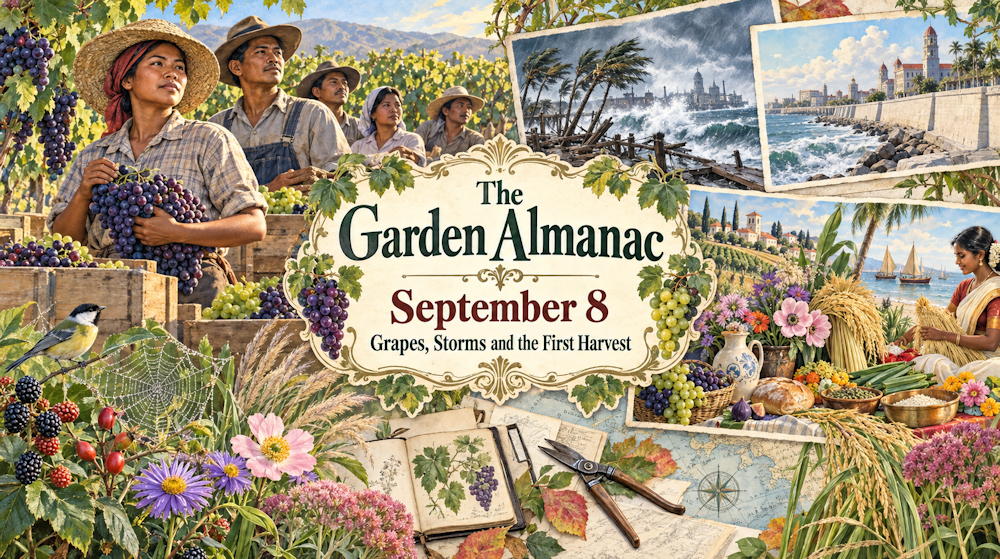
September 8 carries three particularly powerful stories from cultivated landscapes. One begins among California grapevines, where farmworkers demanded that the people harvesting the fruit should share in its value. Another unfolds on a low Texas island transformed by a catastrophic hurricane. The third travels through vineyards and rice-growing regions, where the first fruits of the harvest become symbols of gratitude, community and continuity.
September 8, 1965 – The Grapes That Became a Question of Justice
On September 8, 1965, Filipino farmworkers belonging to the Agricultural Workers Organizing Committee voted to strike against table-grape growers around Delano, California. Led by organisers including Larry Itliong, Philip Vera Cruz, Benjamin Gines and Pete Velasco, approximately 1,500 workers left the vineyards, demanding fairer wages and better conditions. Their decision began what would become the five-year Delano grape strike and boycott.
Eight days later, the predominantly Mexican American National Farm Workers Association joined them. The alliance challenged a system in which growers had often used divisions between ethnic groups to weaken labour action. The two organisations later merged, and the campaign eventually secured contracts that improved wages while introducing protections involving drinking water, sanitation, healthcare, hiring practices and exposure to hazardous pesticides.
This history belongs in a garden almanac because every grape, strawberry, lettuce head or apple carries two intertwined stories. One is biological – soil, water, sunlight, pollination and plant health. The other is human – the knowledge, judgement and physical labour required to grow, tend and harvest it. Sustainable horticulture cannot be measured only by yields, soil carbon or pesticide reduction; it must also include the wellbeing of the people working among the plants.
For home gardeners, the lesson begins with attention. Ask where plants, compost, cut flowers and seasonal produce come from, support growers who describe their labour and environmental practices openly, and remember that the cheapest product may carry costs hidden far beyond the checkout. In your own garden, handle sprays carefully, provide shade and drinking water when working in heat, and plan strenuous jobs for cooler hours. A productive garden should sustain its gardener as well as its crops.
Garden Science – Why does extreme heat make vineyard work more dangerous?
Plants cool themselves by releasing water vapour through their leaves, but people working between sunlit rows depend mainly on sweating. High temperatures, direct radiation, physical exertion and limited air movement can overwhelm that cooling system. Mulched soil and vegetated margins may reduce local surface temperatures, but they cannot replace shade, water, rest breaks and sensible working hours.
Garden Reminder – How Can You Tell When Grapes Are Ready to Pick?
Grapes do not continue ripening significantly once removed from the vine, so colour alone is not a reliable signal. Taste berries from several parts of the bunch and look for a balance of sweetness, flavour and acidity.
- Harvest when berries have developed their full flavour and characteristic colour.
- Cut whole bunches with clean scissors or secateurs instead of pulling them from the vine.
- Pick in dry weather once morning dew has evaporated.
- Remove damaged or mouldy berries before storing the bunches.
- Protect nearly ripe fruit with fine netting if birds or wasps become persistent visitors.
Avoid stripping away too many leaves around exposed bunches at once. Fruit that developed in shade can suffer sunscald when suddenly subjected to strong late-summer sunlight.
September 8, 1900 – The Storm That Forced Galveston to Rise
On the evening of September 8, 1900, a powerful hurricane struck Galveston, Texas. Winds exceeding 130 miles per hour and a storm surge of more than 15 feet swept across the low barrier island. Thousands of buildings were destroyed, and at least 8,000 people are believed to have died, making the disaster the deadliest weather event in United States history.
Galveston responded with an extraordinary programme of physical adaptation. Engineers constructed a massive seawall, while sections of the city were raised by pumping in sand beneath elevated buildings, streets and utilities. The project changed not only the city but also its ground levels, drainage and relationship with the coast. It was a dramatic acknowledgement that rebuilding in the same place required rebuilding differently.
A home garden cannot stop a hurricane, but it can be designed to cope better with intense rain, wind and temporary flooding. Keep large trees structurally sound through correct pruning rather than topping, avoid placing sheds or brittle ornamental trees where they could strike a house, and give runoff somewhere safe to travel. Rain gardens, shallow planted basins and permeable paths can slow ordinary downpours, while salt-tolerant plants are valuable in coastal gardens exposed to sea spray. During an official severe-weather warning, however, personal safety and evacuation instructions always take priority over protecting plants.
Seasonal Tips – Is Your Garden Ready for Autumn Storms?
- Remove dead, cracked or hanging branches that could fall in strong wind.
- Clear gutters, drains and water-butt overflows before heavy rain.
- Secure pots, lightweight furniture, tools and temporary supports.
- Check that newly planted trees are firmly rooted, but loosen ties that are cutting into bark.
- Direct roof water away from foundations and into a suitable planted or permeable area where local conditions allow.
Wildlife Note – What Happens to Garden Animals During a Storm?
Birds usually seek dense vegetation, cavities and sheltered sides of hedges, while many insects retreat beneath leaves, bark or stones. A garden containing shrubs of different heights, mature trees, ground cover and undisturbed corners offers more refuge than a uniformly clipped landscape.
After a storm, check ponds and water containers for displaced animals before clearing debris. Leave safe piles of twigs or fallen leaves where possible, and restore bird water carefully. Avoid cutting an entire damaged hedge immediately unless it presents a hazard – the surviving structure may still be sheltering wildlife.
September 8 – When Grapes, Grain and Flowers Mark the Harvest
September 8 is celebrated in many Christian traditions as the Nativity of Mary, and in agricultural communities the feast has acquired local harvest customs. Among winegrowers in parts of France, it became known as Our Lady of the Grape Harvest. Bunches of the season’s best grapes were traditionally blessed, and the new fruit appeared at the festive meal.
Far away, among Konkani Catholic communities in coastal India, Monti Fest also brings faith and harvest together. New rice or paddy is blessed and shared, children offer flowers, and families gather for a meal traditionally rich in vegetables and pulses. Different crops and climates shape the celebrations, yet the underlying gesture is remarkably similar – the first fruits are not treated as ordinary produce but as something worthy of gratitude.
Modern gardeners can recover that sense of occasion without copying a religious custom that is not their own. Choose a day to taste the first ripe grape, apple or autumn raspberry with full attention. Record the harvest date, weather and flavour, save seed from suitable open-pollinated plants, and share some surplus produce. These small rituals create useful records while reminding us that a harvest is the result of a whole living system, not simply the gardener’s effort.
What to Observe Right Now – Signs That the Garden Is Turning Towards Autumn
- Morning dew remaining longer on grass and leaves
- Spiders’ webs becoming visible in low, slanting light
- Seed heads forming on grasses and late perennials
- Birds feeding more actively on berries and fallen fruit
- Ripening grapes becoming sweeter while their seeds darken
- Cooler nights slowing the growth of tomatoes, peppers and courgettes
These changes do not follow the calendar at exactly the same pace everywhere. Comparing their timing from year to year can reveal how local weather, shade, soil moisture and longer-term climate patterns affect your garden.
Garden Inspiration – Create a First-Fruits Table
Once a week during harvest season, place a small selection of what is ripening on a table before storing or cooking it. Include imperfect produce as well as the finest specimens. Note what performed well, what suffered from drought or pests, and which varieties you would grow again.
This turns a pleasant display into a practical garden record. A photograph and a few written observations can be more useful next spring than relying on memory alone.
Looking Ahead
September 8 reminds us that cultivation is never only about plants. It is also about fair work, preparedness, shared knowledge and respect for the forces that no gardener can control. By protecting the people who produce our food, designing gardens that cope with difficult weather and observing each harvest closely, we make cultivation more resilient. The future of gardening may depend less on mastering nature than on learning how to work responsibly within its limits.