


By August 19, the garden has begun to keep two seasons at once. Tomatoes still glow in the heat, late flowers hum with insects, and yet the mornings may carry the first cool suggestion that summer is no longer endless.
This date also joins three very different ways of looking at life: fixing a landscape in light, discovering the trace element that helps leaves use light, and carrying living organisms beyond the atmosphere. Together, they turn an ordinary late-summer day into a celebration of observation – from the smallest mark on a leaf to the widest possible view of Earth.
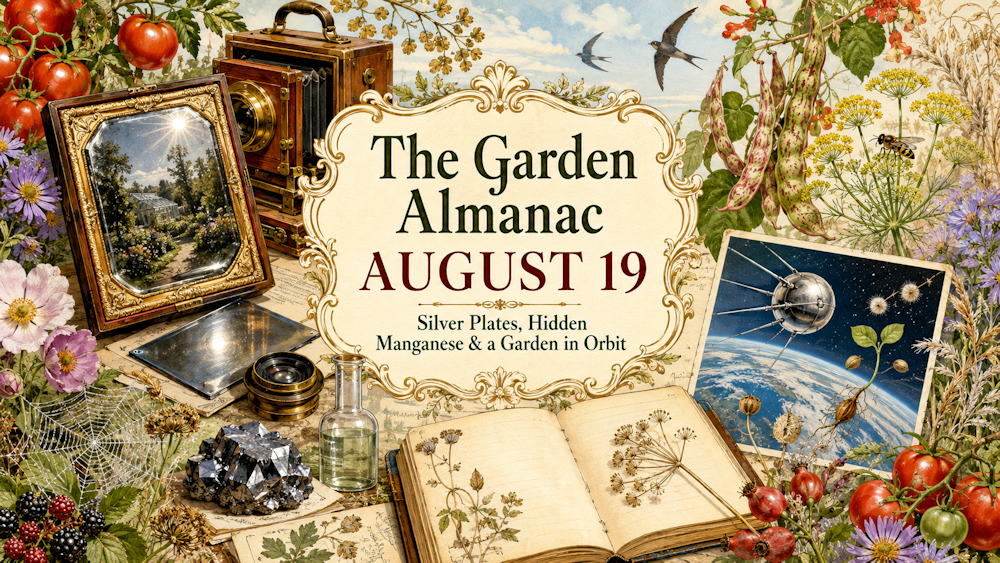
August 19, 1839 – The Day the World Learned to Hold Light
On August 19, 1839, the practical details of Louis Daguerre’s photographic process were presented publicly in Paris before a joint meeting of the French academies of sciences and fine arts. The daguerreotype made a finely detailed, permanent image on a polished, silver-coated copper plate. Each picture was unique, and the process was difficult and hazardous by modern standards, but it changed what people believed could be recorded.
The new medium soon turned towards scenery, buildings and plants. Photography did not replace botanical illustration, whose artists could combine several stages of growth in one carefully constructed plate, but it gave gardeners and naturalists another kind of evidence. A photograph could preserve the form of a tree, the layout of an estate or the condition of a landscape at a particular moment – details that memory might soften and written records might omit.
For today’s gardener, a camera is much more than a way to collect beautiful flower portraits. Repeated photographs reveal patterns that are almost invisible from day to day: where shade reaches in August, how quickly a hedge closes after pruning, when a perennial first flowers, or which bed dries before the others. Taking the same view from the same position every few weeks creates a practical garden record, not merely an album.
August 19 is now widely observed as World Photography Day, and the garden offers an ideal subject because it never gives exactly the same picture twice. Photograph plants in context as well as close up, include a ruler or familiar object when recording pests or damage, and keep the date and plant name with the image. Over several seasons, those pictures become a personal field guide to the climate, soil and living rhythms of one particular place.
Garden Reminder – What should you photograph in the garden today?
- Take one wide view to record the reach of sun and shade.
- Photograph unfamiliar leaf damage on both sides of the leaf before removing it.
- Record a successful plant combination while its spacing and colour balance are visible.
- Capture seed heads and ripe fruit before harvesting, then label the images by variety.
August 19, 1745 – The Metal Hidden Inside Green Leaves
Swedish chemist and metallurgist Johan Gottlieb Gahn was born on August 19, 1745. In 1774, working in the mineral-rich world of eighteenth-century Scandinavian chemistry, he became the first person to isolate manganese as a metal. He could not yet have known how important this element would prove to the quiet chemistry of a leaf.
Plants need manganese only in tiny quantities, but they cannot complete normal photosynthesis without it. It helps the light-driven system that splits water molecules, releasing oxygen and supplying the plant with electrons needed to capture energy. In gardens, shortage can appear as yellowing between the veins of younger leaves, sometimes followed by small brown or grey specks – yet these symptoms can resemble iron deficiency or other problems.
The practical lesson is to diagnose before adding anything. Manganese may already be present in the soil but become difficult for roots to absorb in alkaline or heavily limed ground; waterlogging and very acidic conditions can create the opposite problem and make too much available. Check drainage and soil pH, compare symptoms across old and young leaves, and use a soil or tissue test when a valuable crop is affected. A general handful of fertiliser is not a reliable cure for a micronutrient problem.
Garden Science – Why can a well-fed plant still turn yellow?
Nutrients must be chemically available, not merely present. Soil pH, oxygen levels, moisture and interactions between minerals determine what roots can absorb. Interveinal yellowing is therefore a clue rather than a diagnosis – first note whether it begins on young or old leaves, then examine watering, drainage and pH before reaching for a supplement.
August 19, 1960 – When Plants Joined a Voyage Around Earth
On August 19, 1960, the Soviet Union launched the spacecraft commonly known as Sputnik 5. Its best-known passengers were the dogs Belka and Strelka, but the biological cargo also included rodents, fruit flies and plants. The capsule orbited Earth and returned safely the following day, making the mission an important step in learning whether living systems could endure launch, weightlessness and recovery.
Those early biological flights belonged to the beginning of space life science, but their gardening connection has grown stronger with time. Plants are potential food, oxygen producers, water-cycle partners and sources of psychological comfort in closed habitats. Their needs also expose the limits of any artificial growing system: roots require both water and oxygen, leaves need usable light, pollination must be managed, and every gram of nutrient has to circulate rather than disappear as waste.
A home garden is not a spacecraft, yet the same principle of closed resources is useful on Earth. Composting returns plant material to the soil, captured rain reduces demand on treated water, and locally adapted plants require fewer outside inputs. The goal is not a perfectly sealed garden – wildlife must be able to enter and leave – but a more circular one, where fallen leaves, prunings and water are treated as resources before they become waste.
Wildlife Note – Who is visiting the late-summer flowers?
Watch a flowering patch for ten quiet minutes rather than judging it at a glance. Bees may dominate in sunshine, while hoverflies, butterflies and beetles use different flower shapes and feeding times. Leave some seed heads standing and avoid spraying open blooms – late-season nectar and later seeds can support insects and birds as the garden moves towards autumn.
What to Observe Right Now – The First Signs of Seasonal Change
Late summer often announces its turn through small details rather than a dramatic change in weather. Look for:
- longer morning shadows and dew lingering in sheltered places;
- spiders rebuilding webs across gaps that were empty in midsummer;
- berries beginning to colour on hedges and shrubs;
- swifts or swallows gathering and feeding intensely before migration;
- the first mature seeds loosening in dry pods and flower heads.
These signs vary with latitude, altitude and local weather, which is precisely why observation matters. Record what you see rather than forcing the garden to match a fixed calendar. A dated photograph and a short note can reveal, over several years, whether flowering, fruiting or migration appears to be shifting in your own region.
Seasonal Tips – Useful Jobs for the August Garden
- Water deeply in the morning when the root zone is dry, concentrating on containers, recent plantings and fruiting crops rather than sprinkling every surface.
- Harvest beans, courgettes, cucumbers and ripe tomatoes frequently to keep productive plants from diverting energy into overmature fruit.
- Collect seed only from healthy, correctly identified plants, and let it dry fully before storing it in a cool, dark place.
- Remove diseased fallen material where appropriate, but keep clean leaves and hollow stems available for composting or wildlife habitat.
- Delay major hedge cutting until you are certain active bird nests are no longer present, following local wildlife rules.
Looking Ahead
The stories attached to August 19 move from recording life, to understanding its chemistry, to testing its limits beyond Earth. In the garden, the same sequence remains useful: observe carefully, learn what a plant actually needs, then manage resources with restraint. A photograph, a soil check and ten minutes spent watching pollinators can all lead to better decisions. The future of gardening will depend not only on new technology, but on our ability to notice change early and work with living systems rather than against them.