
May 1 is one of the most exuberant days in the spring calendar. It belongs to green boughs, flowering branches, outdoor festivity, courtship, birdsong, and the sense that the season has crossed into open abundance. In the Garden Almanac, this is not a shy date. It is one that steps fully into view.
Across Europe, May Day has long been associated with fertility, renewal, flowers, woodland gatherings, and the ceremonial marking of spring’s triumph. That broader seasonal atmosphere gives the day its almanac force. It is not only about weather or work, but about the visible arrival of life in its social, floral, and emotional forms.
The Maypole and the Visible Body of Spring
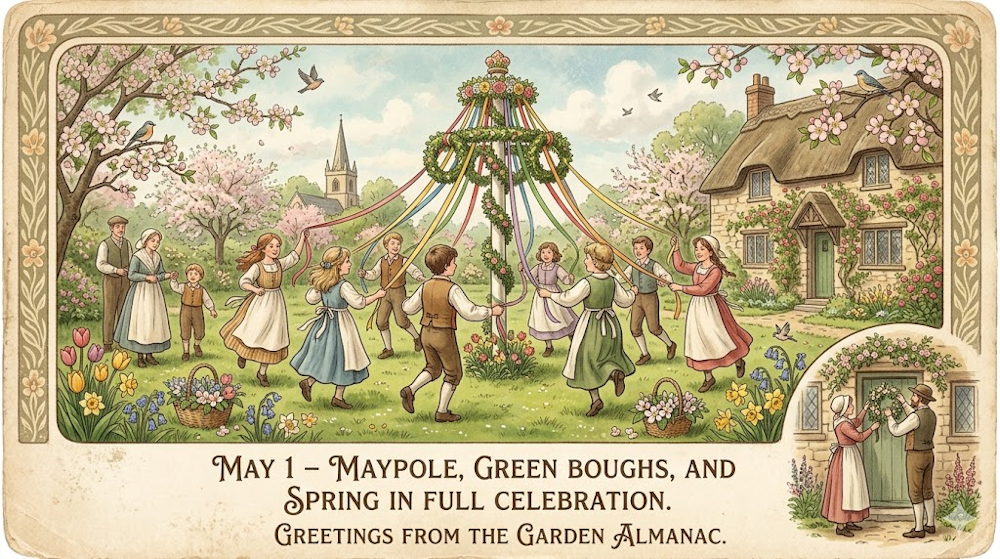
The maypole is one of the clearest symbols of May Day. Whether raised as a courtship token, a village sign, or the center of communal celebration, it turns spring into something upright, visible, and shared. A tree or branch cut from the green world is brought into human space and treated as a living emblem of the season.
That makes perfect sense in garden terms. By May 1, spring is no longer a subtle force. It has shape, height, color, and momentum. The maypole expresses outwardly what the garden is already saying in leaves, blossom, and vertical growth.
Walpurgis Night and the Charged Edge of the Season
The night before May 1 has long carried special meaning in European tradition. Walpurgis Night gathers together fear, protection, transition, fire, and the lingering possibility that the season may still test what has newly begun.
For the gardener, that mood feels entirely familiar. Even at the threshold of May, a single cold night, a late frost, or a rough shift in weather can still matter. This gives May Day its tension. It celebrates flourishing, but never forgets vulnerability.
Fertility, Flowers, and the Joy of Going Out
May Day is also a day of outward movement: into woods, meadows, gardens, and public green space. Garland-making, flowering branches, shared meals, songs, and outdoor festivities all belong to its atmosphere. In almanac terms, this matters because it shows that spring is not only productive. It is participatory.
The season asks not merely to be managed, but to be entered. It invites people outdoors, into relationship with growth, fragrance, weather, and one another.
Reading the Day, Enjoying the Day
Traditional lore often treated May 1 as a sign-bearing date, one whose weather might hint at what lies ahead. This instinct fits the almanac well. A garden in early May can already tell us much about the balance of the season to come.
And yet this is also a day for delight. The almanac does not exist only to warn and calculate. It also preserves moments when the year feels worth celebrating simply because it has opened so fully.
What This Day Suggests in Practice
May 1 is a good day to notice where the garden has become lush, where flowering is widening into abundance, and where the energy of spring has shifted from promise into confidence. It is also a fine moment to spend time in the garden without agenda: to walk, sit, gather, notice, and let the season speak in its festive language.
In the Garden Almanac, May 1 belongs to visible spring: the kind that decorates doors, fills trees with birds, sends people outdoors, and reminds them that flourishing can be communal as well as natural.