


June is one of those moments in the gardening year when everything seems to be happening at once. Roses are opening by the day, vegetables are racing upward, pollinators fill the air, and the longest days of the year still linger across much of the Northern Hemisphere.
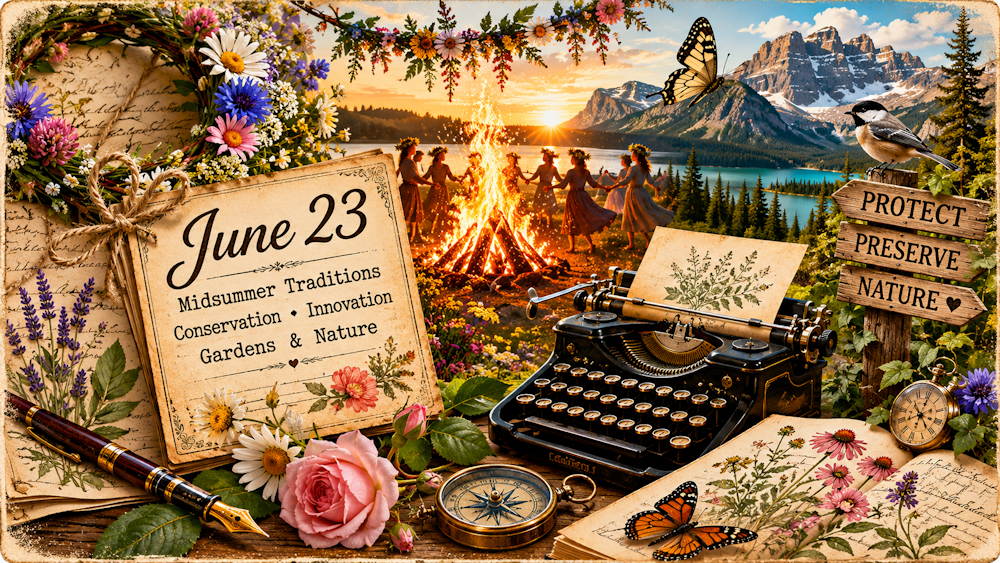
June 23 sits at an interesting crossroads. In many parts of Europe, it marks the eve of traditional Midsummer celebrations, when communities gather around bonfires, decorate with flowers, and celebrate the abundance of the growing season. At the same time, this date is connected to milestones in conservation, science, and our changing relationship with landscapes.
Looking back at the stories associated with June 23 reveals a common theme: the choices people make about land, nature, and the future. Some of those choices helped protect extraordinary places. Others transformed how knowledge and ideas spread. Together, they offer a fascinating lens through which to view our gardens today.
Midsummer Eve – When Nature Was Celebrated With Fire and Flowers
Across Northern and Eastern Europe, June 23 is traditionally associated with Midsummer Eve celebrations. Bonfires, flower crowns, herbal traditions, and nighttime gatherings remain part of cultural celebrations in countries including Latvia, Estonia, Finland, Sweden, and many other regions influenced by ancient seasonal customs.
Long before modern calendars and weather forecasts, people paid close attention to the rhythms of daylight, flowering plants, and seasonal transitions. Midsummer celebrations reflected gratitude for fertile fields, healthy livestock, and successful harvests yet to come.
Many traditional midsummer herbs were gathered around this time because they were believed to possess their greatest strength near the summer solstice. While folklore often exaggerated their powers, the timing itself was not accidental. Late June is indeed when many medicinal and aromatic plants reach peak growth and flowering.
For gardeners today, these traditions offer a reminder that gardens are not only productive spaces. They are also places where seasonal change can be observed, celebrated, and shared.
Nature Watch
Take an evening walk through your garden after sunset.
Look for:
- Moths visiting night-scented flowers
- Bats hunting insects overhead
- Roses reaching their seasonal peak
- The longest lingering twilight of the year
Many of nature’s most interesting summer activities happen after most gardeners have gone indoors.
Banff National Park – A Landmark in Conservation History
On June 23, 1887, Canada’s Rocky Mountains Park Act became law, creating what would eventually become Banff National Park, Canada’s first national park.
The establishment of Banff reflected a growing realization that some landscapes were too valuable to be lost to unchecked development. What began as a protected area around hot springs eventually evolved into one of the world’s most celebrated conservation success stories.
For gardeners, the connection may not be immediately obvious. Yet national parks and home gardens share a surprisingly similar purpose: creating spaces where biodiversity can thrive.
A wildlife-friendly garden, however small, functions as a miniature protected area. Native flowers support pollinators. Shrubs provide shelter for birds. Ponds become habitats for amphibians and insects.
While Banff protects thousands of square kilometers, the same principle can begin with a single flowering border or a small patch left undisturbed for wildlife.
Garden Inspiration
Ask yourself:
What part of your garden is protected for nature rather than appearance?
Even a modest wild corner can become one of the most valuable habitats on your property.
The Typewriter Patent and the Spread of Gardening Knowledge
On June 23, 1868, inventor Christopher Latham Sholes received a patent for what he called the “Type-Writer,” one of the key developments that eventually transformed written communication around the world.
At first glance, a typewriter may seem far removed from gardening. Yet the spread of horticultural knowledge owes much to advances in communication technology.
Garden journals, seed catalogs, agricultural bulletins, botanical records, and scientific observations became easier to produce and distribute during the late nineteenth century. New varieties of plants could be documented, exchanged, and promoted on an unprecedented scale.
Many of the vegetables, flowers, and fruit varieties we enjoy today became widely available because information traveled more efficiently than ever before.
Modern gardeners benefit from a long chain of knowledge-sharing that stretches from handwritten notebooks to printed catalogs and today’s digital resources.
International Women in Engineering Day – Designing Greener Futures
June 23 is also observed as International Women in Engineering Day.
Engineering and gardening may appear to belong to different worlds, but increasingly they work hand in hand. Sustainable irrigation systems, green roofs, rainwater harvesting, urban forestry projects, and climate-resilient landscapes all depend on engineering expertise.
As climate challenges grow, the collaboration between horticulture, ecology, and engineering becomes increasingly important. The gardens of the future will not simply be beautiful spaces. They will also help manage water, reduce heat, support biodiversity, and make cities more resilient.
The date offers an opportunity to appreciate the often unseen work behind the landscapes we enjoy every day.
Seasonal Tip
Late June is an excellent time to:
- Check irrigation systems for leaks and inefficiencies
- Install rain barrels before summer dry spells intensify
- Add mulch around vegetables and ornamentals
- Observe which areas of the garden suffer most during hot afternoons
- These small observations can guide more sustainable garden design in the years ahead.
A Day That Celebrates Care
June 23 is also recognized by the United Nations as International Widows’ Day, highlighting the importance of community support and resilience.
Gardens have long played a role in helping people recover from loss, uncertainty, and change. Community gardens, memorial gardens, and simple backyard spaces often become places of reflection and healing.
Throughout history, tending plants has provided more than food and flowers. It has offered continuity. Seasons continue. Seeds germinate. New growth appears where old growth has faded.
That quiet lesson remains one of gardening’s most enduring gifts.
Garden Reminder
Late June is often the turning point between spring abundance and summer maintenance.
This is a good time to:
- Deadhead repeat-flowering roses
- Harvest herbs regularly before flowering reduces flavor
- Support fast-growing tomatoes and climbing vegetables
- Watch for signs of drought stress during hot periods
- Leave water available for birds, pollinators, and other wildlife
- Small actions now can have a noticeable impact later in the season.
Looking Ahead
The stories connected to June 23 share an unexpected common thread. Whether through ancient midsummer celebrations, the creation of protected landscapes, technological innovation, or modern sustainability efforts, they all reflect humanity’s desire to shape a better relationship with the world around us.
For gardeners, that relationship begins close to home. Every pollinator-friendly flower, every conserved drop of water, every wildlife refuge, and every observation of seasonal change contributes to a larger picture.
As summer gathers momentum, June 23 reminds us that caring for nature is not only about preserving the past. It is also about designing landscapes – and gardens – that can thrive well into the future.