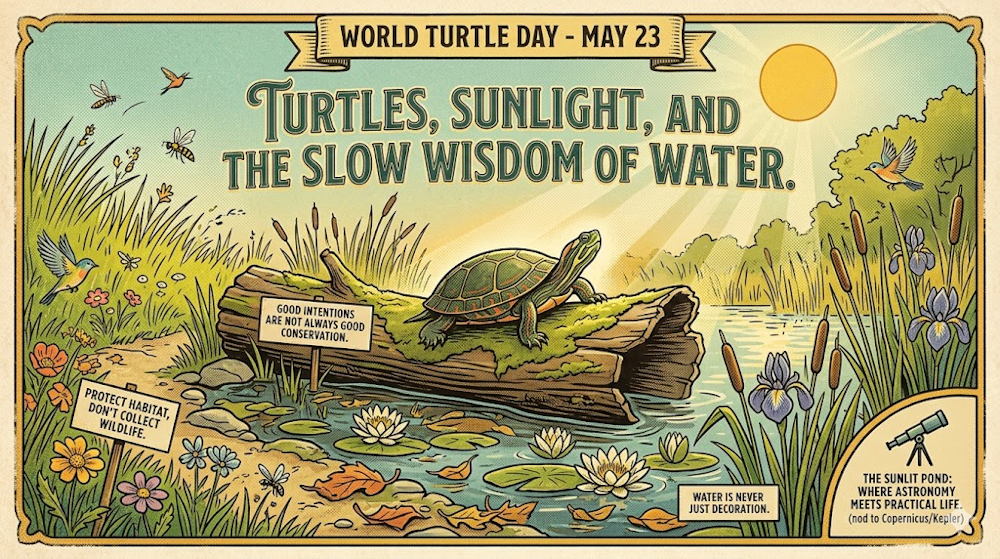

May 23 slows the Garden Almanac down. It is World Turtle Day, a day for turtles, tortoises, water, sunlight and the fragile habitats that these ancient animals depend on.
By late May, the garden is full of speed. Grass grows fast, weeds appear overnight, seedlings stretch, flowers open, insects move constantly. The turtle brings another rhythm. It reminds us that not every living thing rushes, and not every act of care has to be dramatic.
Sometimes, the best thing a gardener can do is leave room.
World Turtle Day in the Garden
World Turtle Day draws attention to turtles, tortoises and their habitats. These animals are often loved as symbols: slow, wise, patient, ancient. But they are not only symbols. They are living creatures with specific needs, and many of them face habitat loss, road danger, pollution, illegal collection and the consequences of irresponsible pet keeping.
In the garden, turtles lead us toward one of the most important questions of late spring: what do we do with water?
A pond, ditch, wet corner, stream edge or even a small wildlife-friendly water feature can support far more life than it first appears. Water is never just decoration. It is drinking place, breeding place, hunting ground, cooling system and refuge.
A Turtle Is Not a Garden Ornament
A turtle in a pond may look charming, but a wild turtle does not belong in a garden simply because someone wants it there. Taking wild turtles home, moving them from their habitat, or releasing unwanted pet turtles into local waters can harm both the animal and the ecosystem.
This is one of the clearest lessons of World Turtle Day: good intentions are not always good conservation.
A pet turtle released into the wild is not being “set free” in a harmless way. It may compete with native species, spread disease, or fail to survive. A wild turtle moved into a backyard pond may lose access to the habitat it actually needs.
The kindest garden is not always the one that collects wildlife. Often, it is the one that protects habitat.
The Slow Life of Water
Water changes a garden. It brings dragonflies, birds, frogs, beetles, bees, hoverflies and countless small creatures most people never name. Around water, the garden becomes layered: wet and dry, sunny and shaded, open and hidden.
A wildlife-friendly pond does not need to be large, but it does need generosity. Plants at the edge. Shallow places. Safe access for small animals. No unnecessary chemicals. Some shelter. Some mess. Some patience.
Even a simple birdbath or shallow dish with stones can help insects and birds during warm weather. A damp corner planted with moisture-loving plants can become a small refuge. A log near a pond may be more useful than a polished ornament.
The living garden is rarely the neatest one.
Copernicus, Kepler, and the Sunlit Pond
May 23 is also associated in some Christian calendars with the commemoration of Nicolaus Copernicus and Johannes Kepler, two figures who changed how people understood the heavens. They belong to astronomy rather than gardening, yet the connection is not as distant as it seems.
Gardeners live by light. Day length, sun angle, warmth, shade and season shape everything from seed germination to flowering, from fruit ripening to the behavior of animals.
A turtle basking on a log is a small, living reminder of the sun’s importance. It climbs toward warmth. It gathers energy. It places itself exactly where light and water meet.
The garden is full of astronomy made practical.
Slow Gardening, Stronger Habitats
The turtle teaches a kind of gardening that is less about control and more about continuity. Soil improves slowly. Ponds mature slowly. Shrubs become shelter slowly. A healthy balance of insects, birds, amphibians and plants takes time.
A garden made for life is not finished in a weekend.
It grows into itself. It gains shade. It gathers fallen leaves. It develops edges and hiding places. It becomes useful to creatures that never read our plans.
Slow gardening does not mean doing nothing. It means doing the right things with patience: planting for habitat, protecting water, avoiding unnecessary chemicals, leaving some natural cover, and resisting the urge to tidy away every sign of wildness.
What May 23 Teaches
The message of May 23 is simple: some creatures do not ask to be rescued. They ask for room to live.
Turtles need more than admiration. They need wetlands, ponds, quiet edges, nesting places, clean water and responsible human choices. The garden can be part of that wider care, not by turning wild animals into decorations, but by respecting the systems that support them.
In the Garden Almanac on this day, the turtle is a patient teacher. It tells us to slow down beside the water, look closely, and remember that a living garden is not measured only by what it gives us.
It is measured by what can live there when we make space.