

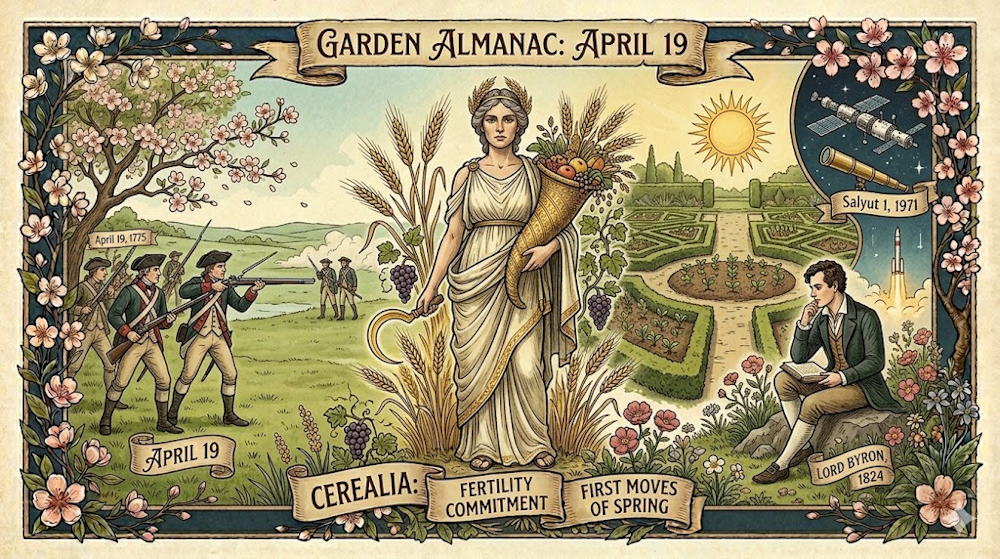

A Date When Spring Becomes Committed. April 19 is one of those spring dates that feels more decisive than gentle. It still belongs to the season of growth and fertility, yet it also carries the atmosphere of commitment — the moment when preparation gives way to action, and hope becomes something more than wishfulness.
That tone is beautifully captured by the Roman association of this date with Ceres and the Cerealia, but it also echoes through literature, revolution, and even space exploration. April 19 is a day of beginnings that are no longer tentative.
Ceres and the Seriousness of Fertility
Ceres, the Roman goddess of agriculture, grain, and fertility, belongs naturally to this day. By the time of the Cerealia, the agricultural year was no longer a concept. It was underway. Seeds had been entrusted to the soil, weather had become consequential, and the possibility of abundance had taken on real stakes.
This is why April 19 matters in an almanac. It is not a day of harvest, but it is already beyond mere expectation. The work has begun, and the future is now tied to what has been placed in motion.
Lexington, Concord, and the Force of a First Move
On April 19, 1775, the battles of Lexington and Concord marked the beginning of the American Revolutionary War. In an almanac, the historical detail matters less than the pattern it represents: there are days when history stops hovering and starts moving.
Spring has its equivalents. There comes a point in every season when delay is no longer the dominant posture. One sows, commits, prunes, protects, and accepts that the year is taking shape whether one feels ready or not.
This gives April 19 an unusual energy. It is a date of first moves with consequences.
Lord Byron and the Beautiful Weight of the Season
April 19 also marks the death of Lord Byron in 1824. His presence lends the date a more reflective, poetic shadow. Byron belongs to landscapes, weather, longing, pride, beauty, and the sense that human feeling is often amplified by the natural world.
This too belongs in a spring almanac. April is never only practical. Even while the garden demands labour, the season stirs imagination, restlessness, memory, and drama. Byron reminds us that growth is not always calm.
Salyut 1 and the Human Need To Go Beyond the Ground
On April 19, 1971, the Soviet Union launched Salyut 1, the first space station. This makes for a striking counterpoint to Ceres and the agricultural earth: on the same date, human attention is pulled both into the soil and away from it, toward orbit and technological extension.
An almanac can hold both because both belong to the same human impulse. We cultivate the ground beneath us, and we look beyond it. April 19 becomes a date about confidence in systems larger than immediate sight.
What To Notice In The Garden Today
April 19 is especially good for noticing when the garden shifts from possibility to commitment.
- Which bed has clearly crossed from preparation into real growth?
- Where is fertility visible not as hope alone, but as momentum?
- What in the garden feels like a first move that cannot be undone?
- Which beauty is already carrying weight as well as promise?
- Where does the season seem to be asking for faith backed by action?
- A strong almanac date does more than record history. It changes the way the present feels.
The Meaning Of April 19
April 19 gathers together fertility, action, poetry, and human ambition. Through Ceres, Lexington and Concord, Byron, and Salyut 1, it becomes a date about the moment when a future begins to demand commitment.
That is one of spring’s deepest truths. Hope matures when it is finally trusted with consequence.