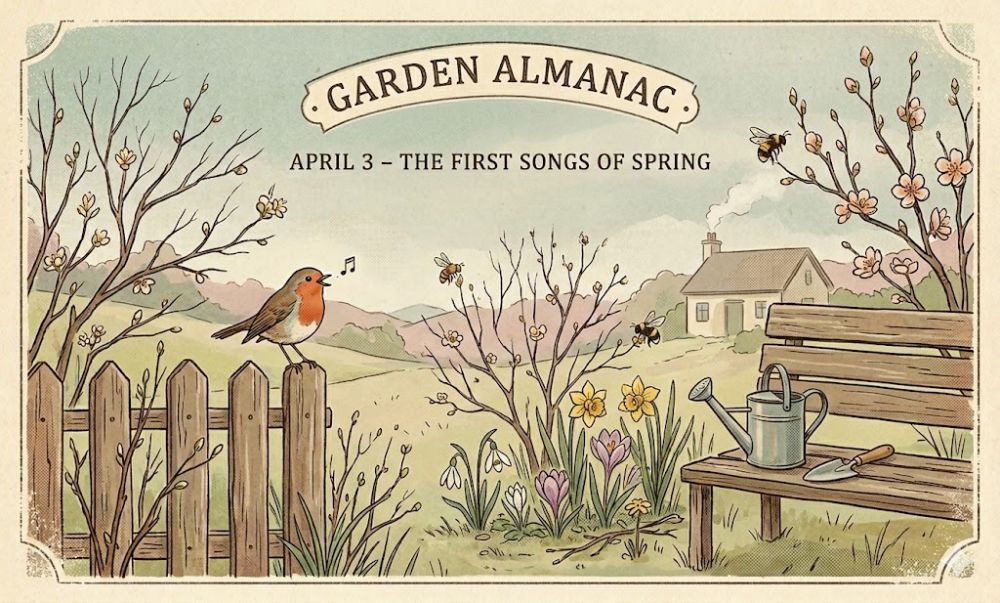

In early April, the garden often becomes audible before it becomes abundant. Leaves may still be sparse, borders still unfinished, and many plants only partly awake, yet the season is already announcing itself in sound. A bird call from a fence post, the first uncertain hum of pollinators, the changed movement of wind through swelling branches, the subtle rise in evening activity — these are often the first real confirmations that spring is no longer only an idea.
April 3 offers a particularly fitting way to think about this, because the date is associated in the Christian tradition with Joseph the Hymnographer, remembered for sacred song and devotional poetry. The connection works beautifully in a garden context. Early spring has something hymn-like about it: it builds through repetition, return, quiet intensification, and voices that gather one by one before the whole landscape has fully changed.
When Spring Is Heard Before It Is Seen
There are moments in the gardening year when sight seems to lead everything. Peak blossom, summer abundance, autumn color — these arrive with visual confidence. But early spring is different. It often enters first through rhythm and sound.
A garden at this stage may still look restrained. Bare branches are only beginning to soften. Herbaceous growth is still low to the ground. Empty spaces remain visible between emerging plants. Yet the ear notices what the eye cannot yet fully confirm. Dawn is less empty. Midday carries more movement. Evening lingers with more life in it than before. Even the silence changes, becoming less winter-still and more expectant.
This is why April 3 is such a useful almanac day. It teaches that one of the best ways to understand a season is to notice how it sounds when it is just beginning to gather strength.
The Garden’s Soundscape as a Sign of Change
Sound is rarely treated as a primary gardening tool, but it can be surprisingly informative.
- Increased birdsong often reflects a livelier, more habitable garden environment.
- The first regular presence of bees and other pollinators suggests that certain flowers and sheltered spaces are becoming active.
- Wind moving through buds, soft shoots, and early leaves produces a very different atmosphere from wind moving through bare winter wood.
- A garden that stays subtly busy later into the day is often a garden that has crossed an important seasonal threshold.
None of these signs functions like a precise measurement, yet together they create a reliable impression. Good gardeners often learn to trust patterns before they trust declarations. The garden rarely shouts that spring has arrived. More often, it layers the evidence.
Listening as a Form of Garden Knowledge
Modern gardening often leans heavily on forecasts, calendars, soil temperatures, and task lists. All of these have their place. But there is another kind of knowledge available in the garden: direct, local, sensory knowledge. Listening is part of that.
A quiet corner that suddenly holds more bird movement, a hedge that begins to sound inhabited again, a fruit tree that draws pollinators at a particular hour, a sheltered wall where insects arrive earlier than elsewhere — these details can reveal which parts of a garden have truly entered the new season and which are still waiting.
This matters because gardens never awaken evenly. One bed may behave like late spring while another still feels undecided. A pot beside a warm wall may host activity well before open ground does. A tree in blossom may become the center of the day’s sound while nearby spaces remain subdued. Learning to hear these differences deepens a gardener’s timing and patience.
The Gradual Music of the Season
One of the loveliest truths about spring is that it does not arrive all at once. First comes the hint, then the echo, then the recurring phrase, then the fuller chorus. Sound often carries that progression more gently than sight does.
This is part of what makes early April so memorable. The garden is not finished, but it is no longer mute. Something is underway. A person standing still for even a few minutes can often sense the difference between a garden still held by winter and one that has begun to answer back.
In that sense, April 3 is less about spectacle than attunement. It invites gardeners to become slightly more receptive, slightly less hurried, and slightly more aware of life returning in forms that are easy to miss when attention is fixed only on visible growth.
What Belongs to This Day
April 3 is a good day for practical work, but also for calibration.
- Walk the garden in the early morning and again near dusk if possible.
- Notice where sound gathers first and where quiet still dominates.
- Observe which flowering plants are already supporting pollinators.
- Keep some rougher sheltering spaces intact for beneficial wildlife.
- Let the day remind you that a healthy garden is not only one that looks alive, but one that sounds alive.
These are modest acts, but they change how the rest of the season is understood. The more clearly a gardener can detect the first songs of spring, the more wisely the next decisions tend to follow.