
March 25 is one of those remarkable spring dates on which religious meaning, seasonal timing, and practical garden work seem to meet naturally.
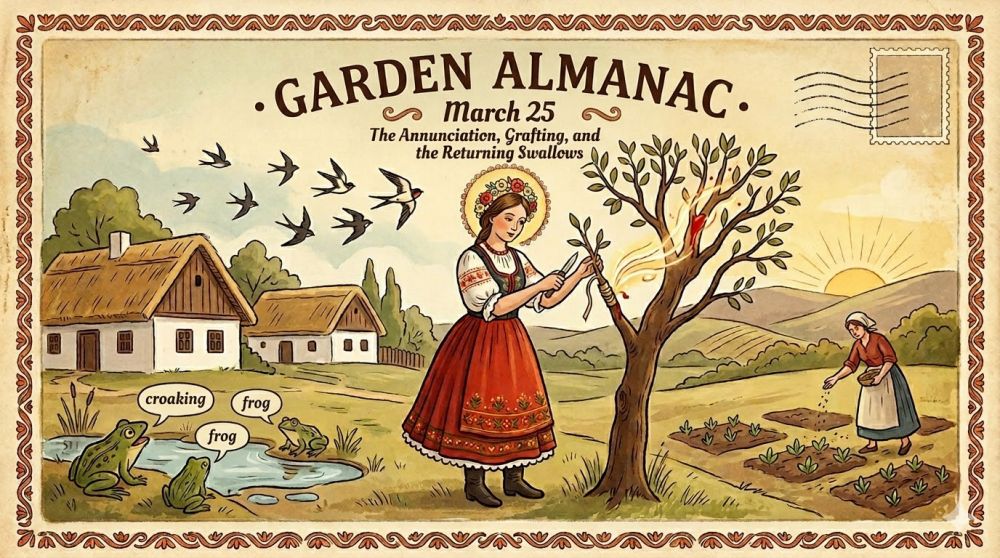
In Hungarian tradition, the day is known as Gyümölcsoltó Boldogasszony — literally, something close to “Our Lady of Fruit Grafting” — and it became strongly associated with grafting and budding fruit trees. The connection is deeply symbolic: the Feast of the Annunciation marks the conception of Christ, and in folk imagination that mystery of receiving new life found a vivid echo in the grafted tree.
This is precisely the kind of date an almanac loves. It carries a practical task, a devotional layer, and a sense that spring’s invisible processes are finally becoming tangible.
Lady Day and the Garden Year
In the wider English-speaking tradition, March 25 is the Feast of the Annunciation, also known as Lady Day. It has long stood as one of the old quarter days in England, giving it a place not only in the church year but in the older seasonal and agricultural rhythm of life. That makes it especially fitting for a garden calendar: it is both sacred date and working date, a point when the year begins to move outward into action.
The Annunciation is celebrated on March 25 because it falls nine months before Christmas, and it remains one of the principal feasts of the Christian church. The older association with Lady Day adds another layer of seasonal resonance, placing the feast near the heart of spring’s first true expansion.
Why Grafting Belongs Here
From a gardening perspective, the tradition makes excellent sense. By late March, sap is beginning to rise in many fruit trees, the bark and cambium are becoming more responsive, and the conditions for successful grafting improve. Much still depends on method, species, local weather, and the state of both rootstock and scion wood, but the underlying timing is sound.
Grafting is one of the most hopeful acts in the garden. It joins two living parts in trust, asking them to grow into one future-bearing whole. That imaginative power helps explain why the practice gathered so much folklore around it.
Frogs, Swallows, and Unfinished Spring
Hungarian belief also watched the day for signs in the wider landscape. If frogs were heard on March 25, some took it as a warning of forty more days of cold. At the same time, the date could be thought of as one that called the swallows home, with southern winds helping to turn migration back toward familiar eaves.
That pairing feels exactly right for late March. One sign warns that spring is still fragile; the other promises that it is coming anyway.
Seedlings, Vines, and the Work Ahead
The day was not only for grafting. In some places it was also considered a good time for cleaning fruit trees, tending vines, and sowing for future transplants in the kitchen garden. This broadens the meaning of the date beautifully. March 25 is not only about fruit trees, but about the whole garden beginning to commit itself to the season ahead.
What the Day Holds
In the Garden Almanac, March 25 becomes a day of precision, faith, and forward motion. It is about making unions that cannot yet be proven, trusting the life hidden under bark, and listening for the signs that spring gives unevenly — through wood, wind, frogs, and birds.
Few garden days feel so practical and so poetic at once.