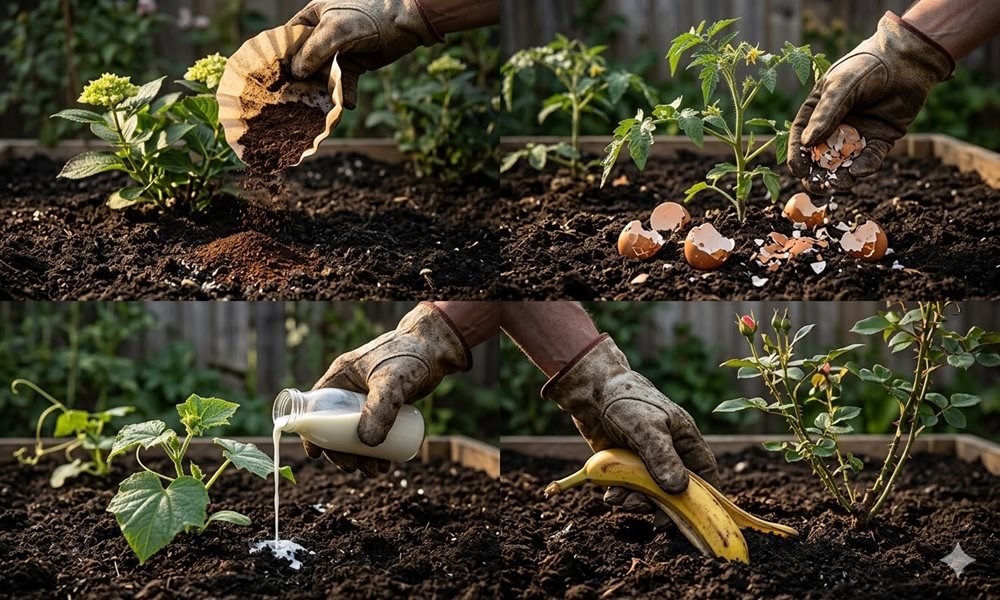

There comes a point in gardening when a person is no longer just sowing seeds, planting things, pruning tomatoes, and fighting slugs, but also starts eyeing kitchen scraps with suspicion. Coffee grounds begin to look like potential soil improvers, eggshells like calcium bombs, banana peels like potassium-powered miracle weapons, and milk like some secret foliar tonic inherited from a grandmother who was apparently both wise and slightly mysterious. And then come the internet graphics, confidently declaring which household leftover is the perfect natural fertilizer for which plant.
The trouble is that a garden is not a recipe book, a plant is not an algorithm, and the word “natural” does not automatically mean useful, fast, or effective. So let’s take a sober, slightly amused, and properly fact-checked look at how much truth is really hiding behind these popular home-garden tricks.
The short answer is that each one has some logic behind it, but in most cases the magic is far smaller than the gardening legend suggests. The longer answer is that it depends on how it is used, how much is used, what soil it goes into, and whether that plant actually needs what people think it does.
Coffee grounds: not a magical acidifier, and not a universal rose booster
Coffee grounds have developed something close to a gardening religion around them. Roses, azaleas, blueberries, hydrangeas — as if you could simply scatter yesterday’s espresso leftovers and all acid-loving plants would immediately feel seen, supported, and deeply fulfilled. Reality is much less cinematic.
Used coffee grounds do contain organic matter and small amounts of nutrients, so they are not pointless. In compost, or used sparingly in soil, they may have some value mainly as an organic amendment. The misunderstanding begins when people assume that coffee grounds will meaningfully acidify soil and are therefore especially perfect for azaleas, blueberries, or blue hydrangeas.
Extension literature and horticultural guidance from multiple universities suggest that used coffee grounds are not a reliable way to acidify soil. In plain terms, your blueberry will not become happier just because you handed it café waste if the soil pH is wrong to begin with. If you are dealing with acid-loving plants, the proper answer is correct soil preparation, pH testing, and suitable amendments — not coffee-shop optimism.
Worse, when overused, coffee grounds can create problems. Several sources warn that heavy direct application can form a compacted, water-resistant layer and may even inhibit growth in some situations. So coffee grounds are not an all-purpose miracle feed. They are better thought of as a cautious organic supplement.
Fact check
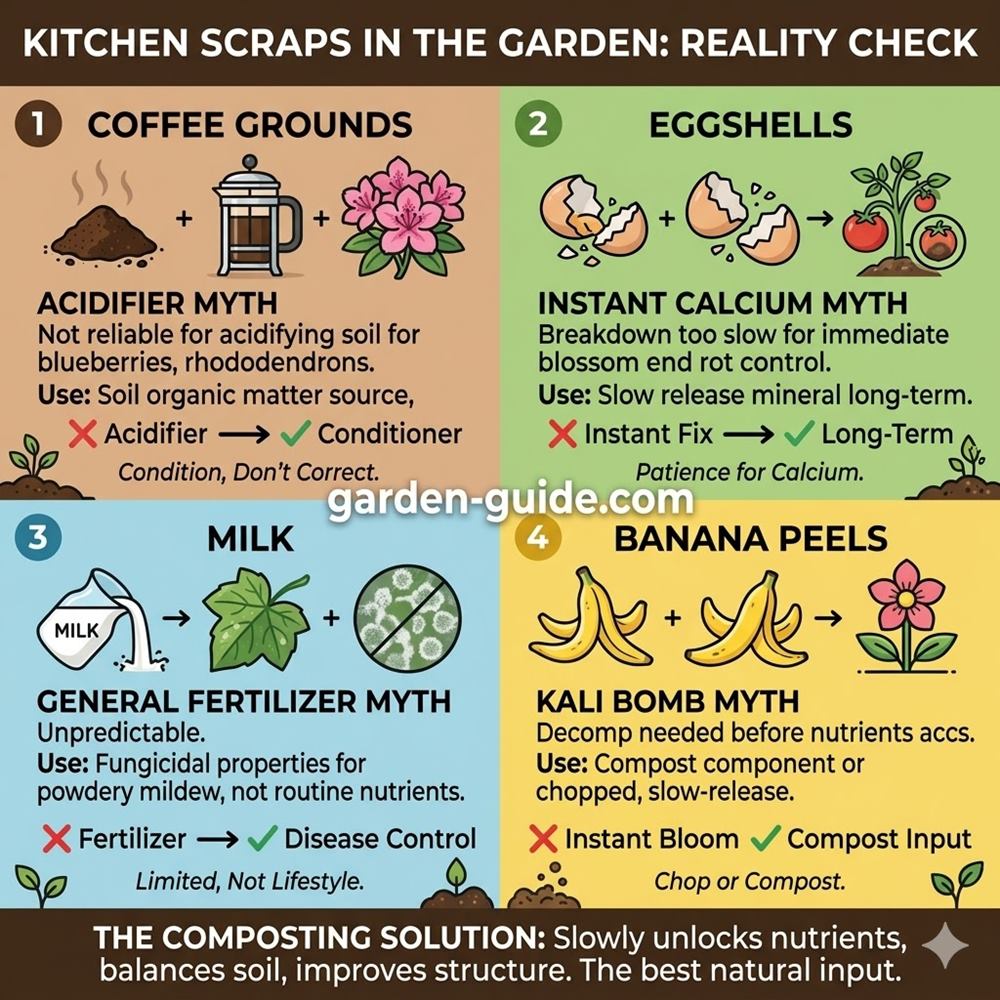
The image’s claim that coffee grounds are especially good for roses, azaleas, blueberries, and hydrangeas is overstated in this form. The important point is not the plant list, but that used grounds can be applied in small amounts, sensibly, and preferably through compost or as a mild soil-building material. The “they acidify the soil and are therefore ideal for these exact plants” claim is much closer to garden folklore than to a dependable formula.
Eggshells: a slow calcium source, not an instant tomato rescue hero
Eggshells may be the most famous kitchen-garden offering of all. Tomatoes, peppers, zucchini, broccoli — and very often they are brought in dramatically to prevent blossom end rot. The only problem is that while eggshells do indeed contain calcium, they do not deliver that calcium like an express courier service.
Eggshells are composed mainly of calcium carbonate, so the theory is not nonsense. In practice, though, they break down very slowly. Multiple university sources point out that eggshells do not decompose fast enough to solve blossom end rot in the short term. That disorder is often not simply about low calcium in the soil anyway, but about water stress and interrupted calcium transport within the plant.
So when someone drops a few chunky shell pieces into the planting hole with great hope, and the tomatoes still develop blossom end rot later, the issue is not tomato ingratitude. The method was just oversold.
That does not make eggshells useless. Finely ground and added to compost, or worked into soil over time, they may contribute to the mineral balance of the soil. Just not in the same season, and not as an emergency intervention.
Fact check
The image’s suggestion that eggshells are especially good for tomatoes, zucchini, peppers, and broccoli is only partly true. These crops do care about calcium, but eggshells are not a fast or targeted solution. They make sense as a long-term, slow mineral input, not as emergency calcium treatment.
Milk: more folklore than fertilizer
This is where things get especially interesting. Milk as a “natural fertilizer” sounds charming, but in home gardening it is much murkier than people think. Milk does contain nutrients, including nitrogen, phosphorus, potassium, and calcium, but that does not mean pouring it around squash, peas, cucumbers, or tomatoes is automatically a brilliant idea.
Milk is more often discussed in garden use as a disease-management folk remedy, especially for powdery mildew. There is some research and some practical use around that, but even there it is not an all-purpose miracle. As a nutrient source in the home garden, milk is hard to manage well, can smell unpleasant, may cause microbial issues, and can easily create more questions than it answers.
In large-scale agricultural situations — for example when waste milk disposal is the problem — it may indeed be considered a nutrient source. But that is a completely different world from pouring leftover milk onto a few tomato plants in the backyard. The two should not be confused.
Fact check
The image’s claim that milk is a good natural fertilizer for squash, peas, cucumbers, or tomatoes is highly questionable. Milk is not generally regarded as a standard, recommended home-garden feed for these crops. This is much more gardening legend and misunderstood practice than solid routine advice.
Banana peels: not nonsense, just slower and less dramatic than the legend
Banana peels are popular largely because people associate them with potassium, and potassium is the celebrity nutrient of flowering and fruiting. From there it is only a short leap to declaring them perfect for annual flowers, pumpkins, beans, and peppers. There is more truth here than in the milk story — but there is still an important asterisk.
Banana peels do contain plant nutrients, but they do not function like an immediate, concentrated potassium fertilizer. The peel has to decompose before those nutrients become available. If you bury large pieces next to a plant, the result is not that your pepper suddenly enters a state of productive enlightenment the next morning. The result is that soil life slowly begins working on the peel.
The sensible gardening use is to compost banana peels or chop them finely and use them modestly as an organic matter source. As a direct “secret flowering weapon,” they are heavily overmarketed.
And if too much kitchen waste is buried badly, it may attract unwanted visitors and encourage local rotting. So banana peels are not inherently bad. The romantic stories told about them are just much faster than decomposition.
Fact check
Banana peels are not fake, but neither are they a targeted, immediate nutrient bomb specifically for annual flowers, pumpkins, beans, or peppers. They can absolutely have a place as general organic matter input and compost ingredient, but the claim that they are the best natural fertilizer for those exact plants is another oversimplification.
So what actually works?
The real working principle here is that some kitchen scraps can indeed be returned to the garden — but most sensibly through compost. It is the least flashy and the most intelligent option. During composting, materials break down, balance out, and release nutrients more gradually, with far less risk that one so-called miracle ingredient gets overused.
For most plants, the real question is not “which kitchen scrap matches their personality,” but what the soil structure is like, what the pH is, how the water supply behaves, how much organic matter is present, and whether a nutrient is actually missing. That may be less romantic, but it is much closer to good gardening.
So should all of this go in the bin?
Not necessarily. Just do not look at these materials as magical, plant-by-plant recipes.
- Coffee grounds can go into compost or be used lightly as a soil-building material, but they are not reliable miracle acidifiers.
- Eggshells may be useful over the long term, but they are not a fast calcium injection for tomatoes or peppers.
- Milk is highly questionable as a home-garden fertilizer, and probably not the routine solution you want.
- Banana peels are fine in compost or chopped and used modestly, but they are not targeted instant bloom rockets.
Final lesson: plants are not influencers, and they do not feed on trends
One of the best things about gardening is that it keeps dragging us back toward reality. Just because something is natural does not mean it is effective. Just because lots of people share it does not mean it is true. And just because a graphic beautifully pairs roses with coffee grounds or tomatoes with eggshells does not mean the plant will clap.
The best natural fertilizer is often not one dramatic kitchen leftover, but good compost, soil-based nutrient management, steady watering, and the decision not to expect each eggshell fragment to perform a horticultural miracle.
By all means keep collecting eggshells and banana peels. Just do not expect them to solve on their own what soil quality, water management, and practical gardening sense are meant to solve together.