
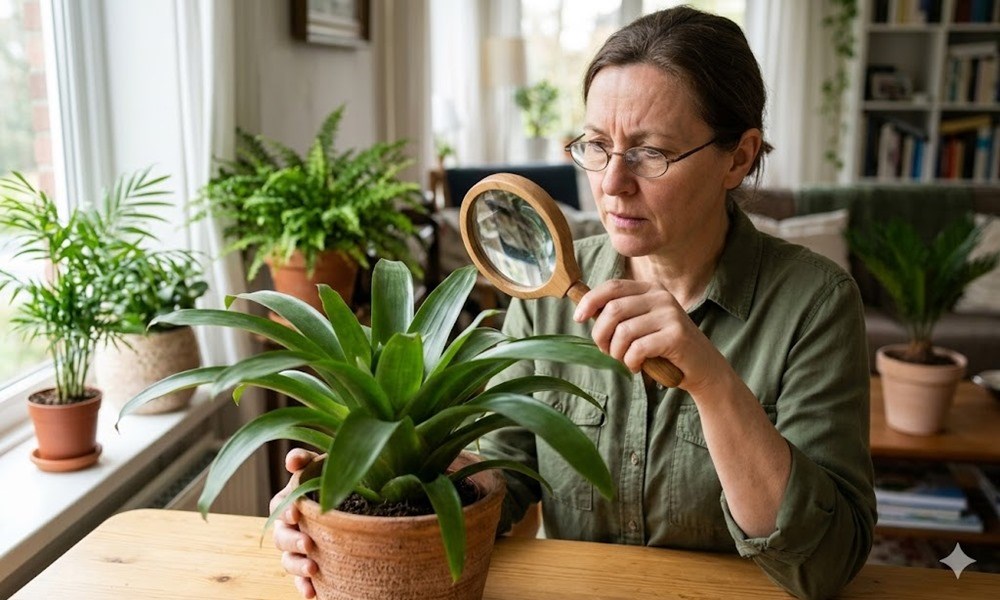

A bromeliad is one of those houseplants that people bring home with big hopes and immediate affection. It looks exotic, architectural, and just dramatic enough to make any windowsill feel upgraded. Then weeks pass. Or months. The plant stays alive, mostly handsome, perhaps even smug, but no bloom appears. At some point you begin to suspect the bromeliad is not failing — it is judging. I had one like that once. It sat there with total composure, producing leaves and absolutely no flowers, as if its main goal in life was to teach me patience through passive resistance. Eventually I learned the truth: bromeliads are not difficult in the theatrical sense. They are simply very particular.
Bromeliads do not bloom on demand
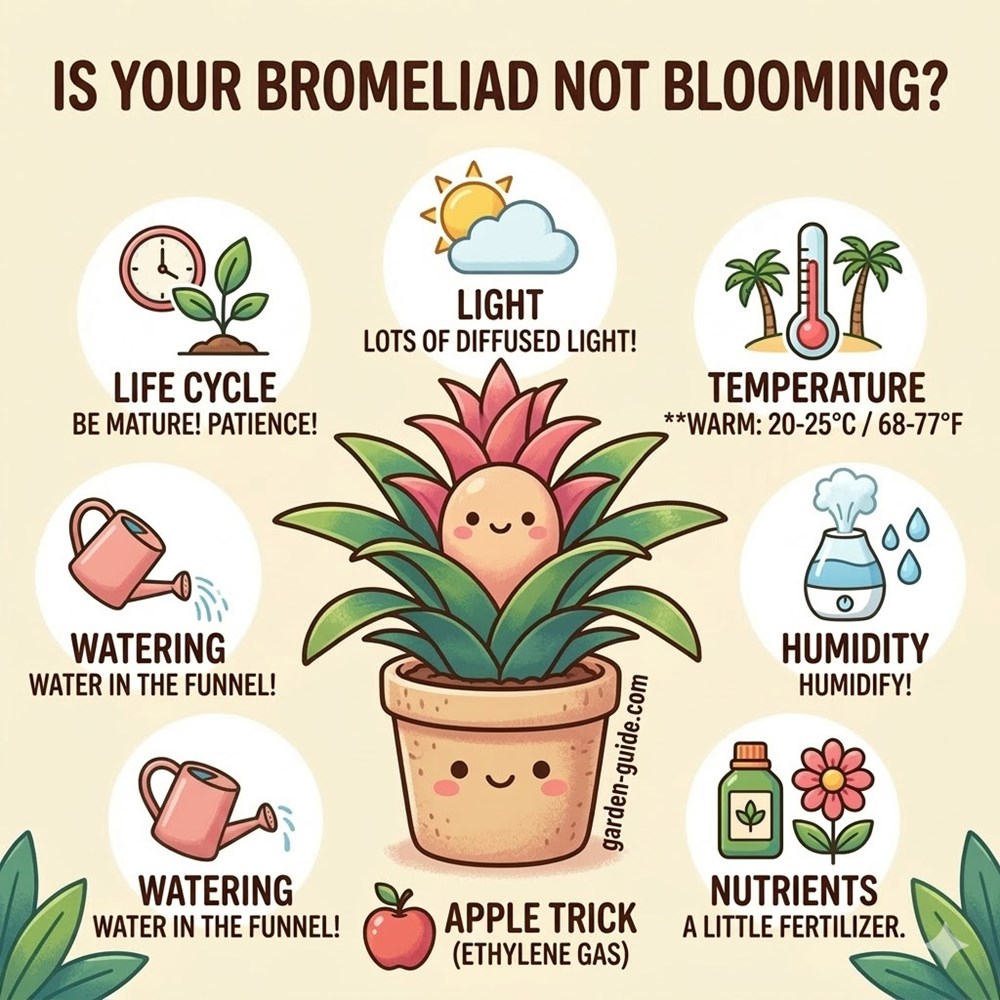
The first thing to understand is that bromeliads live by a different rhythm than many common houseplants. They often take time to mature, and in many cases flowering is a one-time major event rather than a repeated seasonal performance.
That means a healthy plant may still not be ready. Sometimes the problem is not neglect. Sometimes the problem is expectation.
1. It may not be getting enough light
Bromeliads want bright conditions, but not scorching, direct all-day sun. Put them too deep into a dim room and they may survive politely without ever gathering enough energy to bloom. Put them into harsh midday sun and they may scorch instead.
Bright, indirect light is usually the sweet spot. A position near an east- or west-facing window is often ideal. A bromeliad does not want to live in a cave, but it is also not looking to become a crisp.
2. The plant may still be too young
This catches people off guard. Store-bought bromeliads are often sold at or near their showiest phase, so it is easy to assume your plant should simply do it again whenever you wish. But immature plants do not bloom just because conditions are decent.
They need time to build up enough size and energy. Before flowering, they are busy becoming the kind of plant that can flower at all.
3. The room may be too cool
Most bromeliads come from tropical or subtropical environments, so they are not fond of chilly window ledges, cold drafts, or prolonged cool temperatures. Around 20–25 °C is generally comfortable for active growth and bloom development.
If conditions stay too cool for too long, the plant slows down. It may not collapse dramatically. It may simply refuse to proceed. This is one of the most frustratingly elegant ways a plant can disagree with your care.
4. Dry air can hold it back
Indoor air, especially during the heating season, is often much drier than bromeliads prefer. These plants appreciate humidity. When the air is too dry, leaf tips may suffer and the plant may become less inclined to bloom.
Grouping plants together, keeping them away from direct heat sources, or lightly increasing humidity around them can help. A bromeliad does not need full rainforest theatre, but it would like the room to stop pretending it is a desert office.
5. It may need some feeding
Bromeliads are not heavy feeders, but they are not entirely above nutrition either. If the plant has been in the same mix for a long time with no supplemental feeding, it may simply lack the resources needed to form a bloom.
The trick is restraint. Too much fertilizer can be just as problematic as none at all. A mild, occasional feed during active growth is usually enough.
6. Watering may be missing the point
Bromeliads are unusual because the central leaf rosette often acts like a reservoir. In nature, many collect water in this cup-shaped centre. That means watering is not only about the potting mix.
For many types, a little water in the central cup makes sense, as long as it is refreshed regularly and not allowed to stagnate. Constant cold, stale water is not helpful. Neither is treating the plant like a standard houseplant and ignoring how it is built.
7. It may simply be following its natural cycle
This is the big one. Many bromeliads bloom only once in their lifetime from the main rosette. After flowering, that rosette gradually declines while producing offsets, or pups, around the base.
So if your bromeliad has already bloomed and you are waiting for that same centre to flower again, the issue may not be your care at all. You may just be asking the wrong generation.
What if everything seems right?
If the plant is mature, bright enough, warm enough, humid enough, lightly fed, and watered in the way bromeliads prefer, then patience may be the missing ingredient.
Some growers use the old apple trick, placing a ripe apple near the plant for a few days to expose it to ethylene gas, which can help encourage blooming in mature specimens. It is a real technique, but not magic. It only makes sense when the plant is healthy and the basic care is already right.
Bromeliads are not being rude. They are being exact
That may be the best way to think about them. A bromeliad is not dramatic in the usual houseplant way. It does not always wilt spectacularly or throw obvious tantrums. It simply withholds the grand finale until conditions suit it.
And maybe that is why the bloom feels so satisfying when it finally comes. It never looks casual. It feels earned. So if your bromeliad is not blooming, do not assume it is stubborn for the sake of it. More often, it is just waiting for the moment when light, warmth, maturity, moisture, and timing all line up.
In other words, it is not asking for perfection. It is asking you to understand what kind of plant it really is.