

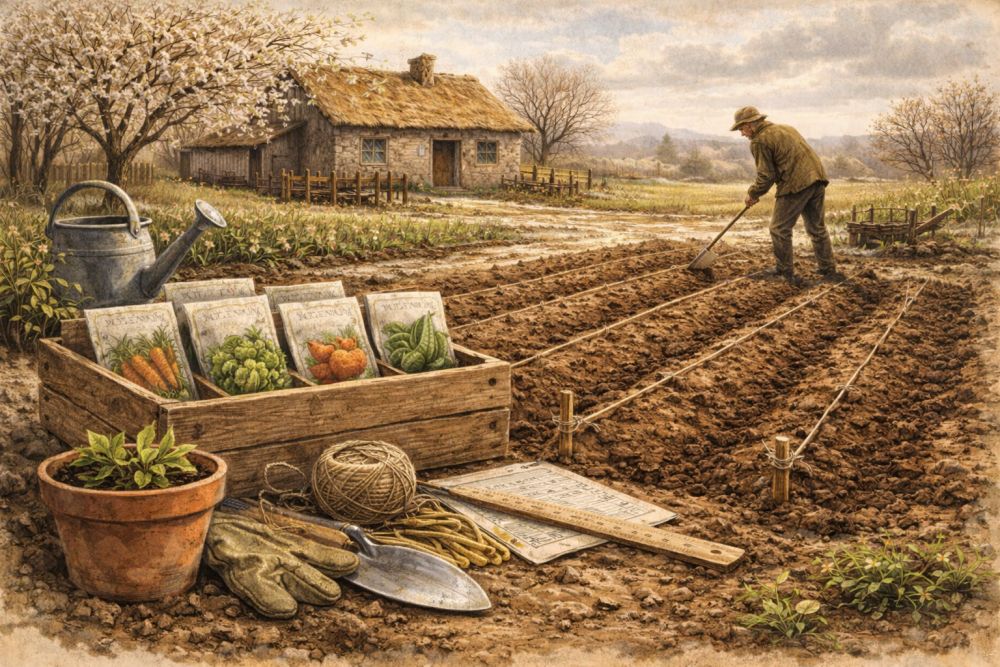

Mid-March in the garden belongs to a subtle kind of order. The loudness of spring has not arrived yet, but preparation is everywhere: seed packets reappear, beds are reconsidered, the light stretches longer, and the mind begins arranging rows, paths and future growth. At this stage, the garden is still part intention, part earth — and that makes it a fitting day for thinking about pattern, proportion and timing.
March 14 is most widely known as Pi Day. At first glance, that may seem far removed from a garden almanac, yet it fits surprisingly well. The beginning of the growing season is also a matter of spacing, balance and measured decisions. How densely should one sow? How much room will later growth require? Where should taller crops cast shade, and where must light remain open? Early spring is one of the year’s most thoughtful seasons, even before it becomes a colourful one.
When structure appears before abundance
There is something almost drawn rather than grown about the garden in early spring. Bare branches still outline the air, soil lies open to view, and the future exists first as lines imagined across a bed. Before bloom and fullness, there is structure.
That is especially true in the kitchen garden. By mid-March, there may still be little colour, but there are already many decisions. Which bed will take early vegetables? Which patch should wait? Where was last year too crowded? Which path proved too narrow? To ask such questions is not to delay the season, but to begin it well.
Good growth depends on measured space
In gardening, proportion is never merely aesthetic. Sowing too densely can produce weak, elongated seedlings. Poor spacing may trap moisture, reduce airflow, increase disease pressure and make later work more difficult. Much of summer’s health is quietly prepared by spring’s restraint.
Nature, meanwhile, keeps its own exactness. Buds do not open all at once. Soil does not warm evenly. Sunlight does not travel through every corner in the same way. March 14 is a beautiful reminder that observation is one of the season’s first tools. The gardener’s task is not simply to begin working, but to notice where the garden is ready, where it is hesitant, and where it asks for a different pace.
Reading the map of the garden again
This day also invites a kind of relearning. After winter, the garden becomes visible in a different way. One can see where growth was once too dense, where compost will be needed, where water lingers, and which places receive the first useful warmth of morning. These are quiet discoveries, but they shape the season more than many dramatic tasks.
So Pi Day, read through the lens of a garden, becomes less about mathematics than about inner order. A well-made garden is not simply full; it is breathable, walkable and prepared for change. It leaves room not only for plants, but for light, weather, movement and time.
A wider environmental note
March 14 is also associated with the International Day of Action for Rivers, which brings another layer to the date. It suggests that proportion and control are not only questions for beds and borders, but for landscapes too. Human beings have long tried to direct water, contain it, channel it and remake its paths. Good environmental thinking, however, begins with respect for what a place already wants to be.
That idea belongs in the garden as well. Not every corner should be forced into the same pattern. Some parts thrive under neat rows, others under a looser, more natural rhythm. Order is not always strict geometry. Sometimes it is simply the wisdom of giving each place its proper measure.
What this day still says in the garden
March 14 belongs to the quieter architecture of spring. It is a day for measuring with the eye as much as with the hand, for imagining before planting, and for trusting that a beautiful season is often built before it is seen.
The garden may still look half-empty now, but that emptiness is not lack. It is possibility, still waiting for its visible form. Perhaps that is why this date feels so right in an almanac. Spring does not only burst forth. It also composes itself.