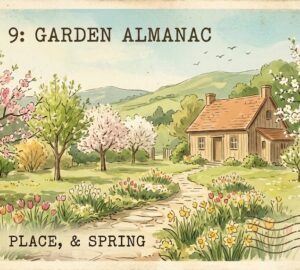
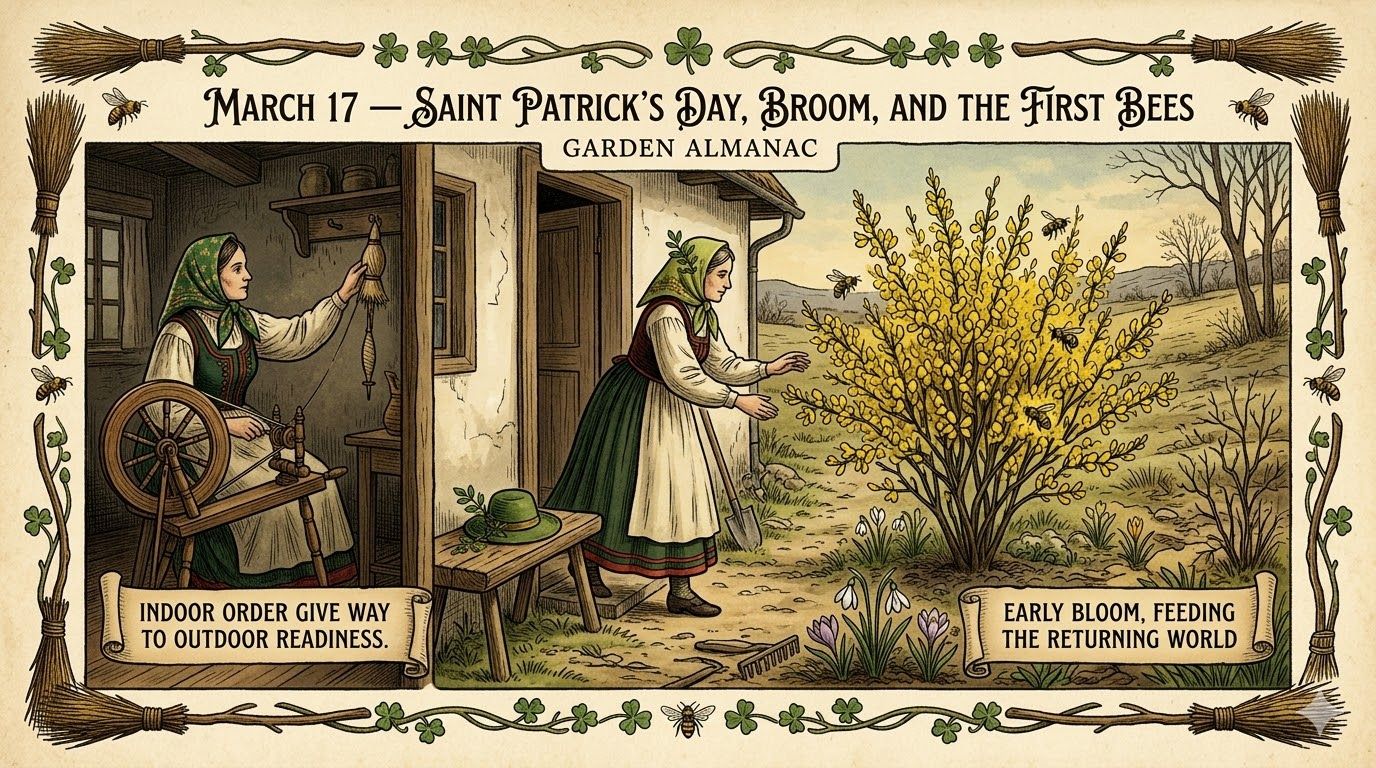

Mid-March marks one of those subtle but decisive shifts in the rural year when the old indoor order can no longer remain the main one. Winter tasks — mending, spinning, weaving, making do indoors — begin to lose their hold, while attention turns outward again toward soil, sowing, garden beds and the practical demands of spring. March 17 carries that change especially well.
In parts of the old South Slavic world, this day was known as a kind of spindle-ending day: a point by which women were expected to lay aside the winter’s textile work and prepare for the season ahead. That custom may sound distant now, yet its meaning is still easy to recognise. There comes a moment each spring when planning is no longer enough. Tools must be checked, seed packets sorted, beds inspected, and the whole household begins to lean toward the land again.
Saint Patrick’s Day, seen from the garden
March 17 is, of course, most widely known as Saint Patrick’s Day. In a garden almanac, that is interesting not only because of its cultural reach, but because of the plant life quietly gathered around it. In Irish tradition, green sprigs were worn on the hat, and Patrick himself became linked in folk imagination with the season’s hardy, thorny and wind-tested plants.
That gives the day a more botanical atmosphere than it might first seem to have. It is a feast of green before full leaf, of emblematic plants before abundance, of landscape waking rather than fully awakened. Read this way, it belongs beautifully to early spring.
The broom and the first bees
The Hungarian tradition preserved in your source gives special attention to the broom shrub, one of the first bright splashes of yellow in rough open country, and one of the early plants visited in earnest by bees after winter. That detail matters. The first nectar and pollen sources of the year are never trivial. They help bridge the gap between scarcity and bloom.
This is one of the loveliest ways to read March 17 in a modern garden. Not simply as a date of folklore, but as a reminder to notice what is already feeding the returning world. Early bulbs, catkins, flowering shrubs and the season’s first tree blossoms are not only ornamental. They are part of the garden’s first generosity.
A day of transition, not fullness
What makes this day so appealing in an almanac is that it belongs neither fully to winter nor fully to spring. It is a threshold day. Indoors, one phase of work is ending. Outdoors, another is beginning. The garden is not yet abundant, but its signals are becoming unmistakable.
And that may be the deepest message of March 17. The year does not change only through weather. It changes through human attention. At some point, hands that spent winter occupied with one kind of making must turn again toward soil, seeds, tools and the quiet urgency of growth.
What this day still says in the garden
Perhaps the most enduring lesson here is that spring is announced first by modest things: a shrub in bloom, the first bees searching, a lengthening light, the moment when indoor order gives way to outdoor readiness. March 17 gathers all of that into one thoughtful date.
It is not yet the season in its fullness. But it is already the season in motion.