
On a November morning, the ground beneath a garden may seem reassuringly still. Fallen leaves cover the soil, hardy vegetables stand beneath cool skies, and bare trees reveal the structure of the landscape. Yet the earth is never quite as motionless or ordinary as it appears.
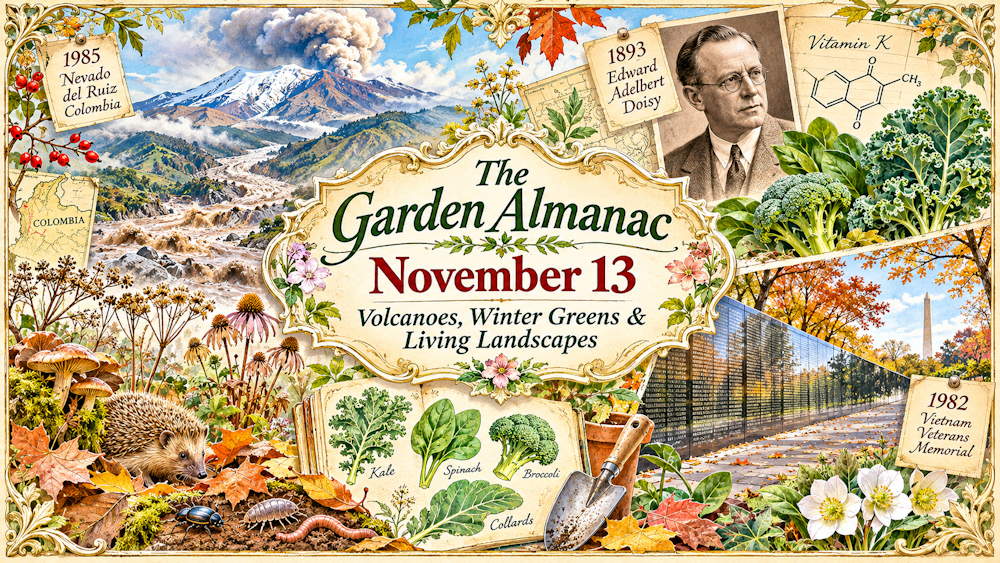
November 13 brings three remarkable stories about what lies beneath the surface. In Colombia, a volcano revealed the devastating power of ice and flowing sediment. In an American laboratory, a scientist helped uncover a vital substance hidden in green leaves. And in Washington, a young designer transformed a simple stretch of ground into one of the world’s most moving memorial landscapes.
November 13, 1985 – The Volcano That Turned Ice into a Deadly River
High in the Colombian Andes, Nevado del Ruiz rises above a landscape of mountain forests, farmland and tropical valleys. Its summit is covered with snow and ice, an unusual sight so close to the equator. On November 13, 1985, the volcano erupted, setting in motion one of the deadliest volcanic disasters of the twentieth century.
The eruption itself was relatively modest compared with some of history’s greatest volcanic explosions. Its consequences, however, were catastrophic. Hot volcanic material melted part of the summit’s ice cap, releasing torrents of water that swept down the mountain. As the water entered steep river valleys, it gathered volcanic debris, soil, rocks and sediment, becoming enormous mudflows known as lahars. Travelling far beyond the volcano, they overwhelmed the town of Armero and other communities. More than 23,000 people lost their lives.
The tragedy was especially devastating because scientists had recognised the danger beforehand. Hazard maps had identified areas vulnerable to mudflows, but warnings did not translate into effective evacuation. Nevado del Ruiz demonstrated that the greatest danger from a natural event is not always the most obvious one. In this case, the interaction between volcanic heat, ice, water and the shape of the landscape proved far more destructive than falling ash alone.
Volcanoes also reveal a striking contrast between destruction and fertility. Over long periods, weathered volcanic rocks and ash can contribute minerals to soils, helping create productive agricultural landscapes. But fresh volcanic ash is not instantly fertile garden soil. Heavy deposits can bury vegetation, damage leaves, interfere with drainage and make cultivation difficult. Soil develops through the gradual interaction of rock particles, water, organic matter and living organisms. For gardeners, the important distinction is between a landscape’s geological material and the healthy, functioning soil that plants actually need. Good drainage, stable soil structure and biological activity cannot be replaced by minerals alone.
Garden Science – Why Are Some Volcanic Soils So Fertile?
Volcanic soils can support highly productive agriculture, but their properties depend on local geology, climate and the time available for soil formation.
- Mineral weathering: Volcanic materials gradually release elements such as potassium, calcium and magnesium, although availability varies considerably.
- Water retention: Some volcanic soils contain minerals and organic matter that help them retain moisture.
- Soil structure: Well-developed volcanic soils can provide favourable conditions for root growth and soil organisms.
- Important limitations: Fresh ash may damage plants, while some volcanic soils strongly bind phosphorus, making it less available to crops.
For ordinary gardens, adding volcanic material is not a substitute for compost, appropriate fertilisation and good soil management.
November 13, 1893 – The Scientist Who Found a Hidden Treasure in Green Leaves
One of the most important discoveries in nutrition began with an unexpected problem: young chickens were bleeding. During experiments in the 1920s, Danish scientist Henrik Dam noticed that birds fed certain restricted diets developed serious bleeding disorders. The missing ingredient was eventually identified as a previously unknown vitamin involved in normal blood clotting.
American biochemist Edward Adelbert Doisy, born on November 13, 1893, helped reveal the chemical nature of this mysterious substance. Working with colleagues, he isolated and investigated forms of vitamin K, helping establish their chemical structures. In 1943, Doisy and Dam shared the Nobel Prize in Physiology or Medicine for their complementary discoveries. What had begun as an unexplained nutritional deficiency became a major advance in understanding human and animal health.
For gardeners, the fascinating connection is that vitamin K1, also called phylloquinone, is abundant in many green leafy vegetables. It is associated with the photosynthetic machinery inside plant chloroplasts, where it plays a role in electron transport. Kale, spinach, collard greens and broccoli are all valuable dietary sources. In climates with relatively mild winters, some of these vegetables can remain productive well into November, particularly with suitable protection. The leafy crops that brighten a fading vegetable garden are therefore performing remarkable biochemical work long before they reach the kitchen.
Garden Reminder – How Can You Keep Leafy Vegetables Growing in November?
In temperate Northern Hemisphere gardens, cold-hardy greens can extend the harvest season, although their growth slows as daylight decreases.
- Harvest kale gradually: Remove mature outer leaves while leaving the central growing point intact.
- Protect spinach: Use fleece or a cold frame during severe frost, especially for young plants.
- Check drainage: Winter vegetables often tolerate cold better than prolonged waterlogging.
- Water carefully: Soil generally dries more slowly in cool weather, so check moisture before irrigating.
- Harvest when thawed: Avoid handling or picking leaves while they are frozen, as tissues can be easily damaged.
Kale and several other brassicas may develop a sweeter flavour after exposure to cool temperatures, although the response varies with variety and growing conditions.
November 13, 1982 – The Memorial That Became Part of the Landscape
When a national competition was announced in 1981 to design a memorial for Americans who had served and died in the Vietnam War, the winning proposal surprised many people. Instead of a towering monument or heroic sculpture, a 21-year-old architecture student named Maya Lin imagined two long walls of polished black granite descending into the earth.
The Vietnam Veterans Memorial was dedicated in Washington, D.C., on November 13, 1982. Its V-shaped walls meet at a central point and gradually disappear into the surrounding ground. More than 58,000 names were originally engraved into the stone, arranged according to the dates of death rather than military rank. The design drew intense debate, but its unusual power soon became apparent. Visitors could see their own reflections alongside the names, while the surrounding landscape remained an essential part of the experience.
The memorial’s relationship with its setting is especially interesting from a garden-design perspective. It is embedded in a gently sloping lawn, with paths and nearby trees helping shape how visitors approach and experience the space. Rather than treating landscape as decoration around a monument, the design uses earth, vegetation, perspective and movement as fundamental elements. The same principles can guide quieter garden spaces. A carefully positioned bench beneath a tree, a gently curving path or a small area sheltered by planting can create a sense of separation from everyday activity. Good garden design is not always about adding more plants or ornaments. Sometimes, the arrangement of space matters most.
Garden Inspiration – How Do You Create a Quiet Corner in a Garden?
A peaceful garden space does not require elaborate landscaping.
Choose a location with some protection from prevailing winds and excessive noise. A small deciduous tree can provide summer shade while allowing more light to reach the ground in winter.
Use shrubs, ornamental grasses or a low hedge to create a sense of enclosure without completely blocking the view. A simple bench, a restrained selection of plants and an uncluttered path may be more effective than numerous decorative features.
In smaller gardens, even a few square metres can become an inviting place to sit, observe wildlife or enjoy seasonal changes.
Wildlife Note – Why Are Fallen Leaves So Valuable to Garden Animals?
By mid-November, leaf litter is becoming an important part of the garden’s winter habitat.
Beneath fallen leaves, many small creatures find protection from drying winds and temperature fluctuations. Ground beetles, spiders, woodlice and other invertebrates may shelter among the layers, while fungi and microorganisms gradually break down the organic material.
These organisms contribute to nutrient cycling and provide food for birds and other animals. In suitable gardens, a sheltered leaf pile may also offer nesting material or protection for hedgehogs.
Rather than removing every fallen leaf, clear paths and lawns where necessary while allowing leaves to remain beneath trees, shrubs and established borders. Avoid covering the crowns of plants that are vulnerable to winter rot.
What to Observe Right Now – The Hidden Changes of Mid-November
November provides an opportunity to explore processes that are often overlooked during the busy growing season.
Examine the soil after rain. Notice whether water infiltrates quickly or remains on the surface. Persistent puddles, compacted patches and small erosion channels can reveal problems with soil structure and drainage.
Compare different leafy vegetables. Kale, spinach and winter brassicas respond differently to decreasing temperatures and daylight. Observe which varieties remain vigorous and which slow down or develop frost damage.
Look at the shapes of trees. As leaves disappear, branch architecture becomes easier to appreciate. Notice how some trees spread widely while others maintain narrow or upright forms, influencing the spaces beneath them.
Watch for activity beneath leaf litter. On mild days, carefully lifting a small section of fallen leaves may reveal earthworms, beetles, woodlice or fungal threads. Replace the leaves afterwards to preserve the habitat.
Notice the changing light. The lower angle of the November sun creates longer shadows. These patterns can reveal which garden areas remain sunny during winter and which become shaded for much of the day.
Looking Ahead
November 13 offers three very different perspectives on the landscapes we inhabit. The Colombian volcano reminds us that soil, water and geology are inseparable, while the discovery of vitamin K reveals the extraordinary chemistry hidden inside familiar vegetables. The Vietnam Veterans Memorial shows how thoughtfully shaped ground and planting can give a place lasting meaning. As gardens settle into winter, observing the soil, making the most of hardy crops and reconsidering the design of outdoor spaces can all help us create gardens that are healthier, more useful and more rewarding in the seasons ahead.