
By early November, a garden can look wonderfully still. Leaves gather beneath trees, seedheads stand against pale skies, and the first frosts begin to redraw the landscape. Yet beneath that quiet surface, countless forms of life are preparing for winter.
November 7 offers an unusual journey through the natural world – from a mysterious boundary between Indonesian islands to a railway crossing the Canadian wilderness, and finally to an Austrian garden where a young goose helped change our understanding of animal behaviour.
November 7, 1913 – Alfred Russel Wallace and the Invisible Line That Divides Two Worlds
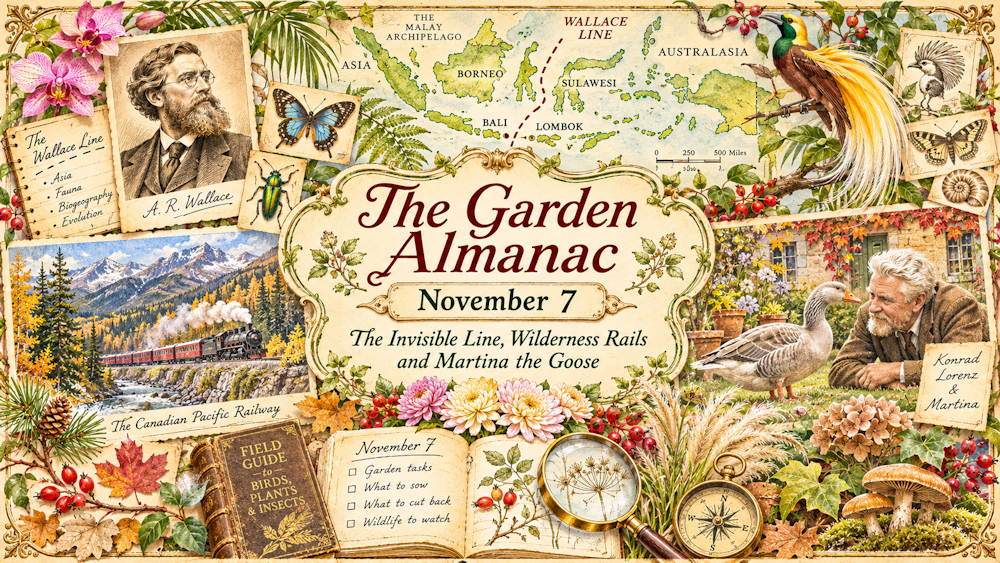
Imagine standing on an Indonesian island and looking across a narrow stretch of sea. On the other side, the climate appears much the same, tropical forests flourish, and the distance seems insignificant. Yet the animals living across that water may belong to an astonishingly different natural world. This was one of the great discoveries of Alfred Russel Wallace, the British naturalist who died on November 7, 1913.
During his travels through the Malay Archipelago in the nineteenth century, Wallace noticed a remarkable geographical pattern. Islands such as Bali and Borneo had animal communities with strong Asian connections, while nearby Lombok and islands farther east showed increasing affinities with the wildlife of Australasia. The boundary became known as the Wallace Line. It was not a visible barrier, but a clue to the ancient history of continents, seas and the movement of species.
Wallace independently developed the theory of evolution by natural selection, but his work on the geographical distribution of living things was equally transformative. He demonstrated that understanding a species requires more than knowing what it looks like or what climate it prefers. Its evolutionary history, opportunities for dispersal and geographical isolation also matter. Two places with apparently similar environments can support very different communities because their histories have followed different paths.
There is a fascinating gardening connection here. A plant that thrives in one region may struggle in another despite similar temperatures, while a species introduced beyond its natural range may encounter few of the organisms that once limited its spread. This is why choosing plants involves more than checking hardiness zones. Soil conditions, moisture, local ecology and the plant’s potential to become invasive all deserve attention. Even a small garden is part of a much larger geographical story.
Garden Science – Why Doesn’t a Suitable Climate Guarantee a Suitable Habitat?
Temperature is only one part of a plant’s ecological requirements.
- Soil matters: pH, drainage and nutrient availability influence which plants can establish successfully.
- Biological relationships matter: Pollinators, fungi, competitors and herbivores can affect survival and reproduction.
- Geographical history matters: Mountains, oceans and other barriers help determine which species naturally occur in a region.
For gardeners, this explains why matching a plant to local conditions is usually more reliable than choosing it solely because it grows at a similar latitude elsewhere.
November 7, 1885 – The Railway That Changed Canada’s Landscape
On November 7, 1885, a railway spike was driven into the track at Craigellachie, British Columbia. It marked the completion of the main line of the Canadian Pacific Railway, creating a continuous rail connection across an immense landscape of forests, mountains and prairies. The ceremony was modest, but its consequences were enormous.
The railway reshaped transportation, settlement and the movement of agricultural products across Canada. It also accelerated changes to Indigenous lands and communities, while its construction depended on dangerous labour, including that of thousands of Chinese workers. Forests were cleared, new settlements developed, and areas that had once been difficult to reach became connected to expanding commercial networks.
But railway lines did more than move people and goods. Transport corridors also create new routes along which plants can spread. Seeds may travel with cargo, machinery or disturbed soil, while embankments provide open ground where opportunistic species can establish. Modern ecological research shows that railways can act as pathways for non-native plants, sometimes helping invasive species reach new habitats.
The same principle is relevant much closer to home. Gardeners introduce plants through nurseries, seed exchanges and online purchases, often across considerable geographical distances. Many introductions are harmless or beneficial, but others can escape cultivation and threaten native vegetation. Before planting a vigorous unfamiliar species, check its local invasive status, how it reproduces and whether it can spread beyond the garden fence.
Garden Reminder – What Should Gardeners Do in Early November?
In temperate Northern Hemisphere gardens, this is a useful time to prepare for colder weather without stripping away valuable wildlife habitat.
- Protect exposed soil: Spread healthy fallen leaves or composted organic matter over empty beds to reduce erosion and temperature fluctuations.
- Check newly planted shrubs: Water during dry spells while the ground remains unfrozen.
- Secure tender containers: Move frost-sensitive plants to appropriate winter shelter before damaging temperatures arrive.
- Keep drainage clear: Remove leaves blocking gutters, paths and drainage channels, while retaining suitable leaf litter in planting beds.
A little selective tidying is often more useful than a complete autumn clear-out.
November 7, 1903 – The Goose That Followed a Scientist Home
One of the most memorable discoveries in animal behaviour began with an apparently ordinary young goose. Konrad Lorenz, born in Vienna on November 7, 1903, became famous for studying how animals respond to their surroundings. Working with geese at his family’s property in Altenberg, Austria, he observed that newly hatched birds could form a powerful attachment to the moving figure they encountered during a sensitive period of early development.
One greylag goose, Martina, became particularly famous. Having imprinted on Lorenz, she followed him about as though he were her parent, providing an extraordinary opportunity to study the relationship between instinct and experience. Lorenz’s observations helped establish ethology, the scientific study of animal behaviour, as a major field of research. In 1973, he shared the Nobel Prize in Physiology or Medicine with Karl von Frisch and Nikolaas Tinbergen.
His work helped challenge the assumption that animal behaviour could be understood entirely as either inherited instinct or learned experience. The interaction between the two could be much more intricate. For gardeners, this opens another way of observing familiar wildlife. Birds returning to reliable feeding places, insects choosing particular shelter sites and young animals learning to navigate their surroundings are not merely charming visitors. Their behaviour reflects adaptations, experience and responses to environmental signals.
Wildlife Note – How Can a November Garden Help Birds and Insects?
A garden may appear almost empty after the growing season, but many creatures are still present or sheltering nearby.
- Leave some seedheads standing: Finches and other seed-eating birds may feed on suitable dried flowerheads.
- Keep leaf litter beneath shrubs: It shelters invertebrates and creates feeding opportunities for birds that search the ground.
- Preserve sheltered corners: Healthy hollow stems, logs and undisturbed vegetation provide overwintering places for various insects.
- Offer clean water: A shallow birdbath can be valuable when natural water sources freeze, provided it is cleaned and kept safe.
Watching how birds use different parts of the garden can reveal which plants and structures are genuinely useful to them.
What to Observe Right Now – The Hidden Activity of November
November is an excellent time to notice changes that are easy to overlook during the busy growing season.
Look beneath deciduous trees. Fallen leaves are gradually becoming part of the soil’s organic layer. Earthworms, fungi and numerous smaller organisms help break down plant material, although decomposition slows as temperatures fall.
Watch the remaining autumn colours. Yellows often become more noticeable as chlorophyll breaks down, while red and purple pigments develop in some species under suitable conditions. Weather and plant genetics influence the final display.
Notice where frost appears first. Low-lying areas, exposed lawns and sheltered borders may experience different temperatures within the same garden. These small variations help explain why a tender plant survives in one location but suffers damage only a few metres away.
Listen for winter birds. As foliage disappears, resident birds often become easier to spot among bare branches. Their movements can reveal sheltered roosting places, dependable food sources and the importance of evergreen cover.
Looking Ahead
The natural world is full of boundaries that cannot be seen, movements whose consequences are not immediately obvious, and behaviours that reward patient observation. Understanding these details can help us choose plants more carefully, recognise ecological risks and make our gardens more welcoming to wildlife. As November advances, even a quiet garden offers opportunities to notice how living things adapt to change. Sometimes the most valuable gardening discovery begins not with a spade or pruning shears, but with a closer look.