
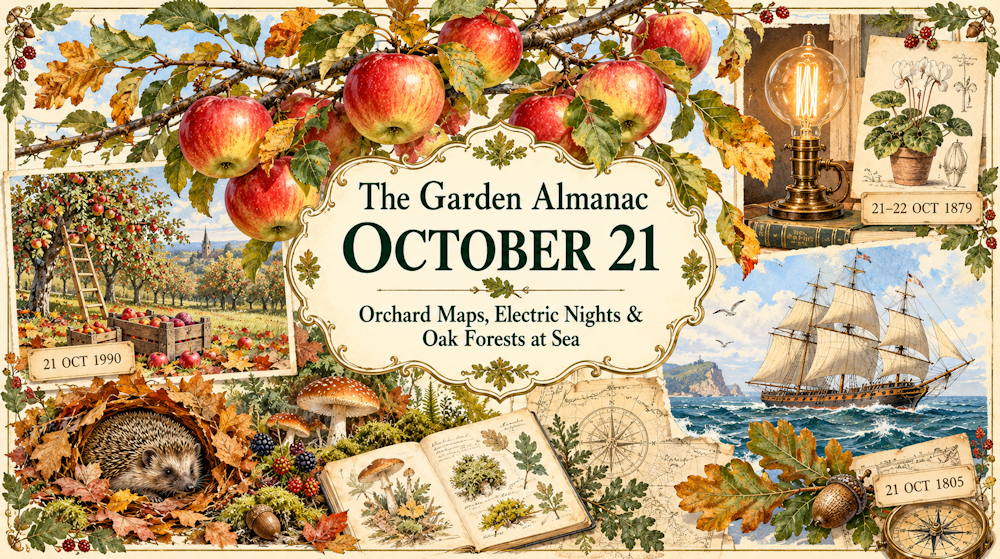

On an October morning, an apple can feel like the whole season held in one hand: cool skin, a little rain on the stalk, perhaps a leaf already turning beneath the tree. Yet this modest fruit carries a longer story than any single harvest – of named varieties, patient grafting and places that learned to value what grows nowhere else in quite the same way.
October 21 opens several such doors. It leads to a London square briefly remade as an orchard, a New Jersey laboratory where night ceased to mean darkness, and a sea battle whose ships had begun life as oak woods. Their histories do not need a single grand conclusion. It is enough to notice how often a garden asks us to think beyond the present season.
October 21, 1990 – The Day an Apple Became a Map of Place
The first Apple Day took place in Covent Garden, London, on 21 October 1990. It was started by the environmental arts charity Common Ground, not as a glossy celebration of one perfect supermarket fruit, but as a prompt to look again at local distinctiveness: the particular apples, recipes, orchards and names that belong to a region.
That was an unexpectedly radical idea. An apple is easy to treat as a generic object – crisp, red, sweet, available all year – but orchards once held a remarkable working vocabulary of difference. Some varieties were bred for storing, some for cider, some for cooking into a sharp purée, and some for eating straight from the tree for only a few precious weeks. Losing a local variety can mean losing a flavour, but also a record of what a climate, soil and community found worth keeping.
For the home grower, the useful question is not simply, “Which apple tastes best?” It is, “Which apple belongs in this garden?” A compact tree on the right rootstock can fit a small space, while a locally successful, disease-resistant cultivar may need fewer interventions than a fashionable but poorly matched choice. Apples also give more than fruit: spring blossom feeds pollinators, foliage feeds caterpillars and a mature tree offers shade, structure and places for birds to forage.
Apple Day is therefore a fine excuse to label an unnamed tree, ask an older neighbour what it was called, or seek out a local fruit fair before ordering a replacement. Pick ripe apples by cupping each fruit, lifting it gently and giving a small twist; if it releases without a tug, it is usually ready. Harvest sound fruit for storing, use bruised ones promptly, and remove fallen, diseased leaves from beneath trees where scab or other leaf diseases were troublesome.
Garden Reminder – Make the Most of the Apple Season
- Sort the crop at once: store only clean, unbruised apples; a single damaged fruit can hasten the decline of its neighbours.
- Choose the right home for new trees: autumn is a good time to plan and order bare-root fruit for winter planting, but check pollination partners as well as ultimate size.
- Mulch, do not bury: spread compost or leaf mould under the canopy, keeping it clear of the trunk so the bark stays dry.
October 21–22, 1879 – When a Cotton Thread Changed the Length of Night
In Menlo Park, New Jersey, Thomas Edison and his team tested a lamp with a carbonised cotton-thread filament across the night of 21–22 October 1879. The date has often been simplified into a tale of one man “inventing the light bulb”, but the more revealing story is that electric light had many predecessors. What Edison’s laboratory was pursuing was a durable, high-resistance lamp that could work as part of an affordable, distributed system.
That distinction matters in a garden as much as in a history of technology. A lamp is never only a lamp to a plant. Day length is information. In autumn, shortening days help many plants prepare for dormancy, while other species use the changing balance of light and darkness to time flowering. Indoor lighting can support seedlings and houseplants, but it can also blur the signals that tell a plant what season it is.
October is a good moment to resist the instinct to compensate for every dim window with more light. Give houseplants the brightest suitable position, clean dusty leaves so they can use the available daylight, and reduce feeding and watering for plants whose growth is slowing. For plants that genuinely need supplemental light, a timer is kinder than an endlessly glowing room: a reliable day–night rhythm is part of the growing conditions, not an optional extra.
Garden Science – Why Do Short Days Matter to Plants?
Plants sense seasonal change through photoperiodism – their response to the length of daylight and, crucially, uninterrupted darkness. Many flowering plants use this cue alongside temperature; it is one reason that the same windowsill can produce very different results in June and November. Artificial light after dusk can confuse this signal, so keep grow lights purposeful and timed rather than treating them as permanent daylight.
October 21, 1805 – Trafalgar and the Forest Hidden Inside a Warship
At the Battle of Trafalgar, fought off the south-west coast of Spain on 21 October 1805, the sea was crowded with warships, canvas and smoke. It is easy to picture the battle as an event of admirals and cannon. Look a little closer and it is also a story of trees: every wooden ship carried an inland landscape out across the water.
HMS Victory, Nelson’s flagship, had required more than 2,000 oak trees for her hull – roughly the equivalent of 60 acres of forest. Shipbuilders prized oak not because trees are interchangeable but because grain, curve, strength and slow growth mattered. A crooked branch could be more valuable than a straight one when it naturally matched a ship’s frame. The naval age depended on woodland knowledge as surely as it depended on navigation.
This is not an argument for imagining an oak as future timber. It is a reminder that a tree’s value grows as its relationships multiply. In a garden or park, an oak can support lichens, fungi, insects, birds and shade-loving plants long before it becomes ancient; its dead wood and leaf litter remain useful after a branch falls. If you have room for a long-lived tree, choose a species suited to the soil and give it space from the beginning. If you do not, protect the mature trees already shaping your street or local landscape – they are slow infrastructure, not replaceable decoration.
Wildlife Note – A Tidier Garden Is Not Always a Kinder One
Autumn clearing needs a little selectivity.
- Rake leaves from lawns and paths, where they can smother grass or become slippery.
- Leave a loose layer on borders, or gather leaves and small twigs into a quiet corner for leaf mould and winter shelter.
- Keep diseased leaves – especially those marked by apple scab, rose black spot or similar problems – out of the wildlife pile and dispose of them with green waste where appropriate.
Hedgehogs, invertebrates and amphibians may use undisturbed piles for cover, while birds forage among them. Before moving a heap, pause and check it – autumn’s apparent untidiness is often somebody else’s winter room.
What to Observe Right Now – The Colours Beneath the Green
Why are the leaves so bright just before they fall? As autumn advances, trees break down chlorophyll, the green pigment that captures light for photosynthesis. Yellow and orange carotenoids, long present but hidden, become visible; reds can develop when sugars accumulate in leaves during bright, cool weather. Watch one tree over several days rather than judging the whole garden at once: colour change is an individual timetable, shaped by species, temperature, moisture and light.
Looking Ahead
An orchard, a timed lamp and an old oak ask for different kinds of attention, but all reward patience. This week, harvest what is ready, learn the name of one plant in your care, and leave one small part of the garden less polished for wildlife. When winter arrives, those choices will not look dramatic – yet they are the sort that give next year’s blossom, soil and garden visitors a better start. October’s best work is often the work that quietly makes room for the future.