


A wet leaf can look like the end of something. Yet in an October garden, it is usually the beginning of several small stories: fungi at work, invertebrates finding cover, birds searching for food, and soil preparing quietly for another season.
October 20 opens rather different doors onto the living world. It leads to a pioneering aquarium on California’s coast, a moment when vast North American landscapes were turned into a political transaction, and the tropical canopy – a place where “slow” is not a failure of nature, but a highly specialised way of belonging.
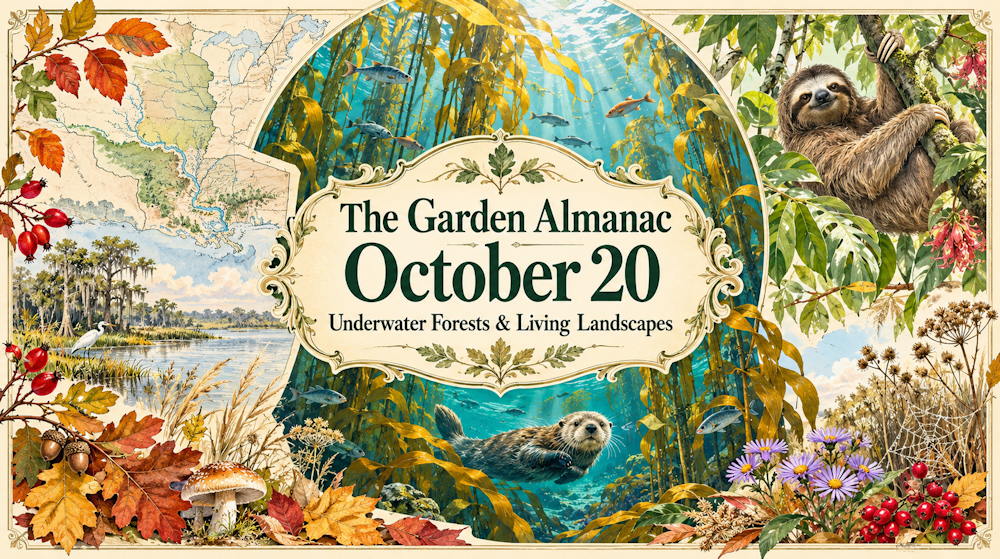
October 20, 1984 – The Aquarium That Let a Forest Grow Underwater
When Monterey Bay Aquarium opened on October 20, 1984, it transformed a former sardine cannery on California’s Cannery Row into a place where visitors could look directly into the life of the Pacific. Its most daring idea was not simply a larger tank, but a living kelp forest – a habitat that had to grow, sway, feed and change rather than sit still as scenery.
The challenge was considerable. Giant kelp needs cold, moving, nutrient-rich seawater and enough light to race upwards towards the surface. The aquarium’s system brought fresh bay water first to the Kelp Forest exhibit, allowing visitors to see a community that is shaped every day by currents, light and the restless appetite of its inhabitants.
That was a valuable change of perspective. Kelp is not a plant, but a large brown alga, and a kelp forest is not a garden in the usual sense. Still, it behaves like one in the ways that matter most: tall fronds form a canopy, smaller species occupy different levels below, and shelter, food and competition are woven together. Sea otters, for example, can help protect kelp forests by eating sea urchins that would otherwise graze the kelp down.
For gardeners, the lesson is not to imitate the sea. It is to recognise that a flourishing space is more than its showiest species. A shrub, groundcover, climbing plant, patch of leaf litter and water source may each support different lives. The most interesting gardens are rarely those in which every surface has been simplified.
Garden Science – Why do layered plantings support more life?
Different heights create different conditions. A tree canopy offers shade and nesting places; shrubs provide cover; flowering plants offer pollen and nectar; ground layers hold moisture and shelter decomposers.
- Combine a few structural layers instead of relying on one repeated plant.
- Leave some stems and seedheads standing where winter tidiness is not essential.
- Notice which layer is missing in your garden – often it is the low, messy, protective one.
October 20, 1803 – When a Continent Became a “Purchase”
On October 20, 1803, the United States Senate ratified the Louisiana Purchase treaty. The decision nearly doubled the size of the young country on paper. It also placed an immense mosaic of rivers, grasslands, wetlands, forests and mountain foothills within the ambitions of a rapidly expanding nation.
The familiar phrase “land purchase” can make this seem strangely empty – as though a map had been bought without people, stories or working landscapes upon it. But the territory was home to many Indigenous nations, whose communities had long farmed, hunted, travelled, traded and managed its varied environments. A political boundary changed quickly; ecological relationships and human consequences did not.
For a gardener, this is a useful corrective to the idea of a plot as blank space waiting for improvement. Every garden has a history: compacted soil beneath an old driveway, seeds surviving from an earlier meadow, a drainage pattern created by a vanished stream, a veteran tree older than the house beside it. Before changing a place, look for what is already there. The best design often begins with reading the ground rather than imposing a plan upon it.
Seasonal Tips – What should you do with fallen leaves?
- Rake leaves off lawns and evergreen rosettes, where a thick wet layer can smother plants.
- Use dry, healthy leaves as mulch beneath shrubs or add them gradually to compost.
- Leave a modest undisturbed corner under a hedge or tree for overwintering insects and other small wildlife.
- Avoid piling leaves against woody stems, where constant damp can encourage disease.
October 20 – A Day to Look Up into the Canopy
October 20 is also observed as International Sloth Day, a reminder that the rainforest is not merely a collection of individual trees. For sloths, the canopy is a connected world of food, shelter, movement and camouflage – an entire landscape held above the ground.
Their apparent stillness is easy to misread. Sloths have slow metabolisms and specialised digestion suited to a leafy diet, while their shaggy fur can host algae and tiny organisms. They are not simply resting in a tree; they are part of a living web that includes leaves, branches, rain, fungi, insects and the complex architecture of the forest itself.
A temperate garden cannot become a tropical rainforest, nor should it try. But the sloth offers a useful question: do we treat trees as isolated ornaments, or as habitats with a life beyond their outline? Mature trees, dense hedges, climbers, berrying shrubs and unbroken planting corridors can make a garden more navigable and safer for wildlife – especially when winter begins to thin the available cover.
Wildlife Note – A garden does not need to be tropical to have a canopy story.
In October, watch the upper layers of your garden as carefully as the flowerbeds below. Woodpeckers may inspect bark for insects, tits move through seedheads and branches, and spiders use fading stems as anchor points for their webs. A little structural variety can matter more than another perfectly cleared border.
What to Observe Right Now
Look at the garden after rain, when its levels become easiest to see. Notice where water gathers, where leaves lodge, which shrubs keep their berries, and which bare branches are still busy with birds. At this point in the year, a garden reveals not only what it grew, but what it can shelter.
Looking Ahead
The stories of October 20 do not need to make one grand argument. They simply ask us to notice that a kelp forest, a prairie, a rainforest canopy and a back-garden hedge all become more interesting when we see relationships rather than isolated objects. This autumn, leave room for layers, for small untidy refuges and for the history already written into the ground. A garden becomes more resilient not when every part is controlled, but when more life has a place within it.