
By mid-September, the garden begins to speak in a different register. The light is lower, the mornings are cooler, and even vigorous summer plants start to reveal what the season has asked of them: which leaves have scorched, which roots have held, which flowers still have something to offer pollinators before the year turns.
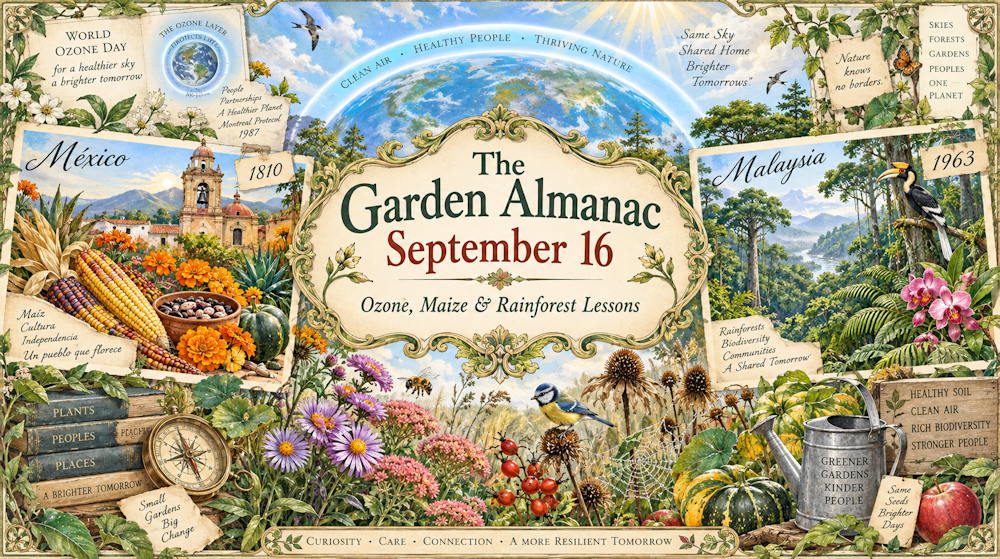
September 16 brings together three stories that seem, at first, to belong to different worlds: a global treaty to protect the sky, a cry for independence in a land shaped by maize, and the formation of a country whose rainforests hold some of Earth’s richest biodiversity. Looked at through a gardener’s eyes, they all ask the same question: how do we protect the living systems that protect us?
September 16, 1987 – The Day the Sky Became a Shared Garden
On September 16, 1987, the Montreal Protocol was adopted, creating one of the most successful international environmental agreements in modern history. Its purpose was clear: to phase out substances that were damaging the ozone layer, the fragile atmospheric shield that helps filter harmful ultraviolet radiation before it reaches life on Earth.
For gardeners, the ozone layer may sound distant, but its importance is deeply practical. Plants use sunlight to grow, but too much UV-B radiation can damage plant tissues, affect photosynthesis, alter flowering and reduce the resilience of crops and wild plants. A healthy atmosphere is part of the garden’s invisible infrastructure, as essential as soil structure, clean water and pollinating insects.
The success of the Montreal Protocol also offers a rare environmental lesson with hope in it. When science, policy and public action moved in the same direction, measurable recovery became possible. That matters in the garden because many of our own environmental choices are smaller versions of the same principle: choosing less harmful materials, reducing waste, improving soil health and thinking beyond one season.
In September, when gardeners often review the successes and failures of the growing year, this anniversary is a reminder to look upward as well as downward. Healthy gardens are not sealed little worlds. They are connected to the chemistry of the air, the stability of the climate and the choices made far beyond the garden gate.
Garden Science: Why Does UV Light Matter to Plants?
Plants need light, but different wavelengths affect them in different ways. UV-B radiation can trigger protective compounds in leaves, yet excessive exposure may stress plant cells and reduce growth.
In practical gardening terms:
- Young seedlings and shade-adapted plants are more vulnerable to sudden intense sun.
- Gradual hardening off helps plants build tolerance before moving outdoors.
- Mulches and steady watering reduce stress when strong sun and dry soil arrive together.
- Leaf scorch is often a combined effect of sunlight, wind, heat and water shortage, not sunlight alone.
By mid-September, sun stress usually eases in temperate gardens, but drought stress may still linger. Check evergreen shrubs, newly planted perennials and container plants carefully: damaged roots and dry compost can make even softer autumn light feel harsh.
September 16, 1810 – Mexico’s Independence and the Garden of Maize
On September 16, 1810, the call known as the Cry of Dolores helped begin Mexico’s struggle for independence. It was a political and social turning point, but behind the national story lies a deeper landscape: one of maize fields, village gardens, agave, beans, squash, chillies and long traditions of cultivating difficult land with remarkable skill.
Maize is especially important here because it is not just a crop. It is one of humanity’s great acts of plant partnership, domesticated over thousands of years from wild grasses and developed into countless local varieties. In the milpa system, maize is traditionally grown with beans, squash and other plants, creating a layered, mutually supportive planting community rather than a single-species field.
For today’s gardeners, this history offers more than romance. It shows the value of diversity, companion planting and local adaptation. Beans can fix nitrogen, squash leaves can shade soil, and maize can provide vertical structure. The exact system may not suit every climate or plot, but the principle travels well: gardens become more resilient when plants are chosen for relationship, not only for individual performance.
September is a good time to read the vegetable garden like a record of these relationships. Which crops helped shade the soil? Which flowers brought in beneficial insects? Which varieties coped best with heat, rain or dry spells? Seed saving, even on a small scale, begins with this kind of noticing.
Garden Reminder: What Should Vegetable Gardeners Do in Mid-September?
This is a useful moment to shift from harvesting only to learning from the season.
- Save seed only from healthy, true-to-type plants, and label it immediately.
- Leave some late flowers for pollinators rather than clearing everything at once.
- Compost disease-free crop remains, but remove badly infected tomato or squash foliage.
- Sow quick autumn greens where the climate allows, such as rocket, mustard, spinach or lamb’s lettuce.
- Add organic matter to empty beds so soil organisms can begin working before winter.
If your summer crops struggled, resist the urge to see the season as a failure. September’s most useful harvest is often information: which varieties belong in your garden again, and which do not.
September 16, 1963 – Malaysia Day and the Living Wealth of Rainforests
On September 16, 1963, Malaysia was formed, bringing together Malaya, Sabah, Sarawak and Singapore at the time. For a garden almanac, the date opens a window onto one of the world’s great biodiversity regions, especially the tropical forests of Borneo and Peninsular Malaysia.
Malaysia’s rainforests are not simply “green spaces” on a map. They are layered living systems, with towering canopy trees, epiphytes, palms, fungi, insects, birds, mammals and soil organisms all interacting in dense ecological networks. Many species are highly specialized, and many exist nowhere else. This richness makes the forests globally significant, but also vulnerable to fragmentation, overuse and climate pressure.
Home gardeners cannot recreate a rainforest, and they should not try to imitate one superficially. But the ecological lesson is highly transferable. A healthy garden also depends on layers: groundcovers, herbaceous plants, shrubs, climbers, trees, leaf litter, dead wood and undisturbed corners. The more structure a garden offers, the more kinds of life it can support.
In mid-September, this is especially relevant because wildlife is beginning to prepare for seasonal change. Seedheads, berries, fallen leaves and hollow stems may look untidy to us, but they are habitat, food and shelter. A garden managed with biodiversity in mind is not neglected; it is edited with restraint.
Wildlife Note: What Should You Leave for Garden Wildlife Now?
As autumn approaches, small decisions can make a large difference.
- Leave some seedheads standing for birds and overwintering insects.
- Keep a few quiet leaf-litter areas under hedges or shrubs.
- Delay cutting back hollow-stemmed perennials where insects may shelter.
- Let ivy, late asters, sedums and other autumn flowers feed late pollinators.
- Provide shallow water during dry spells, especially where natural sources are limited.
The aim is not to abandon the garden, but to avoid making it too clean. Many useful creatures survive the colder months in exactly the places a tidy gardener is tempted to remove.
What to Observe Right Now: The Garden’s September Signals
Mid-September is one of the best times to watch transition rather than tasks. The garden is still active, but its energy is changing direction.
Look for the first signs of autumn colour in stressed or early-turning trees. Notice which late flowers attract the most bees, hoverflies and butterflies. Watch how morning dew gathers on lawns, seedheads and spider webs, revealing tiny structures that are invisible in dry daylight.
Also pay attention to fruiting and seed formation. Rose hips, berries, pods and dry seedheads show which plants are feeding wildlife or preparing next year’s generation. In a well-balanced garden, beauty does not end when flowering slows; it simply changes form.
Looking Ahead
September 16 reminds us that gardens are connected to much larger systems: the atmosphere above them, the food cultures that shaped them, and the wild habitats that teach us how life organizes itself. The practical lesson is encouraging: protection can begin with informed, repeated choices. We can grow more diverse plantings, reduce unnecessary chemicals, protect soil, leave habitat for wildlife and choose resilience over short-term neatness.
A garden cared for in this spirit becomes more than a pleasant outdoor room. It becomes a small, living contribution to the wider repair work our shared planet still needs.