
By mid-September, the garden has begun to reveal what summer made of it. Some borders are still bright with asters and dahlias, while seed heads, ripening fruit and cooler mornings hint that the season is turning. It is a time for gathering evidence – which plants coped with heat, where water lingered, and which flowers continued to feed insects after the summer rush.
September 15 has its own remarkable collection of evidence. On this date, a young naturalist reached islands that would transform our understanding of life, a small boat sailed towards a nuclear test site and helped launch a global environmental movement, and one of India’s most influential water engineers was born. Together, these stories ask a question every gardener eventually meets: how should we observe, protect and share the living world?
September 15, 1835 – Darwin Reaches the Lava Islands
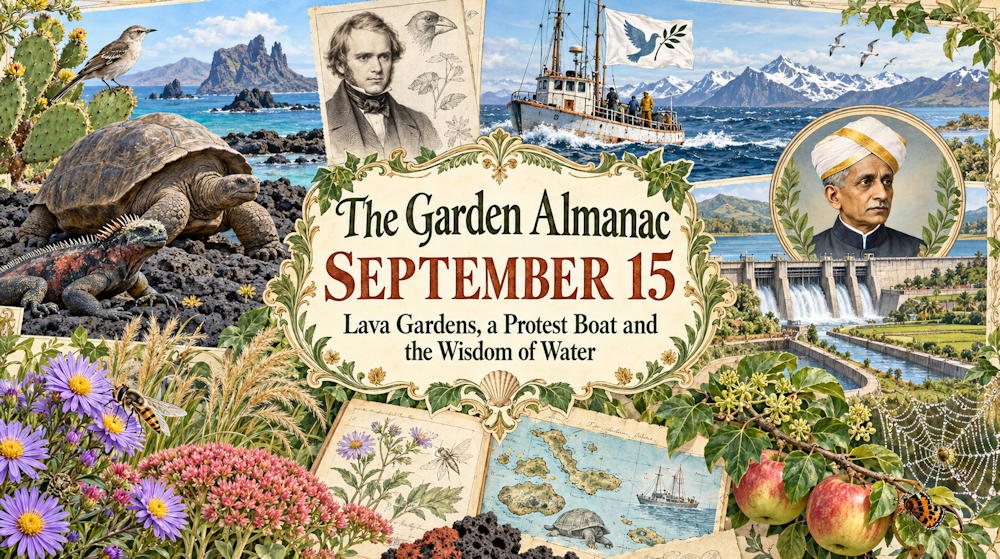
On September 15, 1835, HMS Beagle reached the Galápagos Islands, carrying the 26-year-old Charles Darwin. Nearly 1,000 kilometres off the coast of Ecuador, the archipelago presented him with a landscape of black volcanic rock, sparse vegetation and animals unlike those he had encountered elsewhere. It hardly resembled a conventional garden, yet it would become one of history’s most influential places for thinking about how living things respond to their surroundings.
Darwin visited several islands and collected plants, birds, reptiles and geological specimens. The familiar story often suggests that the theory of evolution arrived fully formed as he watched the Galápagos finches, but the real process was slower and more complex. Mockingbirds, tortoises, fossils, geology and the differences between related organisms all contributed to questions that continued developing long after the voyage.
The islands demonstrated something gardeners witness on a smaller scale: place exerts pressure. Soil depth, rainfall, wind, exposure, competition and available food favour some traits over others. Even within one garden, a plant thriving beside a warm wall may struggle in an exposed bed only a few metres away. The Galápagos magnified this principle because isolated populations met different conditions and changed along separate paths.
For today’s gardener, the practical lesson is to observe before replacing. If a plant repeatedly fails, consider whether the site – rather than the species alone – is responsible. Record sun, soil moisture and wind; notice which seedlings flourish without help; and choose varieties suited to local conditions. A resilient garden is not created by forcing every plant into the same ideal, but by matching plants to the distinct habitats already present.
Garden Science – Why do plants from similar species grow differently?
Plants show variation in traits such as flowering time, drought tolerance, height and resistance to disease. When certain traits improve survival and reproduction under local conditions, they can become more common across generations. Garden varieties are usually shaped by deliberate human selection, while wild populations are influenced by natural selection – but both remind us that diversity is valuable. Growing several cultivars rather than relying on one can reduce the risk that a single pest, disease or weather event will cause complete failure.
September 15, 1971 – The Voyage That Helped Launch Greenpeace
On September 15, 1971, a small group of activists left Vancouver aboard an ageing fishing boat. Their destination was Amchitka, an island in Alaska’s Aleutian chain where the United States planned an underground nuclear test. They hoped that their physical presence near the test site would draw public attention to the environmental risks and make the explosion harder to ignore.
The voyage did not reach Amchitka, and the test went ahead later that year. Yet the campaign succeeded in another way: it captured imaginations, strengthened opposition to further testing and helped give rise to Greenpeace. The organisation’s name joined two ideas that were often treated separately – environmental protection and peace – while the voyage demonstrated how a small, visible action could turn a remote ecological issue into an international public concern.
Gardens offer a quieter version of the same principle. An individual wildlife pond will not restore every wetland, and one peat-free border will not halt global habitat loss, but visible local choices can spread through neighbourhoods and communities. Avoiding routine pesticide use, providing flowers across the seasons, collecting rainwater and sharing surplus plants are modest acts with measurable benefits. Environmental change often begins when private concern becomes something others can see and copy.
Wildlife Note – Which flowers still help pollinators in September?
Late-flying bees, hoverflies and butterflies still need nectar and pollen. Useful autumn flowers include:
- asters and other late-flowering members of the daisy family
- sedums with open, accessible flower heads
- ivy, whose flowers are exceptionally valuable late in the year
- single-flowered dahlias, where the central disc remains accessible
- culinary herbs such as mint, oregano and thyme if some stems are allowed to bloom
On mild days, watch before cutting back – a plant that looks past its peak may still be serving as a busy feeding station.
September 15, 1861 – Visvesvaraya and the Art of Sharing Water
September 15 is also observed as Engineers’ Day in India, commemorating the birth of civil engineer and statesman Mokshagundam Visvesvaraya in 1861. His long career included work on irrigation, water supply, reservoir gates, drainage and flood protection. Among his notable contributions was a block system of irrigation designed to distribute a limited supply of water more systematically across agricultural land.
The underlying challenge remains familiar far beyond large canals and reservoirs. Water must arrive where it can be used, in sufficient quantity but without needless loss or damage. Too little irrigation weakens crops, while poorly timed excess can wash nutrients below the root zone, encourage disease and deprive waterlogged soil of oxygen. Good water management is therefore not simply about supplying more – it is about storage, timing, distribution and fairness.
A home gardener can apply the same logic by dividing the garden into irrigation zones. Newly planted trees, containers and vegetable beds need different schedules from established shrubs or drought-tolerant borders. Watering deeply but less frequently encourages many plants to develop deeper roots, while mulch reduces evaporation and buffers soil temperature. Check the soil beneath the surface before watering: a dry crust can conceal moisture below, while apparently damp foliage says little about conditions around the roots.
Garden Reminder – What should be done in the mid-September garden?
- Collect ripe seed on a dry day and label it immediately with the plant name and year.
- Plant spring-flowering bulbs in well-drained soil, leaving tender tulips until later if disease is a recurring problem.
- Divide congested herbaceous perennials once temperatures moderate and the soil is moist.
- Continue watering recent plantings during dry spells – established autumn growth depends on active roots.
- Remove diseased foliage, but leave healthy stems and seed heads that can shelter insects or feed birds.
- Begin a simple garden record noting successful crops, pest problems and unusually dry or wet areas.
What to Observe Right Now – The Garden Changes Its Priorities
September growth has a different character from the exuberance of early summer. Shortening days influence plant development, while cooler nights slow evaporation and change the rhythm of flowering. Many perennials divert more resources towards seeds, roots and storage organs, preparing for dormancy or next year’s growth.
Look closely for the first colour changes in deciduous leaves, dew remaining longer in shaded areas and spider webs becoming visible on cool mornings. Notice where migratory birds pause to feed and which fruits disappear first from hedges. These observations reveal the garden as habitat rather than scenery – a place whose food, shelter and moisture are continuously being assessed by wild visitors.
Seasonal Tip – Should faded plants be cut back now?
Not all of them. Remove collapsing or diseased material, especially where it could harbour infection, but retain sturdy hollow stems and seed heads wherever they do not cause a problem. They provide winter shelter for invertebrates, food for birds and structure in the border. A selective autumn tidy is usually better for wildlife than clearing every bed at once.
Looking Ahead
The stories attached to September 15 begin with close observation, continue through public action and arrive at careful management of a shared resource. In the garden, those ideas belong together: understand the conditions, protect what depends on them and use water and soil thoughtfully. This autumn, even one better-matched plant, one pesticide-free corner or one improved watering routine can make a garden more resilient. Small plots cannot solve every environmental challenge, but they can become convincing demonstrations of how richer, more adaptable landscapes are made.