

By late August, the garden has begun to speak in two seasons at once. Tomatoes and peppers are still ripening in the heat, yet the first tired leaves, lengthening shadows and seed-heavy flower heads already hint that summer is preparing to loosen its grip.
August 20 gathers several remarkable stories around that turning point. In Hungary, a national holiday links statehood with newly baked bread and a changing tradition of celebration. Elsewhere, the date recalls a discovery that transformed our understanding of mosquitoes and the publication of an idea that changed how we see every living thing – including the plants outside our own back doors.
August 20 in Hungary – A Crown, a Loaf and a Celebration in Transition
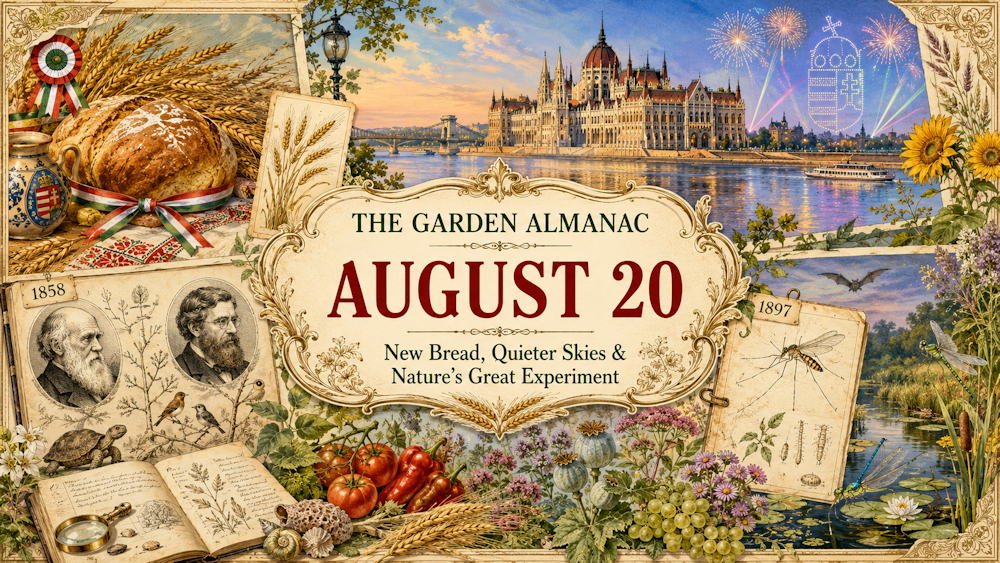
Hungary’s August 20 national holiday commemorates Stephen I, the country’s first king and the founder of the medieval Hungarian state. Stephen died in 1038, but the date is associated with the elevation of his relics and his canonisation on August 20, 1083. Over the centuries, the day accumulated several layers of meaning: a religious feast, a celebration of statehood, a political anniversary and, eventually, the country’s principal national holiday.
For gardeners and farmers, however, its most tangible symbol is not a crown but a loaf. August 20 is also known as the Day of the New Bread, when flour from the recently harvested wheat is used to bake and bless the season’s first ceremonial loaf. Although the modern nationwide tradition was shaped largely during the 20th century, it draws its emotional force from something much older – the relief and gratitude that follow a successful harvest.
Bread makes the agricultural year visible. A loaf begins in autumn or early spring with the sowing of grain, continues through winter survival, spring growth, flowering and grain filling, then depends on dry enough weather for harvesting and careful storage. By the time it reaches the table, it carries the story of soil structure, rainfall, temperature, seed selection and human work. For today’s gardener, the new bread is a reminder that even the simplest food is the final chapter of a long ecological process.
The evening celebration in Budapest is also changing in 2026. The traditional fireworks display, which previously lasted more than 20 minutes and sometimes approached half an hour, has been shortened to ten minutes. Pyrotechnic material already purchased before this year’s programme changes will be used, while projections on the Parliament building, drones, lasers, lighting and music will carry more of the visual story. No final decision has been made about abandoning fireworks in future years, but the government is considering public support as well as objections, while organisers have pointed towards alternatives such as architectural light shows and street celebrations.
That shift has a horticultural and ecological dimension. Shorter, more concentrated fireworks mean a shorter period of intense noise for pets, urban birds, bats and other nocturnal animals. Light projections, drones and public festivities are not impact-free, but they offer ways of creating spectacle with less smoke, debris and explosive disturbance. The most interesting question is therefore not whether a tradition must disappear, but how it can evolve – much as gardeners retain the purpose of an old practice while adapting its method to a changing climate and a more crowded living landscape.
Garden Reminder – What should you do in the late-August edible garden?
- Harvest tomatoes, cucumbers and courgettes regularly so plants continue producing.
- Remove damaged or diseased fruit promptly, but keep healthy leaves whenever possible.
- Water deeply in the morning rather than sprinkling the surface every day.
- Sow quick autumn crops such as radish, rocket, spinach and Asian leafy greens where summers are beginning to cool.
- Leave some sound seed heads on herbs and flowers for wildlife and next year’s sowing.
August 20, 1858 – When the Living World Acquired a New Story
On August 20, 1858, the joint work of Charles Darwin and Alfred Russel Wallace on evolution by natural selection appeared in print. Their ideas had already been presented to a scientific society in London in July, but publication made the argument available to a wider scholarly audience. Wallace had developed his thinking while studying the extraordinary biodiversity of the Malay Archipelago, while Darwin had spent years comparing wild organisms, cultivated plants and domesticated animals.
Natural selection can seem like a theory concerned with distant islands and deep time, yet its workings are visible in every garden. Plants vary. Some seedlings tolerate drought better than their neighbours; some flowers attract more pollinators; some weeds germinate earlier, spread faster or survive mowing. When particular traits help organisms reproduce under local conditions, those traits can become more common over generations.
This is why ecological gardening benefits from genetic variety. A garden filled with clones of a single cultivar may look perfectly uniform, but uniformity can create vulnerability to heat, disease or a newly arrived pest. Growing several cultivars, saving seed from healthy open-pollinated plants and including locally adapted native species creates a wider range of responses. Diversity does not guarantee that every plant will thrive – it increases the chance that something will.
Garden Science – Why do some plants cope with drought better than others?
Drought tolerance can come from several different traits. Deep roots may reach moisture below the dry surface, while small, hairy, waxy or grey leaves reduce water loss and reflect sunlight. Some plants temporarily close the pores in their leaves, slow their growth or shed foliage. Others complete flowering and seed production before the driest part of the year. A drought-resilient garden therefore works best when it combines plants with several survival strategies rather than relying on a single supposedly “drought-proof” species.
August 20, 1897 – The Mosquito Discovery That Changed Public Health
World Mosquito Day is observed on August 20 because on this date in 1897, Ronald Ross identified malaria parasites developing inside a female Anopheles mosquito in India. The discovery helped establish the mosquito’s role in malaria transmission and opened the way for more effective prevention. It also changed the way people understood the relationship between human health, insects, water and the management of inhabited landscapes.
For gardeners, mosquito control begins with an important distinction: ponds are not automatically the problem. A balanced wildlife pond with deeper water, moving surfaces and predators such as dragonfly larvae can support biodiversity without becoming a major mosquito nursery. The more troublesome sites are often small, warm, predator-free pockets of standing water – blocked gutters, uncovered water butts, saucers beneath pots, discarded containers and folds in plastic sheeting.
Inspect these places weekly during warm weather, because some mosquitoes can develop from egg to adult surprisingly quickly. Empty and scrub unused containers, keep gutters clear, cover stored rainwater with fine mesh and refresh bird baths regularly. Do not drain a healthy pond or apply broad insecticides indiscriminately – such measures can kill the predators that naturally help keep mosquito numbers in check.
Wildlife Note – Which garden animals eat mosquitoes?
Dragonflies, damselflies, aquatic beetles and other pond predators consume mosquito larvae. Adult mosquitoes may be taken by spiders, birds and bats, although none of these should be treated as a complete control system. The most effective wildlife-friendly approach combines predator-rich habitat with the removal or covering of small artificial water reservoirs where larvae can develop without natural enemies.
What to Observe Right Now – The Garden Between Two Seasons
Late August is an excellent time to notice where summer is holding on and where autumn has already arrived.
- Watch bees and hoverflies crowding late flowers such as oregano, asters, sedums and single-flowered dahlias.
- Look for the first mature seeds on poppies, grasses, sunflowers and perennial herbs.
- Notice which plants remain fresh after hot, dry weather and which wilt first – this is useful evidence for future planting.
- Check whether morning dew is returning to lawns, cobwebs and broad leaves.
- Listen for changes in bird activity as some species gather, disperse or begin seasonal movements.
- Observe where rainwater disappears quickly and where it remains standing – both patterns reveal useful information about soil and drainage.
These observations can guide practical decisions. Plants that repeatedly struggle may need a cooler position, improved soil or replacement with a better-adapted species. Areas that remain damp can become rain gardens or homes for moisture-loving plants, while the driest corners may suit Mediterranean herbs, ornamental grasses and deep-rooted perennials.
Looking Ahead
August 20 shows that traditions and living systems share an important quality – neither remains healthy by refusing to change. A ceremonial loaf asks us to value soil, seed and harvest; natural selection reminds us that diversity strengthens resilience; mosquito science shows how closely human health depends on careful habitat management. Even the move towards shorter fireworks and alternative public spectacles suggests that celebration can be redesigned with wildlife, resources and communities in mind. In the garden, the same principle begins with small choices: protect variety, observe before intervening and let good traditions grow into better ones.