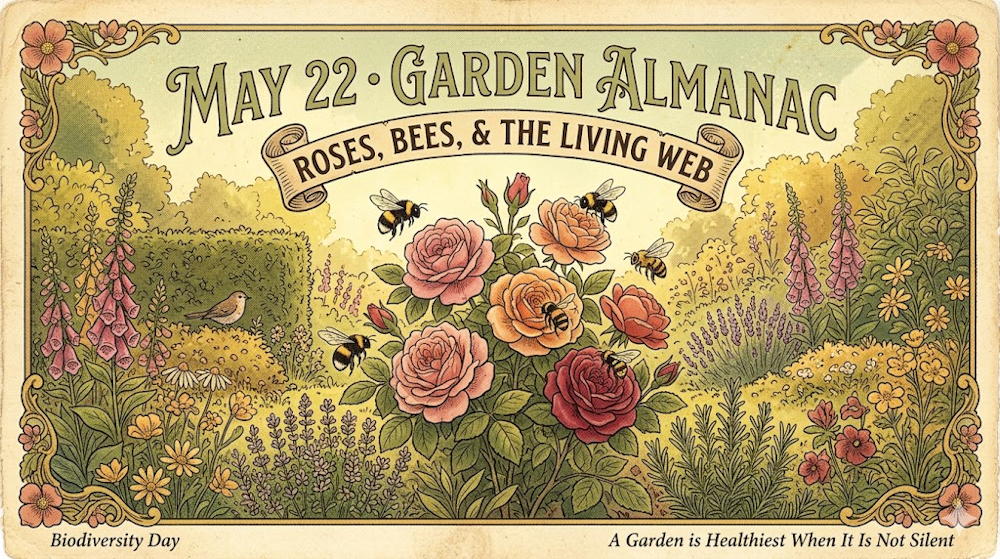

May 22 is a day of roses, bees, biodiversity and hope in the Garden Almanac. It brings together an old saint’s legend, a global environmental observance and a very practical garden truth: a garden is healthiest when it is not silent.
By late May, the garden is no longer waiting for spring. It is awake. Roses are opening, bees are moving from flower to flower, hedges are thickening, herbs are stretching toward bloom, and every corner seems to be doing something. This is the season when life becomes visible in layers.
Biodiversity Begins Close to Home
May 22 is the International Day for Biological Diversity. The word may sound large and official, but biodiversity is not only about distant rainforests, coral reefs or endangered animals on the other side of the world. It begins close to home.
It begins in the bee on a rose, the hoverfly above a herb flower, the worm in the compost, the bird in the hedge, the moss in a damp corner, the beetle under a log and the wildflower left standing in the grass.
A garden is not just a designed space. It is a living web. Every plant, insect, fungus, bird and soil organism plays a part in that web, whether we notice it or not. The more varied the garden, the stronger that web becomes.
Saint Rita’s Rose
May 22 is also the feast day of Saint Rita of Cascia, often remembered as a patron saint of difficult and seemingly hopeless situations. One of the most beloved legends connected with her is the story of a rose.
Near the end of her life, according to tradition, Rita asked for a rose from the garden of her old home, even though it was winter. The request seemed impossible, yet a blooming rose was found. The story is not important as gardening advice. It matters as a symbol: even where hope seems unlikely, life may still appear.
Gardeners understand this kind of hope. A frost-damaged plant sends up new growth. A rose thought lost breaks bud again. A dry-looking branch reveals green beneath the bark. The garden is full of small resurrections, and roses are among its most dramatic teachers.
They are beautiful, but they are not soft. They have thorns. They ask for pruning, patience and attention. They can be troubled by disease and still return with flowers. That may be why the rose has carried so much meaning across cultures: love, pain, endurance, beauty and renewal, all on one stem.
Bees Around the Saint, Bees in the Garden
Bees also appear in stories connected with Saint Rita, and in many traditions they symbolize diligence, order, sweetness and blessing. In the garden, however, bees are more than symbols. They are workers in the living system.
Honeybees, bumblebees, solitary bees, butterflies, hoverflies and beetles all help connect flowers with fruit and seed. Without pollinators, many gardens would be poorer in harvest, color and sound.
A pollinator-friendly garden does not need to be complicated. It needs flowers across the seasons, fewer unnecessary chemicals, some shelter, some water, and enough tolerance for life that is not perfectly tidy. A blooming herb, a patch of clover, a native shrub, a fruit tree, a wild corner: each can become part of the larger web.
The Beauty of a Less Silent Garden
A silent garden can look neat, but it may not be alive in the deepest sense. A living garden hums, rustles, flickers and changes. It has movement in the flowers, birds in the branches, insects in the grass and hidden work in the soil.
Not every wild plant is an enemy. Not every fallen leaf is waste. Not every untidy corner is neglect. Sometimes a less polished place is exactly where life finds room.
This does not mean abandoning the garden to chaos. It means gardening with more attention and less fear. Mow less often in one area. Let a few herbs flower. Keep a small log pile. Plant for pollinators. Avoid spraying when there is no real need. Leave some seed heads standing. Give the garden layers: trees, shrubs, flowers, herbs, vegetables, soil cover and shelter.
Acting Locally in the Garden
The great lesson of biodiversity is that small places matter. A balcony planter, a courtyard, a cottage garden, a community bed or a strip along a fence can all support life. The garden is one of the easiest places to turn concern into action.
On May 22, the message is not that every gardener must do everything. It is that every gardener can do something.
Plant a flower for bees. Keep a corner uncut for a little longer. Add water for birds and insects. Choose plants that feed more than the eye. Compost. Protect the soil. Notice what already lives nearby.
What May 22 Teaches
Saint Rita’s rose and Biodiversity Day may seem like very different observances, but in the Garden Almanac they belong together. The rose speaks of hope. The bee speaks of connection. Biodiversity speaks of survival through variety.
A garden without variety becomes fragile. A life without hope becomes hard. May 22 reminds us that both are renewed in small ways: through one rose, one bee, one living corner, one gardener willing to leave room for more than themselves.
The garden is not alive because we control every inch of it. It is alive because we allow relationships to happen.