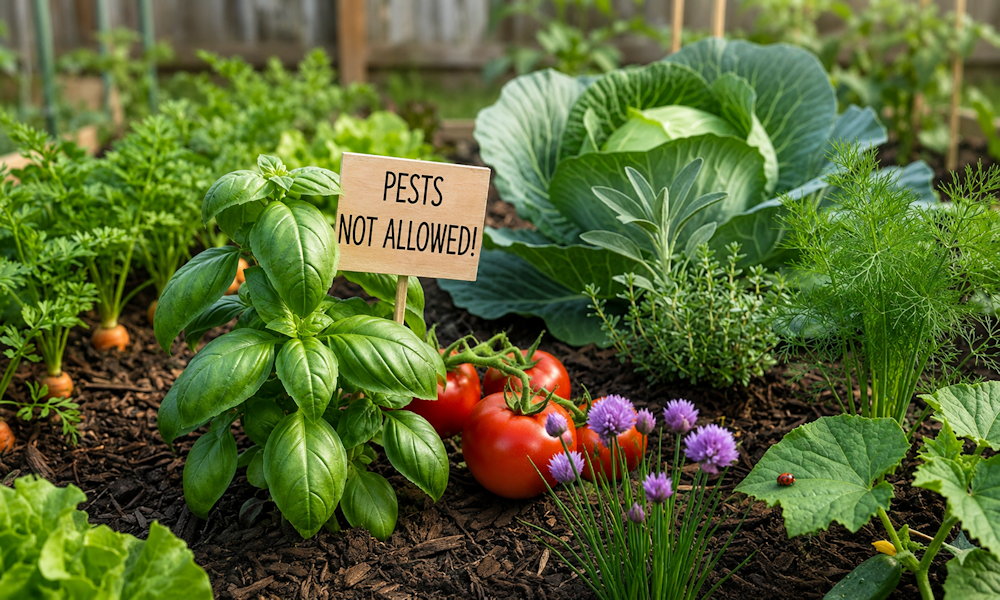

Herbs are often grown for the kitchen, but they can do much more than season a salad or lift a summer drink. In the vegetable garden, the right herbs can attract pollinators, support beneficial insects, add scent and structure – and make the whole plot feel more alive.
Companion planting with herbs is one of the easiest ways to create a more diverse, natural-looking and useful vegetable garden. You do not need to turn every bed into a herb garden. A few well-placed plants of basil, dill, chives, thyme or sage can bring beauty, fragrance and quiet practical benefits to your growing space.
The secret is not to plant herbs at random, but to match them with the right conditions – and with vegetables that enjoy similar growing situations.
Why Herbs Make Good Companion Plants
Many culinary herbs have strongly aromatic leaves. Their scent may help confuse some pests, especially in mixed plantings where vegetables are not growing in large, uniform blocks.
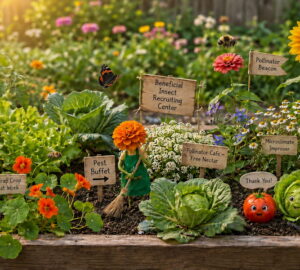
Flowering herbs can also be valuable for pollinators and beneficial insects. The small flowers of dill, coriander, fennel, thyme, oregano and chives are especially useful because they are easy for smaller insects to access.
A vegetable bed that includes herbs is often more varied, more attractive and more active with insect life – and it also gives the gardener something fresh to pick for dinner.
Basil: A Classic Partner for Tomatoes, Peppers and Aubergines
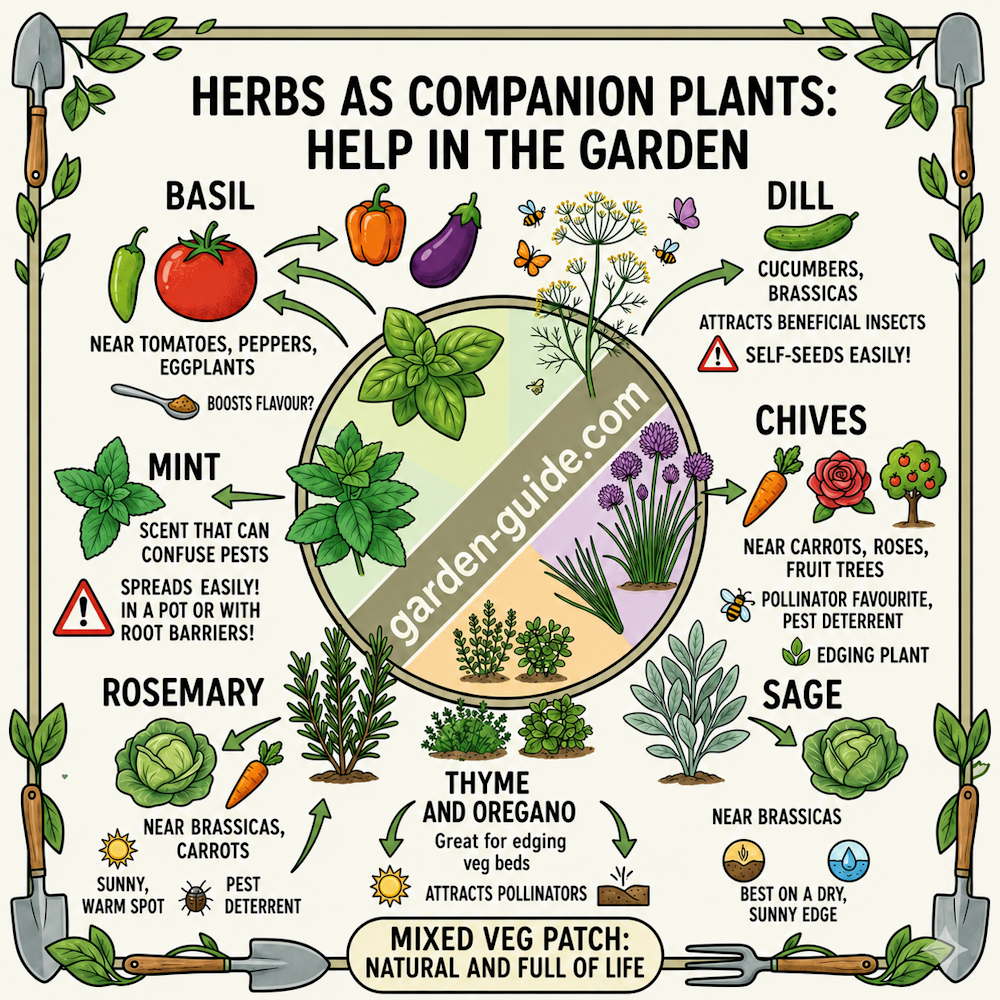
Basil (Ocimum basilicum) is one of the best-loved herbs for warm-season vegetable beds. It grows well near tomatoes (Solanum lycopersicum), peppers (Capsicum annuum) and aubergines or eggplants (Solanum melongena), because all of these plants enjoy warmth, sunshine and reasonably rich soil.
Gardeners often say that basil improves the flavour of tomatoes. That claim is hard to prove with certainty, but the two plants certainly make sense together. They like similar conditions, they look good in the same bed, and they are a perfect match in the kitchen.
If the garden and the plate both agree, that is usually a good sign.
Dill: Helpful Near Cucumbers and Brassicas
Dill (Anethum graveolens) is one of the most useful flowering herbs in the vegetable garden. Its airy umbels attract a range of beneficial insects, including hoverflies and parasitic wasps.
It is a natural companion for cucumbers (Cucumis sativus) – both in the garden and later in the jar, if you are making pickles. Dill can also be useful near brassicas such as cabbage, kale, broccoli and cauliflower (Brassica spp.), where it may help bring in insects that support a more balanced garden ecosystem.
There is one practical warning: dill can grow tall and self-seed freely. Let it flower, but do not let it take over unless you are happy to find surprise dill plants popping up next year.
Chives: Small, Pretty and Useful Around the Garden
Chives (Allium schoenoprasum) take up little space, have a strong onion-like scent and produce flowers that pollinators love. They can be grown near carrots (Daucus carota), lettuce (Lactuca sativa) and tomatoes, and they also work well as an edging plant.
Chives can even be planted near roses (Rosa spp.) or beneath young fruit trees in relaxed, mixed gardens. Their purple flowers are decorative, the leaves are edible, and the plants stay compact enough not to dominate a bed.
For small gardens, they are one of the easiest herbs to fit in.
Sage: Good Near Brassicas, But Choose the Spot Carefully
Sage (Salvia officinalis) is a strongly scented, drought-tolerant herb that is often recommended near brassicas. Its aromatic foliage may help make the area less straightforward for some pests to navigate.
However, sage and cabbages do not have exactly the same needs. Sage prefers full sun, sharp drainage and soil that is not too wet, while brassicas usually appreciate more moisture and richer conditions.
The best solution is to plant sage at the edge of a vegetable bed or in a nearby herb strip, rather than directly at the base of thirsty brassica plants.
Thyme and Oregano: Excellent for Sunny Edges
Thyme (Thymus vulgaris) and oregano (Origanum vulgare) are low-growing, aromatic herbs that work beautifully along paths, raised-bed edges and sunny borders.
When in flower, they attract pollinators. Even when not flowering, they add scent, texture and a Mediterranean feel to the garden.
Both prefer sun and well-drained soil, so they are not ideal for damp, heavily watered vegetable beds. Give them a drier edge or a raised position, and they will usually be much happier.
Rosemary: Useful, But Not for Every Vegetable Bed
Rosemary (Salvia rosmarinus) is a wonderfully fragrant evergreen herb, and many gardeners like to grow it near carrots or brassicas. Its strong scent can be useful in mixed plantings, but its growing requirements matter.
Rosemary wants sun, warmth and very well-drained soil. If your vegetable bed is regularly watered, heavy or damp, rosemary may struggle.
Instead of squeezing it between vegetables, grow it in a sunny herb border, raised bed or large container close to the vegetable garden. That way, it remains useful without being forced into the wrong conditions.
Mint: Lovely, Useful – and Far Too Enthusiastic
Mint (Mentha spp.) has a strong scent, attracts pollinators when it flowers and can be a useful plant near the vegetable garden. The problem is not whether mint grows. The problem is that it grows too well.
If planted directly in open ground, mint can spread aggressively by underground runners and quickly take over more space than intended.
For companion planting, mint is best kept in a pot, a raised container or behind a root barrier. This lets you enjoy the leaves and flowers without discovering, a few years later, that your entire garden has become a mint plantation.
Which Herbs Don’t Make Good Companions?
Not all herbs enjoy the same conditions. Basil likes more moisture and richer soil than many Mediterranean herbs. Thyme, rosemary and sage prefer drier, sunnier and better-drained places.
Planting all of them tightly together in one bed usually means that at least one of them will be unhappy.
Fennel (Foeniculum vulgare) also deserves special attention. It can inhibit the growth of some nearby plants, so it is usually better grown separately rather than placed directly among vegetables.
The Easiest Solution: Create a Herb Border
If companion planting feels complicated, start with a simple herb border around the vegetable garden.
On the sunnier, drier side, plant thyme, oregano, sage and rosemary. In richer, slightly moister areas, grow basil, dill, parsley (Petroselinum crispum) and chives.
This approach is practical, attractive and easy to manage. The herbs are close enough to support a more diverse garden, but each plant can still be placed where it is most likely to thrive. Harvesting becomes easier too – a quick handful of herbs for dinner is never far away.
Herbs Are More Than Decoration
Basil, dill, chives, sage, thyme, oregano, rosemary and mint can all play useful roles in a mixed vegetable garden. Some attract pollinators. Some support beneficial insects. Some bring scent and structure. All of them make the garden feel more varied and alive.
The key is to place each herb according to its needs, rather than expecting every plant to do the same job in the same conditions.
A good herb companion planting scheme is a little like a well-balanced seasoning blend: it is not about one powerful ingredient, but about the right combination. Get the balance right, and your vegetable garden can become more fragrant, more beautiful and more resilient – with plenty left over for the kitchen.