


May 12 marks one of the most practical caution-points in the spring almanac. With Pancras, the first of the well-known Ice Saints, the season reminds gardeners that warmth in May is not always the same as safety. The garden may look ready, but late cold can still test what has only just begun to flourish.
This is why the date matters so much. It sits at the uneasy threshold between confidence and restraint. Tender planting becomes tempting, blossoms are already open, and young shoots seem full of promise – yet a sudden chill, cold wind, or light frost can still quietly undo progress.
Pancras and the Memory of Late Cold
The Ice Saints tradition preserves a form of seasonal memory rather than a rigid rule. Pancras, followed by Servatius and Boniface, belongs to that stretch of mid-May when gardeners across central Europe have long remained wary. Whether or not the cold arrives exactly on schedule, the warning survives because the pattern is real enough to have shaped generations of practice.
In the Garden Almanac, this turns May 12 into a day of intelligent hesitation. It asks for attention rather than alarm.
Frost Does More Than Kill
One reason this date remains useful is that cold damage is not always dramatic. A late frost may blacken leaves or flowers outright, but more often it simply checks growth, stresses tender plants, or weakens the season before it has fully settled. A garden can be set back without looking ruined.
That is why older growers took these days so seriously. They knew that visible disaster was only part of the story.
Smoke, Cover, and Garden Prudence
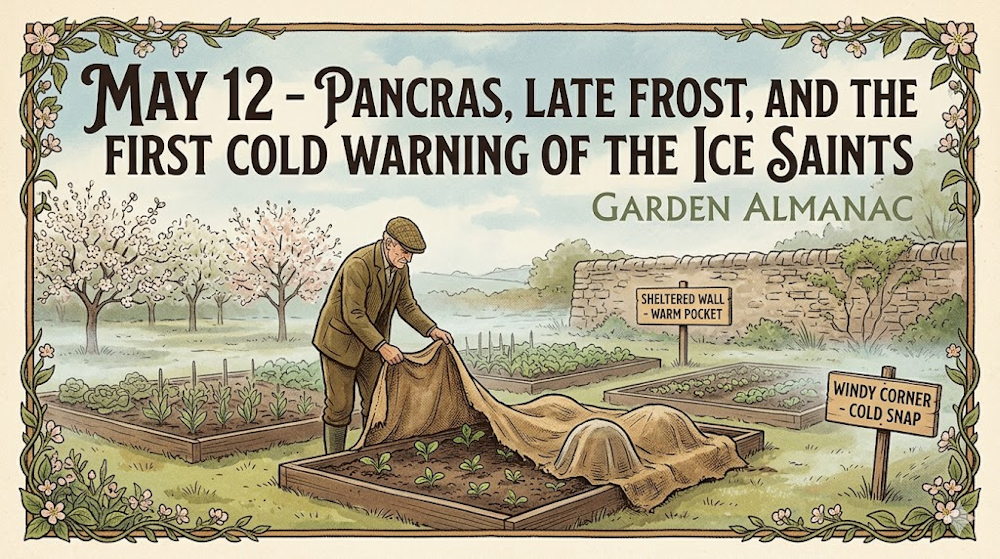
Traditional methods of protection often included smoke, coverings, and careful delay. The exact methods varied, but the principle was the same: do not surrender young growth carelessly to a night that may still turn hard.
This remains good almanac wisdom. The gardener’s task on a day like this is not to dominate the weather, but to reduce risk where possible and avoid needless haste.
The Garden’s Warm and Cold Places
May 12 is also a reminder that no garden is uniform. Sheltered walls, raised beds, low pockets, orchard edges, open ground, and windy corners all behave differently in a cold snap. Reading the garden well means knowing where spring has truly settled and where it is still only provisional.
That local knowledge is one of the oldest and most valuable forms of gardening intelligence.
What This Day Suggests in Practice
May 12 is a good day to review tender crops, delay what does not need rushing, protect vulnerable growth if a cold night threatens, and notice which parts of the garden reliably hold or lose warmth. It rewards patience more than ambition.
In the Garden Almanac, this is the first cold warning of the season’s most deceptive interval: the days that look safe enough to trust, and sometimes are not.