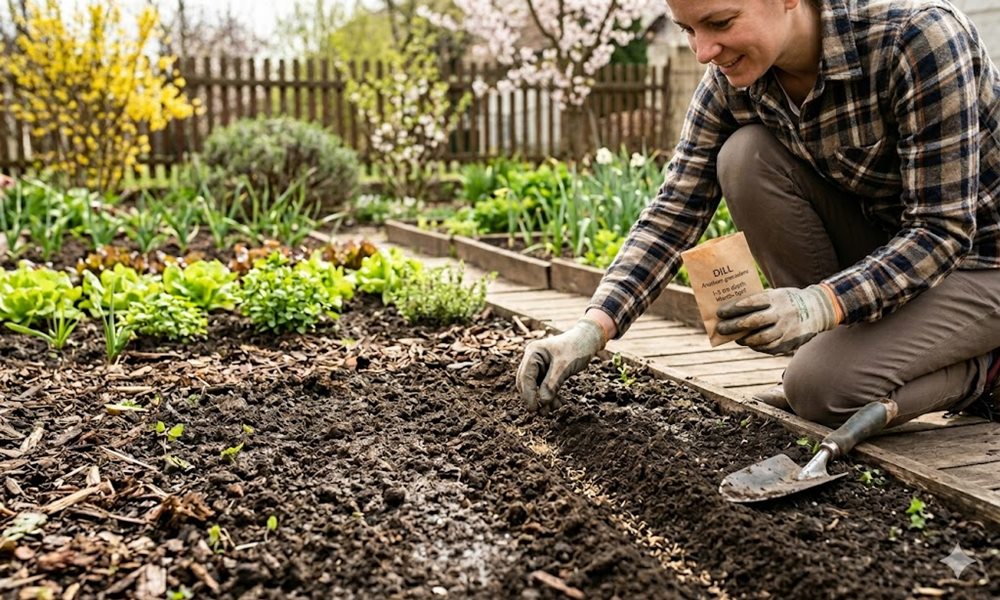

Dill is often treated as an easy herb: scatter the seeds, wait a little, and expect it to appear. In practice, successful dill growing depends more on timing and soil conditions than many gardeners assume. Dill, Anethum graveolens, is relatively cold-tolerant and can usually be sown from late March into April, once the soil is workable and no longer excessively wet. It does not require true summer warmth to begin growing.
Timing Matters, but Soil Matters More
Early sowing is possible, but very cold and compacted soil slows germination significantly. Seeds may remain inactive for a long time, increasing the risk of uneven emergence, drying, or patchy stands. Dill succeeds best when the soil is crumbly, lightly moist, and well prepared rather than simply when the calendar says spring has begun.
Germination Is Often Slower Than Expected
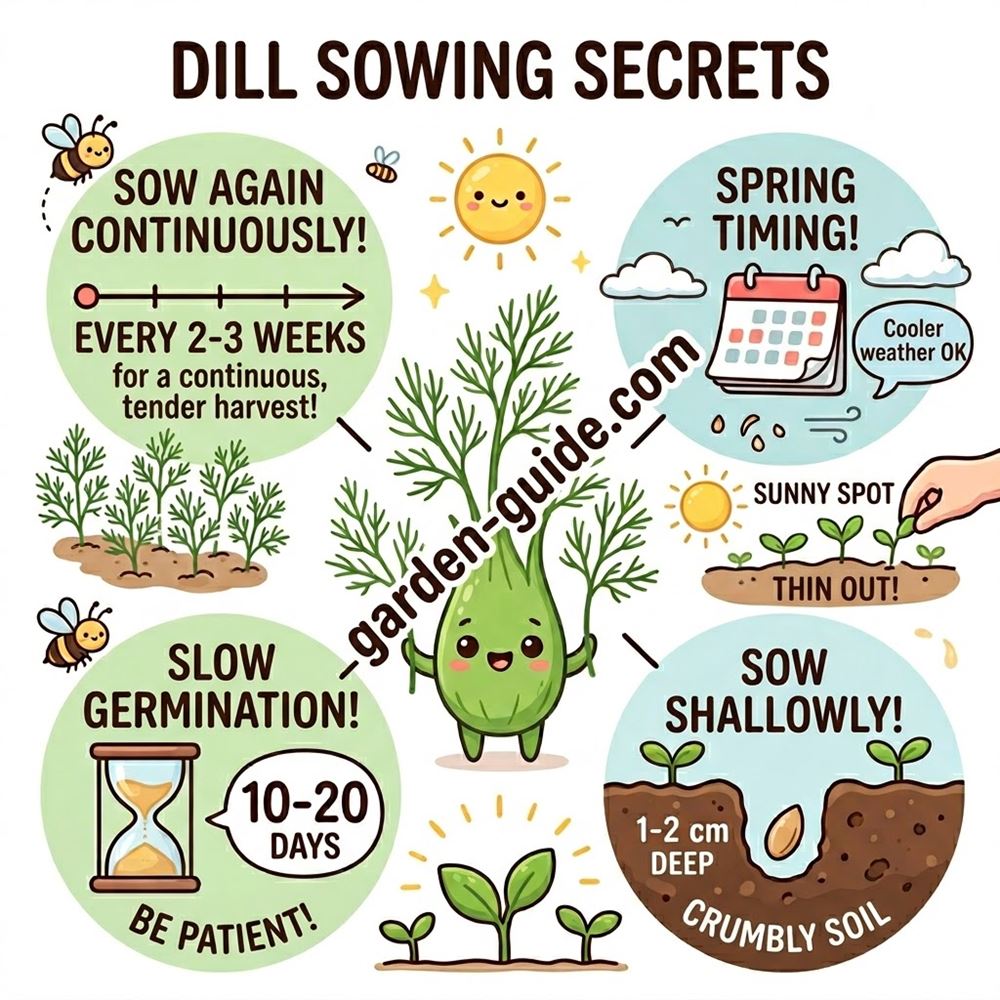
Under good conditions dill usually germinates in about 10–20 days, but cold soil can delay this further. Many gardeners assume the seeds have failed when in fact dill is simply taking its time.
Germination is influenced most strongly by:
- soil temperature,
- consistent moisture,
- correct sowing depth,
- a fine-textured seedbed.
Because dill seed is small, surface crusting or drying can make emergence difficult.
How Deep Should Dill Be Sown?
Dill is usually sown at about 1–2 cm depth. Too shallow and the seed dries out more easily; too deep and the seedlings struggle to reach the surface. A fine covering soil helps young shoots emerge more reliably.
Why Repeat Sowing Is So Useful
Dill is not a crop that stays in perfect leafy condition for months from a single sowing. As temperatures rise it tends to bolt relatively quickly. For a continuous supply of fresh dill, it is best to sow small batches every two to three weeks. This creates overlap between generations and ensures that young, tender plants are always available. This approach is especially useful for kitchen use, where steady harvesting matters more than one large flush.
Site and Growth Habit
Dill grows best in sunny, open locations, though it tolerates light shade. Overcrowded sowings tend to produce weaker, stretched plants, so thinning may be necessary after emergence. Very nitrogen-rich soil can encourage lush growth, but often with weaker stems and less concentrated aroma.
A Better Strategy Than One Big Spring Sowing
After the first sowing in late March or April, it usually works well to continue with repeat sowings through April, May, and even early summer, depending on how long a fresh supply is needed. If flowers or seed heads are desired for pickling and preserving, some plants should be left to mature fully instead of being harvested young.
Dill Is Easy – But Not Completely Automatic
Dill is not difficult to grow, yet the best results come when its small seeds and quick seasonal rhythm are taken seriously. Timing, moisture, sowing depth, and repeat sowing make the difference between a sparse stand and a truly useful crop.
Dill may seem simple, but like many simple garden plants, it performs best when treated with a little precision.