
March 1 is a calendar flip with real weight: in many weather and climate contexts, it marks the start of meteorological spring (March–April–May). It doesn’t guarantee warmth—what it guarantees is momentum.
Meteorological spring vs. the equinox
Meteorological seasons use tidy three‑month blocks. For gardeners, that’s a helpful mindset: you’re not chasing a single “first day,” you’re watching the pattern—soil drying, light increasing, buds swelling.
Baba Marta and the red‑white thread calendar
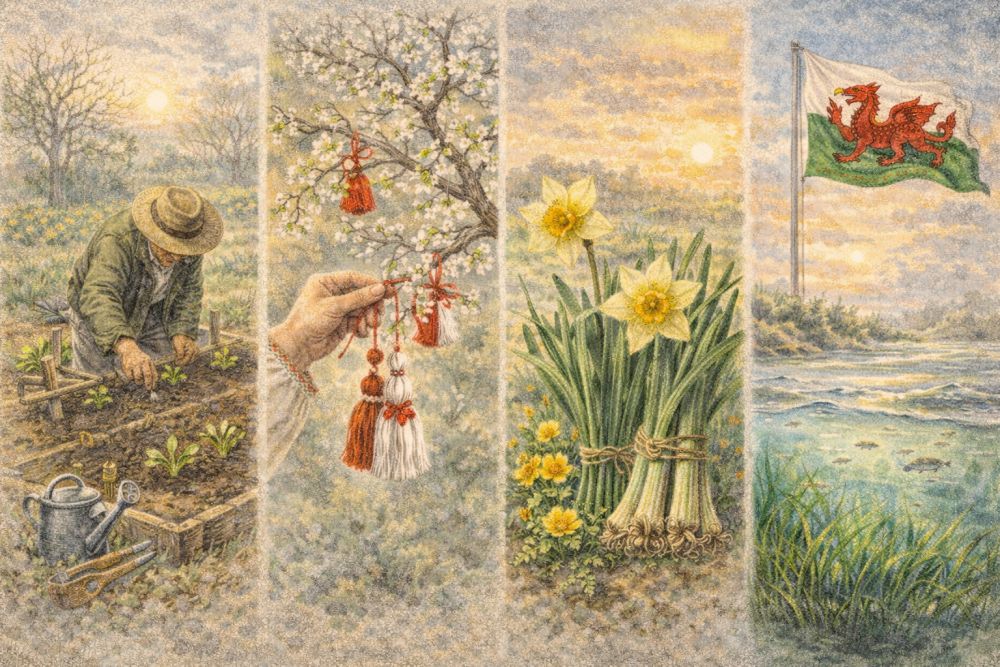
In Bulgaria, March 1 is Baba Marta Day, a spring‑welcoming tradition featuring red‑and‑white threads (martenitsa). They’re often worn until the first clear signs of spring—then tied to a blossoming tree.
Try a garden version: tie a small red‑white string to your notebook or pruners and keep it until your own first undeniable spring sign (first crocus, first bee, first real bud break).
Mărțișor: spring, told in the same colors
In Romania and Moldova, Mărțișor begins on March 1 with red‑white strings and tiny talismans—often worn until the first trees bloom, then left on branches as a wish for luck and good weather.
It’s a reminder that in the garden, the most honest calendar is flowering.
Wales on March 1: leek and daffodil
March 1 is also St David’s Day in Wales, and the symbols are plants: leek and daffodil—edible and ornamental, side by side. It’s a neat way to frame your own spring: food beds and beauty beds both matter.
Yellowstone: the conservation idea made official
On March 1, 1872, Yellowstone was established—often cited as the world’s first national park. For gardeners, the takeaway is small and practical: leave a corner wild, keep leaf litter where it helps, let biodiversity move in.
World Seagrass Day: underwater meadows, above‑ground lessons
The UN marks March 1 as World Seagrass Day, highlighting seagrass meadows as biodiversity engines that also help protect coasts and store carbon. Even if you’re far from the ocean, the principle translates: protect the living surface—keep soil covered, keep roots working, keep systems resilient.
Practical early‑March moves
- Sharpen, clean, and sanitize tools.
- Prune only when conditions match your plants and region.
- If you use dormant‑season sprays, let bud stage and local weather guide timing.
- Test older seeds and adjust sowing plans.
- Protect soil; avoid working it when it’s sticky or saturated.
- Refresh bird water and feeders.