
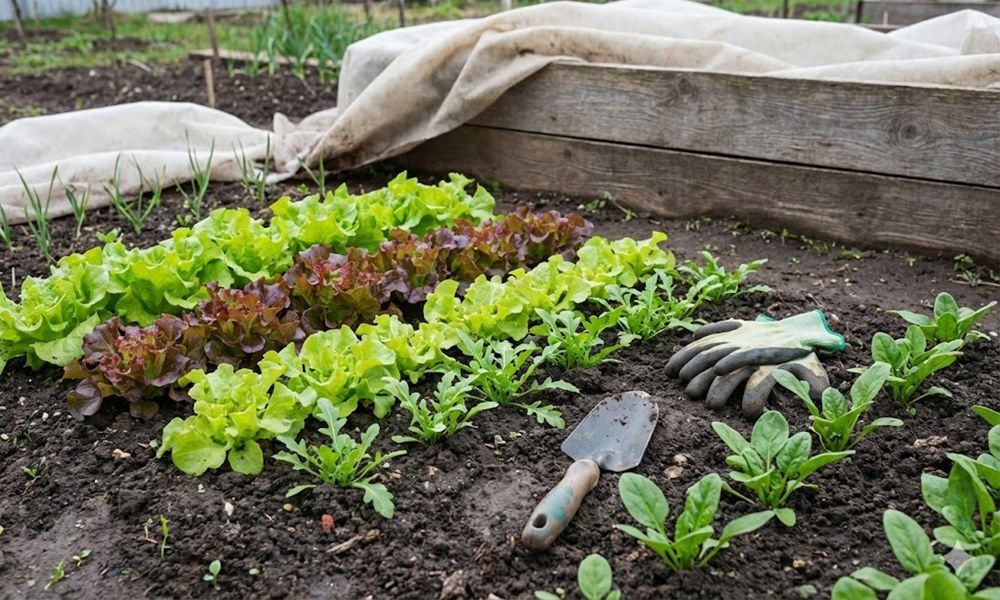

The kitchen garden does not begin in June. Those who understand this can harvest fresh leaves as early as March. Early lettuces and leafy greens provide quick success and help establish momentum at the start of the season. Many tolerate cool conditions far better than expected. The key lies in appropriate species selection and timing. Not every vegetable requires warmth.
Head Lettuce – A Reliable Foundation (Lactuca sativa)
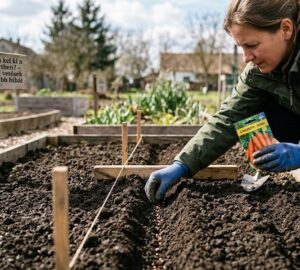
Head lettuce is one of the classic spring crops. It germinates at soil temperatures as low as 5–8 °C and forms compact heads in cool weather. It can be sown outdoors in March as soon as the soil is workable.
Consistent moisture is essential, though waterlogging must be avoided. Rising temperatures trigger bolting, making early sowing particularly advantageous. Under plastic tunnels or fleece covers, sowing can begin two to three weeks earlier.
Loose-Leaf Lettuce – Continuous Harvest (Lactuca sativa var. crispa)
Loose-leaf lettuce does not form a head but produces leaves that can be harvested gradually. This makes it especially suitable for smaller gardens and raised beds.
When sown in March, it develops quickly and can be harvested within a few weeks. Successive sowing extends the harvest period. It tolerates partial shade, which may be beneficial early in the season.
Arugula – Fast and Distinctive (Eruca sativa)
Arugula performs particularly well in cool spring weather. It germinates at 4–6 °C and produces harvestable leaves within three to four weeks. Its peppery flavor adds character even in small quantities.
In warm conditions it bolts rapidly, so March and early April sowings are the most reliable.
Spinach – A Cold-Season Favorite (Spinacia oleracea)
Spinach is a classic cool-season leafy vegetable. It germinates at around 5 °C and tolerates light frost. Sown in March, it is typically ready for harvest by late April or early May.
Adequate moisture and nutrient-rich soil support leaf production. As temperatures rise, spinach quickly bolts, making spring sowing the optimal choice.
Open Ground or Protected Cultivation?
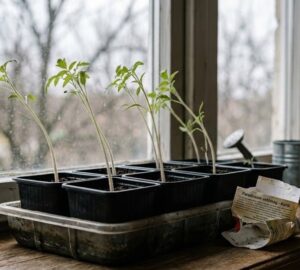
Simple fleece or plastic covers can advance the season by two to three weeks. Soil warms more quickly, and germination becomes more uniform. However, regular ventilation is necessary to prevent excessive humidity and fungal issues.
Sowing in open ground is equally successful in well-drained soil, provided compaction is avoided, as dense soil slows growth.
Quick Results with Strategic Planning
Early lettuces and leafy greens not only provide an early harvest but also allow efficient crop rotation. Spinach or lettuce can be cleared before tomatoes or peppers require the space.
A well-planned spring kitchen garden begins not with haste but with cool-season crops placed at the right time.