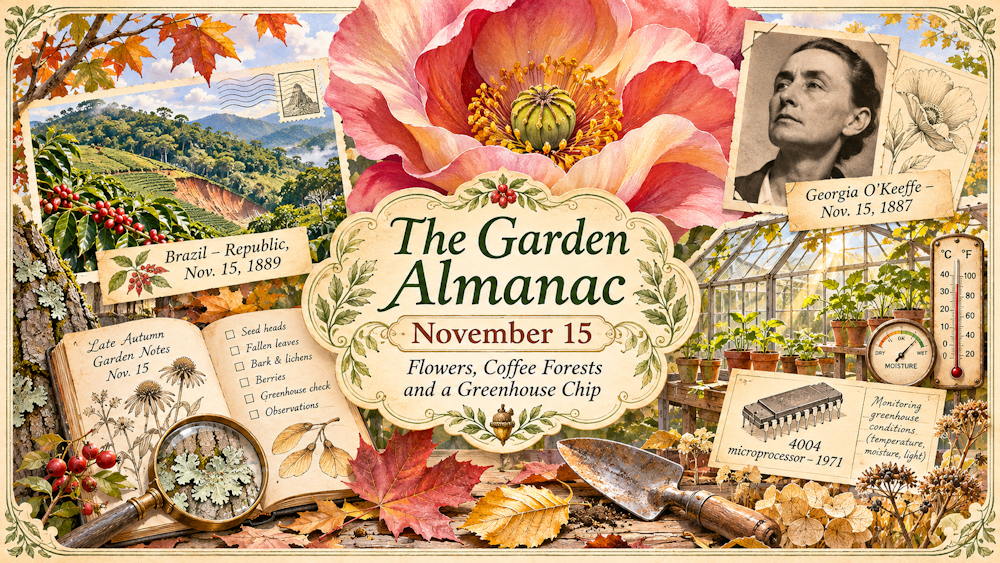

What happens when a flower becomes larger than life, a coffee plantation changes the fate of a forest, or a tiny electronic chip learns to control the temperature of a greenhouse? November 15 brings together three surprisingly different moments in the history of our relationship with plants and landscapes.
In Northern Hemisphere gardens, the middle of November is a season of smaller details. Fading flowers reveal intricate seed heads, bare branches expose their architecture, and the last vegetables await the first hard frosts. It is an ideal time to look more closely at the living world – and to discover how art, agriculture and technology have changed the way we see and manage it.
November 15, 1887 – Georgia O’Keeffe and the Flowers Nobody Had Really Seen
A flower can be small enough to overlook, yet large enough to fill an entire painting. That contradiction became one of the defining ideas of American artist Georgia O’Keeffe, born on November 15, 1887, on a dairy farm near Sun Prairie, Wisconsin. By the 1920s, she was creating extraordinary paintings in which petals, stamens and gently curving floral forms expanded across enormous canvases. Ordinary flowers suddenly became monumental landscapes of colour and shape.
O’Keeffe’s approach was revolutionary because it changed the scale at which people encountered familiar plants. Rather than painting a bouquet or a conventional botanical illustration, she moved so close to individual flowers that their details became almost abstract. The influence of modern photography was important, but her purpose went beyond visual experimentation. She wanted busy people to notice what they normally passed without a second glance. Her giant flowers challenged the assumption that something small and familiar could not also be extraordinary.
Her fascination with natural forms eventually carried her to New Mexico, where she began spending extended periods in 1929. The desert offered a different kind of beauty: bleached animal bones, weathered rocks, distant mountains and delicate wildflowers growing in apparently inhospitable surroundings. In paintings such as Summer Days (1936), she combined desert flowers with an animal skull suspended against the sky. The striking contrast reflected her fascination with the forms and textures of a landscape where life and decay were continually visible together.
For gardeners, O’Keeffe offers a wonderful invitation to change perspective. A fading echinacea flower reveals a beautifully structured seed head; the underside of a fern frond may display rows of reproductive structures; and a dry poppy capsule contains an ingenious mechanism for releasing seeds. Even November’s bare stems, bark and fallen leaves reward close examination. A magnifying glass or a smartphone camera can reveal details that are easily missed, while observing the same plant throughout the seasons shows how its form changes. Sometimes the most interesting part of a garden is not the whole border, but a single square centimetre.
What to Observe Right Now – The Garden Through an Artist’s Eyes
Take a closer look at the details of a mid-November garden.
- Seed heads: Examine the geometric patterns of echinacea, teasel, fennel or ornamental grasses.
- Winter buds: Look for the different shapes, colours and arrangements of buds on deciduous trees and shrubs.
- Leaf veins: Compare the branching patterns of fallen maple, oak and beech leaves.
- Bark and lichens: Observe the textures and colours that become more visible after rain.
Try photographing the same subject from several distances. A close-up often reveals an entirely different natural composition.
November 15, 1889 – Brazil’s New Republic and the Forests Behind Its Coffee Wealth
When Brazil became a republic on November 15, 1889, the country was already one of the world’s great agricultural powers. Coffee had transformed its economy, particularly in the southeastern provinces of Rio de Janeiro and São Paulo. But the familiar image of lush coffee plantations concealed a less obvious story: enormous areas of native Atlantic Forest had been cleared to make room for agricultural expansion.
The change of government ended the Brazilian monarchy, but the transformation of the landscape had begun decades earlier. Coffee cultivation spread across forested hillsides, often relying on enslaved labour before slavery was abolished in 1888. The industry’s economic influence helped shape the political conflicts surrounding the end of the empire. By the late nineteenth century, coffee was so important that its cultivation affected settlement patterns, railway construction and the distribution of agricultural wealth. The agricultural landscape was inseparable from the country’s social and political history.
One of the striking consequences was the deterioration of land that had once appeared extraordinarily productive. Repeated cultivation on exposed slopes, the removal of forest cover and inadequate soil management contributed to erosion and declining fertility in some established coffee-growing districts. In certain regions, abandoned plantations left behind depleted hillsides rather than flourishing farmland. Brazil’s Atlantic Forest remains one of the world’s great biodiversity hotspots, yet much of its original extent has been lost or fragmented. Today, restoration projects and more diversified agroforestry systems offer ways to combine agricultural production with tree cover, habitat protection and improved soil management.
The practical connection to gardening is especially clear on sloping ground. Vegetation intercepts rainfall, roots help bind soil, and fallen organic matter protects the surface from erosion. Bare earth is far more vulnerable to heavy rain than soil covered by plants or mulch. Where suitable, gardeners can use groundcovers, shrubs and deep-rooted perennials to stabilise slopes, while keeping paths and drainage routes designed to slow runoff. The history of Brazil’s coffee landscapes makes one point unmistakable: productive land can lose its fertility when the vegetation and soil beneath it are treated as expendable.
Garden Science – Why Does Bare Soil Erode So Easily?
Raindrops striking exposed ground can dislodge fine soil particles. Flowing water then carries these particles downhill, particularly where the surface is compacted or steep.
Vegetation and organic mulch help by:
- Reducing the impact of raindrops on the soil surface.
- Slowing runoff and allowing more water to infiltrate.
- Supporting soil organisms and the formation of stable soil aggregates.
- Providing roots that help hold soil in place.
On a sloping garden, planting and mulching are often more effective long-term solutions than repeatedly replacing soil washed away by rain.
November 15, 1971 – The Tiny Chip That Changed How We Grow Plants
On November 15, 1971, a newspaper advertisement announced something that would eventually transform everyday technology: Intel’s 4004 microprocessor. Developed initially for a Japanese calculator manufacturer, the chip contained approximately 2,300 transistors and placed a programmable central processing unit onto a single piece of silicon. Its remarkable significance was not simply that it was small, but that the same basic hardware could perform different tasks depending on the instructions it received.
Before general-purpose microprocessors became widely available, electronic control systems often required specialised circuitry designed for individual applications. Programmable computing made it increasingly practical to build more flexible and affordable devices. Over the following decades, microprocessors and microcontrollers found their way into countless systems, including agricultural machinery, irrigation controllers, environmental monitoring equipment and greenhouse climate controls. The original 4004 was not a garden device, but the technological approach it helped popularise would eventually reach almost every corner of modern horticulture.
Today, an automated greenhouse can monitor temperature, humidity and light, then operate ventilation, heating or irrigation equipment according to programmed settings. Soil-moisture sensors can help growers decide when irrigation is necessary, while environmental data loggers record conditions over time. However, automation does not eliminate the need for horticultural knowledge. A moisture sensor may register wet soil while roots are suffering from poor aeration, and an irrigation system can waste water if its settings are inappropriate. The most useful technology combines reliable measurements with an understanding of what plants actually need.
Garden Reminder – What Can Gardeners Monitor in November?
Even without sophisticated equipment, a few measurements can help protect plants through winter.
- Minimum temperatures: A simple minimum-maximum thermometer can reveal how cold a greenhouse or sheltered garden area becomes overnight.
- Soil moisture: Check beneath the surface before watering winter containers or protected crops.
- Ventilation: Open greenhouses or cold frames during suitable mild weather to reduce excessive humidity.
- Rainfall: A rain gauge helps explain differences between apparently dry and waterlogged areas.
- Light exposure: Observe where the low winter sun reaches plants and where shade persists throughout the day.
If using automated irrigation, adjust the schedule as growth slows and temperatures fall. Summer watering settings are rarely appropriate for winter conditions.
Wildlife Note – Why Are November Seed Heads Worth Keeping?
Faded flowers can be surprisingly valuable to wildlife. Across temperate gardens, many birds rely on seeds during autumn and winter, while insects may use standing stems and surrounding leaf litter for shelter.
Goldfinches are particularly associated with seed-bearing plants such as teasels and thistles. Finches and other small birds may also investigate sunflower heads and suitable wildflower patches. Not every ornamental seed head provides useful food, but leaving a varied selection standing can increase the opportunities available to wildlife.
Avoid cutting back every perennial immediately after flowering. Where plants are healthy and their stems remain structurally sound, leaving some standing until spring creates shelter, winter interest and possible feeding opportunities. Keep paths clear and remove diseased material where necessary.
What to Observe Right Now – The Garden’s November Signals
Notice where the frost settles first. Low-lying areas and exposed lawns may become frosty before sheltered borders. These differences reveal the garden’s microclimates and can help guide future planting decisions.
Look at the soil beneath fallen leaves. Compare its moisture and texture with nearby exposed ground. Organic cover can reduce direct rainfall impact and moderate changes in soil temperature.
Watch evergreen foliage after cold nights. Some broadleaf evergreens may curl or droop their leaves temporarily during freezing weather. This is not always a sign of permanent damage.
Observe the remaining flowers. In mild climates, late chrysanthemums, certain asters and other hardy perennials may still provide colour. Their performance can help identify useful plants for extending next year’s flowering season.
Looking Ahead
November 15 offers three different ways of understanding the natural world: Georgia O’Keeffe encourages us to notice overlooked beauty, Brazil’s agricultural history shows how closely farming depends on healthy landscapes, and the microprocessor revolution demonstrates what careful measurement can bring to horticulture. Together, they suggest practical opportunities for the seasons ahead. We can observe our plants more closely, protect the soil that supports them and make better-informed decisions about water, temperature and cultivation. Even as the garden enters its quietest months, there is still plenty to discover – and much to prepare for the next growing season.