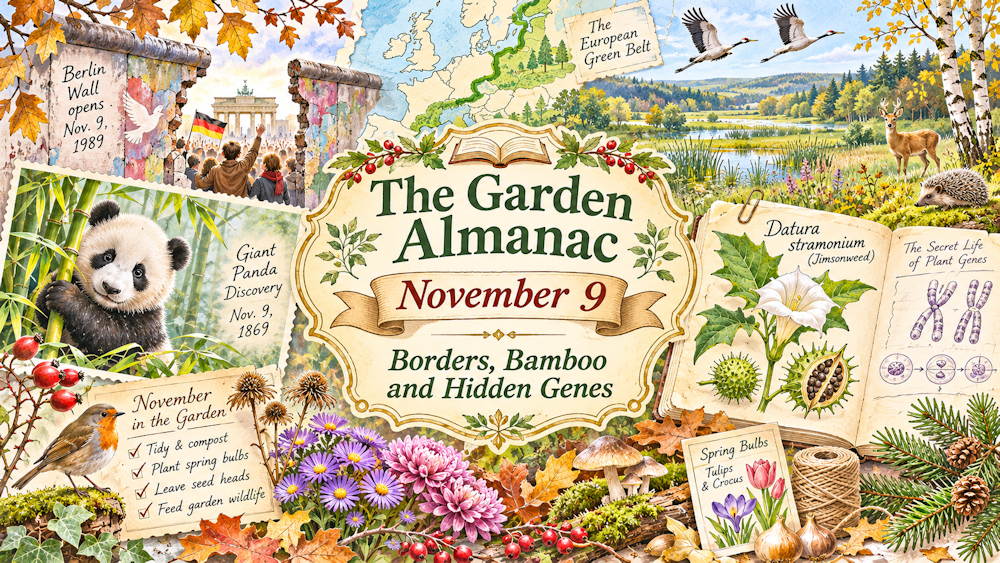

By early November, gardens across much of the Northern Hemisphere are settling into their winter rhythm. Fallen leaves gather beneath trees, seed heads stand against pale skies, and the last autumn flowers offer food to lingering insects. Yet even as the growing season slows, the natural world has plenty of stories left to tell.
November 9 takes us from a once-forbidden strip of European countryside to the misty bamboo forests of China, with a surprising stop in the world of plant genetics. Each story reveals something unexpected about the landscapes, plants and wildlife we encounter today.
November 9, 1989 – How the Iron Curtain Became a Green Lifeline
When the Berlin Wall opened on November 9, 1989, the world watched people cross a border that had divided families and nations for decades. But beyond the celebrations, another remarkable story was waiting to emerge. Along parts of the heavily guarded frontier between East and West Germany, wildlife had found an unexpected refuge.
For nearly four decades, large stretches of the border had been inaccessible to ordinary people. While surrounding countryside was increasingly transformed by intensive agriculture, roads and development, many habitats along the frontier experienced relatively little disturbance. Conservationists observing from the western side had already noticed rare birds and valuable natural habitats. What had been designed as a barrier to human movement had unintentionally helped preserve a chain of living landscapes.
After the border opened, conservationists from both German states moved quickly to protect this ecological inheritance. In December 1989, around 400 environmentalists gathered in the town of Hof to discuss preserving the former border strip. Their efforts helped establish the German Green Belt, a conservation corridor stretching roughly 1,400 kilometres through forests, grasslands, wetlands and river valleys. The idea later inspired the much larger European Green Belt initiative, following the former Iron Curtain across the continent.
The remarkable feature of this landscape is not simply the wildlife it shelters, but the connections it can maintain between habitats. A meadow, woodland or pond becomes more valuable when animals can move between suitable places to feed, reproduce and find shelter. Gardeners can apply the same principle on a smaller scale. A native hedge linked to a flower border, a pond surrounded by vegetation, or a narrow strip of unmown grass can help make a garden part of a larger ecological network. Even modest green spaces become more useful when they are connected.
Wildlife Note – How Can a Garden Become a Wildlife Corridor?
A wildlife-friendly garden benefits from routes between habitats, not just isolated shelters.
- Connect planting areas: Hedges, shrubs and perennial borders offer cover for birds, insects and small mammals moving through the garden.
- Reduce barriers: Where safe and appropriate, small ground-level gaps beneath fences can allow hedgehogs and other small animals to pass.
- Provide shelter: Leaf litter, dead wood and standing plant stems create valuable overwintering habitats.
A garden does not need to be large to contribute to a healthier local ecosystem.
November 9, 1874 – The Botanist Who Revealed the Power of Extra Chromosomes
A familiar garden weed helped transform our understanding of how plants grow. American botanist and geneticist Albert Francis Blakeslee, born on November 9, 1874, became fascinated by the extraordinary variations of jimsonweed (Datura stramonium). Some plants differed noticeably in their leaves, flowers and seed capsules, and Blakeslee wanted to discover why.
His research demonstrated how changes in chromosome number could alter a plant’s characteristics. He studied plants carrying extra individual chromosomes, as well as those possessing additional complete sets. Later, working with colleagues, he explored the use of colchicine, a substance capable of inducing chromosome doubling. This opened new possibilities for investigating plant development and breeding.
The effects of extra chromosome sets, known as polyploidy, are particularly interesting to gardeners. Polyploid plants may have larger cells, thicker leaves, bigger flowers or other altered characteristics, although the results vary considerably between species. Polyploidy occurs naturally and has also played an important role in developing cultivated plants. Many familiar crops, including bread wheat and strawberries, have complex chromosome histories. The flowers and fruit we admire are shaped not only by soil, sunlight and careful cultivation, but also by the remarkable biology hidden inside their cells.
Garden Science – Why Are Some Garden Plants Bigger Than Their Wild Relatives?
Chromosome number is one of several factors that can influence plant size and appearance.
- Polyploidy: Additional complete sets of chromosomes can sometimes produce larger plant cells and organs.
- Selective breeding: Generations of choosing plants with desirable characteristics can produce larger flowers, sweeter fruit or improved yields.
- Growing conditions: Water, nutrients, light and temperature strongly influence how much of a plant’s genetic potential is expressed.
A large flower does not necessarily indicate polyploidy. Nevertheless, plant genetics explains part of the extraordinary diversity found in modern gardens.
November 9, 1936 – A Tiny Panda and the Forest That Made It Famous
Deep in the mountains of China’s Sichuan region, November 9, 1936, brought an extraordinary encounter. American explorer Ruth Harkness and her expedition companions, including Chinese explorer Quentin Young, were searching for a living giant panda. In a cold, mist-filled bamboo forest, they discovered a small cub inside a hollow tree. The animal, later named Su Lin, would become the first living giant panda brought to the United States.
Su Lin attracted enormous public attention after arriving in America that December. At the time, giant pandas were still mysterious animals to much of the Western public. Today, their black-and-white appearance is recognised around the world, and the species has become an international symbol of wildlife conservation. Yet the history of capturing wild animals for display also raises questions about how our relationship with wildlife has changed.
Behind the panda’s popularity lies an equally fascinating botanical story. Giant pandas depend almost entirely on bamboo, a group of giant grasses that grow in the mountain forests of central China. Their feeding habits are highly specialised, and they require access to substantial quantities of suitable bamboo. Different species and plant parts may be preferred at different times of year. Protecting pandas therefore means protecting connected forest habitats with an adequate supply of food. It is a reminder that conserving a beloved animal often begins with understanding the plants on which it depends.
Garden Inspiration – What Bamboo Can Teach Us About Plant Selection
Bamboo is familiar as an ornamental plant, privacy screen and construction material, but its ecological importance extends far beyond gardens.
Some bamboo species spread vigorously through underground rhizomes and can become difficult to control. When selecting bamboo for a garden, check the mature height, growth habit and local regulations. Clump-forming species are often easier to manage than running types, although their suitability depends on climate and available space.
The panda’s dependence on particular bamboo habitats also illustrates a broader gardening principle: plant selection influences which animals can find food and shelter nearby. Native plants suited to local conditions are often especially valuable in supporting local wildlife.
Garden Reminder – What Should Gardeners Do in Early November?
In temperate Northern Hemisphere gardens, November is an important time to prepare for winter while protecting the living systems that will support next year’s growth.
- Plant spring-flowering bulbs: Tulips can often be planted in November where the ground remains workable and well-drained.
- Protect vulnerable plants: After the first frost, lift and store tender dahlia tubers where necessary, or protect suitable plants with mulch in milder climates.
- Check trees and shrus: Inspect stakes and ties before winter storms, making sure they support plants without damaging their bark.
- Make leaf mould: Collect fallen leaves into a ventilated container or dedicated pile, keeping some beneath shrubs for wildlife.
- Leave healthy stems standing: Many perennial stems and seed heads provide winter shelter for beneficial insects and food for birds.
Avoid working waterlogged soil, as digging or walking on it can damage its structure.
What to Observe Right Now – The Garden’s Quiet November Activity
November offers excellent opportunities to notice natural processes that are less obvious during the busy growing season.
Look beneath deciduous trees. Fallen leaves gradually become part of the soil’s nutrient cycle as fungi, microorganisms and soil invertebrates break them down. Their decomposition helps build organic matter and improve soil structure.
Watch the remaining seed heads. Goldfinches and other seed-eating birds may visit teasels, thistles and other plants that gardeners often remove too early. A standing seed head can serve as both winter decoration and a natural feeding station.
Notice which plants remain green. Evergreen shrubs, winter-growing groundcovers and some hardy perennials continue to photosynthesise when conditions allow. Their activity slows during cold weather, but the garden is far from completely dormant.
Observe the effects of the first frosts. Different plants respond differently to cold. Tender foliage may collapse overnight, while hardy species survive through protective physiological adaptations that help their cells withstand freezing conditions.
Looking Ahead
November’s quieter gardens offer an opportunity to rethink how we manage the spaces around us. The story of Europe’s Green Belt shows the value of connected habitats, plant genetics reveals the hidden complexity behind familiar flowers and crops, and the giant panda reminds us how closely wildlife depends on healthy plant communities. These ideas can guide practical choices, from creating wildlife corridors to selecting suitable plants and preserving winter shelter. As the growing season gives way to winter, a little thoughtful planning can help make next year’s garden richer, more resilient and more welcoming to life.