

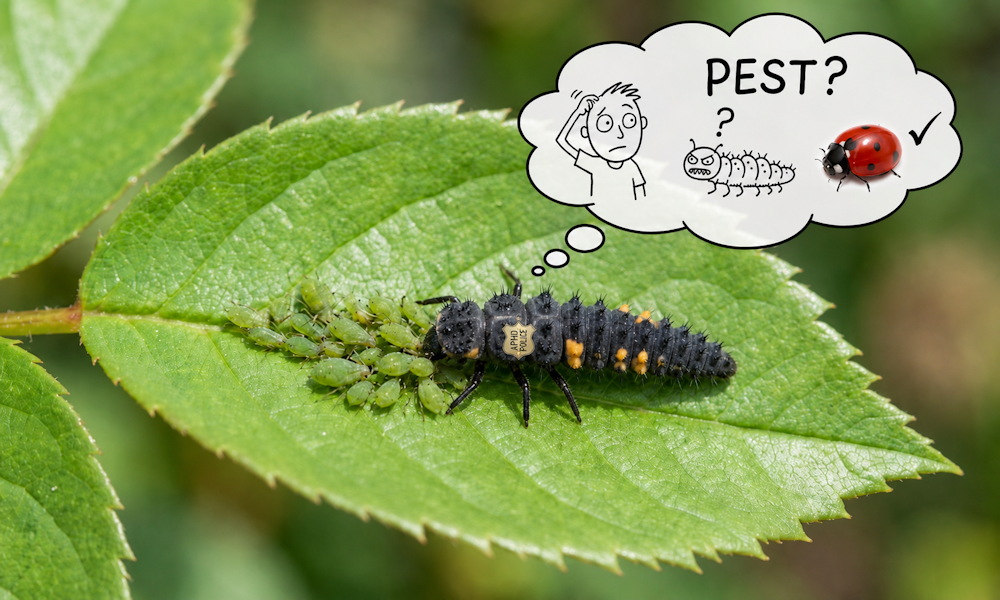

For most people, the word ladybird – or ladybug, as it is often called in North America – brings the same image to mind: a red back, black spots, a charming shape, perhaps even a childhood rhyme. Then, one day, they notice a small black, spiky “monster” crawling on a leaf, and their first thought is not, “How useful!” but rather, “This probably needs to be removed immediately.”
In reality, they may be looking at one of the ladybird’s hungriest and most helpful life stages.
How a Ladybird Develops
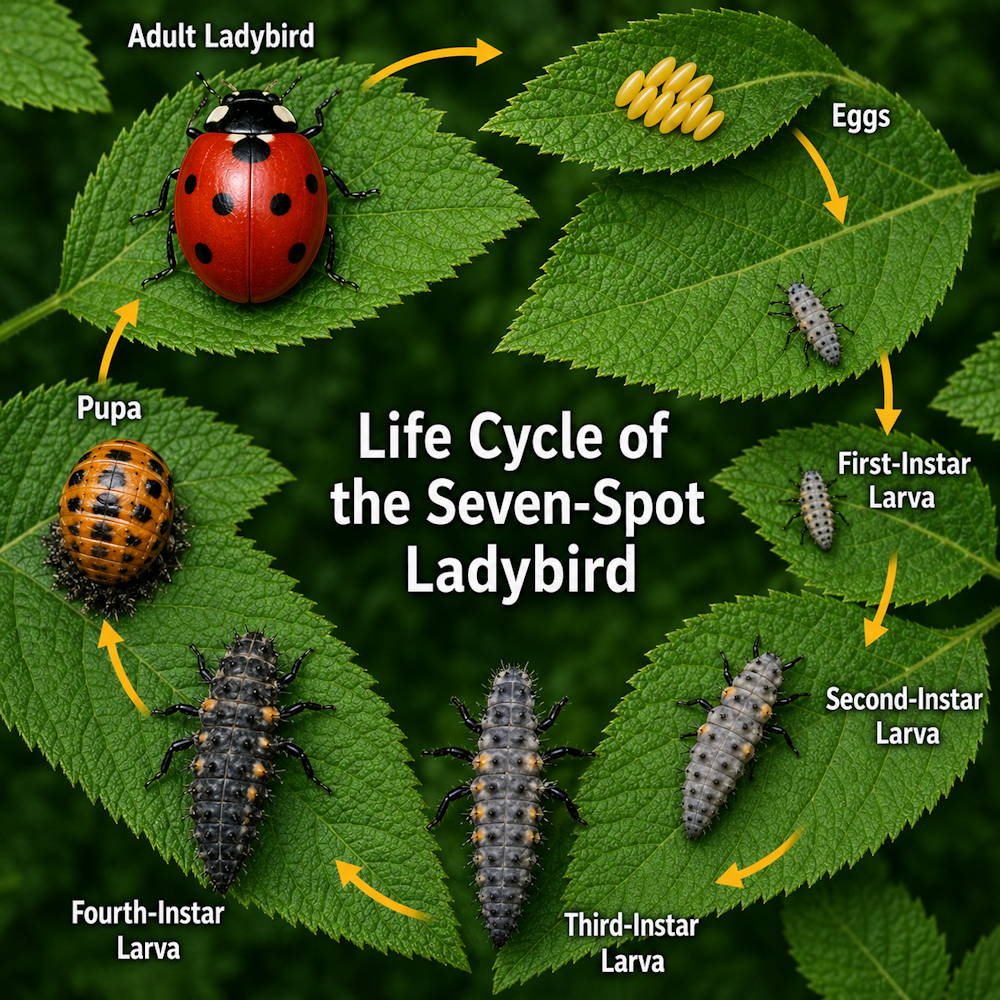
The development of the seven-spot ladybird is not a simple matter of a tiny spotted beetle appearing one day in its finished form. Ladybirds undergo complete metamorphosis: an egg hatches into a larva, the larva passes through several growth stages, then pupates, and only after that does the adult ladybird emerge.
In other words, before the familiar red, charming adult form appears, several very different-looking stages are already at work on the plants.
A Ladybird Does Not Start Life Looking Like a Ladybird
This is one of the most important lessons in the whole story. During the life cycle of the seven-spot ladybird, several forms appear that look strikingly different from one another. If someone only recognises the adult red beetle with black spots, they can easily mistake much of the animal’s life for something harmful.
Yet the eggs, larvae and pupae all belong to the same creature – the ladybird that gardeners are usually happy to see on aphid-covered shoots.
The Eggs: Tiny Yellow Clusters on the Underside of Leaves
Ladybird eggs usually appear in small groups, often on the underside of leaves or in places where the newly hatched larvae will quickly find food. This is no coincidence. A ladybird does not choose a romantic place for her eggs – she chooses a practical one.
The eggs are tiny, yellowish and elongated, and at first glance not everyone associates them with ladybirds. But once you learn to recognise them, you are already one step closer to understanding the small predator stories unfolding in the garden.
The Larva: One of the Garden’s Most Useful “Scary-Looking” Residents
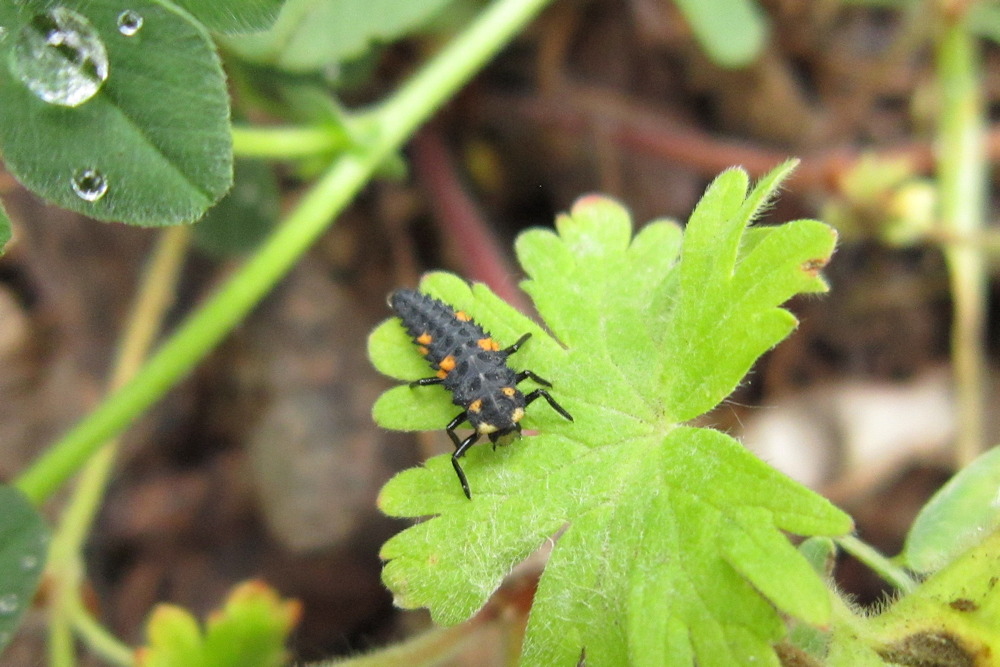
The ladybird larva is the stage where most misunderstandings happen. It is black, slender, mobile, often marked with orange or yellowish patches, and it looks nothing like what most people expect when they hear the word “ladybird”. At first sight, it may look more like a tiny armoured insect with suspicious intentions.
In fact, it is an aphid’s nightmare.
Ladybird larvae are highly voracious predators. They feed on aphids and other small, soft-bodied pests, and they are often even hungrier than the adult beetles. In plain terms: the creature that alarms many people on a leaf may be working for you on your roses, beans or fruit trees.
Why Are There Several Larval Stages?
Because the larva moults as it grows. It does not remain in one fixed form throughout its development, but passes through several stages. That is why early larvae are smaller and simpler in appearance, while later stages become larger, more clearly patterned and more robust.
This is completely normal. The larva is not “another insect”, but a different growth stage of the same developing individual. The gardening lesson is simple: it is not only the classic red beetle that deserves to be left alone, but also the strange black-and-orange larvae.
The Pupa: When It Looks as Though Nothing Is Happening, a Great Deal Is Going On
When the larva reaches the point of transformation, it pupates. The pupa no longer moves like the larva. Instead, it becomes a fixed, unusual little form attached to a leaf or another surface.
Many people do not recognise this stage either and assume that a dead or burnt-looking bit of insect has been left on the plant. But inside the pupa, one of the most dramatic rearrangements of the whole life cycle is taking place: this is where the adult ladybird is formed.
So if you see a motionless, orange-and-black, unusual shape in the garden, it may not be something to clean away. You may be disturbing a ladybird at one of the most important moments of its life.
The Adult Beetle Does Not Always Look Like a Storybook Ladybird at First
This is one of the best parts. A newly emerged adult ladybird is not always bright red and sharply marked straight away. Its colour may be pale at first, its pattern may not yet be strong, and only over time does it darken, harden, shine and take on its familiar appearance.
In other words, even the ladybird does not arrive in the world in full make-up. It needs time before it looks like the classic version everyone recognises.
Why Is This Useful for Gardeners to Know?
Because ladybirds really are valuable garden allies – but only if we do not destroy them out of ignorance while they are still larvae. Many beneficial insects are lost simply because gardeners recognise only the “beautiful final form” and automatically mistake the earlier stages for pests.
This is especially important during aphid season. If ladybird eggs, larvae or pupae are present on a plant, it often means that nature is already working on the problem. A panic-driven spray treatment may not only kill the aphids – it may also wipe out the helpers.
The Seven-Spot Ladybird Is Not the Same as Every Ladybird
The development shown here is that of the seven-spot ladybird, but it is important to know that not every ladybird looks exactly the same. There are many species, with different patterns, more varied colours, and larvae that are not identical either.
The basic logic, however, is similar: egg, larva, pupa, adult beetle. Once you understand this process, it becomes much easier to make sense of the tiny creatures moving around on your plants.
What Should You Do If You See One in the Garden?
In most cases, nothing – and in this case, that is a compliment. If you see ladybird eggs, larvae or pupae on a leaf, the best decision is usually to leave them alone.
Do not wash them off. Do not scrape them away. Do not spray them automatically. If aphids are nearby, there is a good chance you are looking at a functioning little predator system. It may not be pretty or cartoon-cute, but it is real.
The Final Truth: During Its Hardest-Working Stage, a Ladybird Often Does Not Look Like a Ladybird at All
This may be the best sentence in the whole story. In the garden, the most useful insect is not always the one that looks the prettiest. The ladybird’s life cycle is a perfect reminder of that.
Everyone loves the red, spotted beetle. Many people still look at its larva with suspicion. Yet that larva may be doing most of the work against aphids.
So the next time you are about to knock something off a leaf because it looks too black, too spiky or too strange, take a closer look first. You may not have found a pest at all – you may have found one of the garden’s hardest-working allies.