

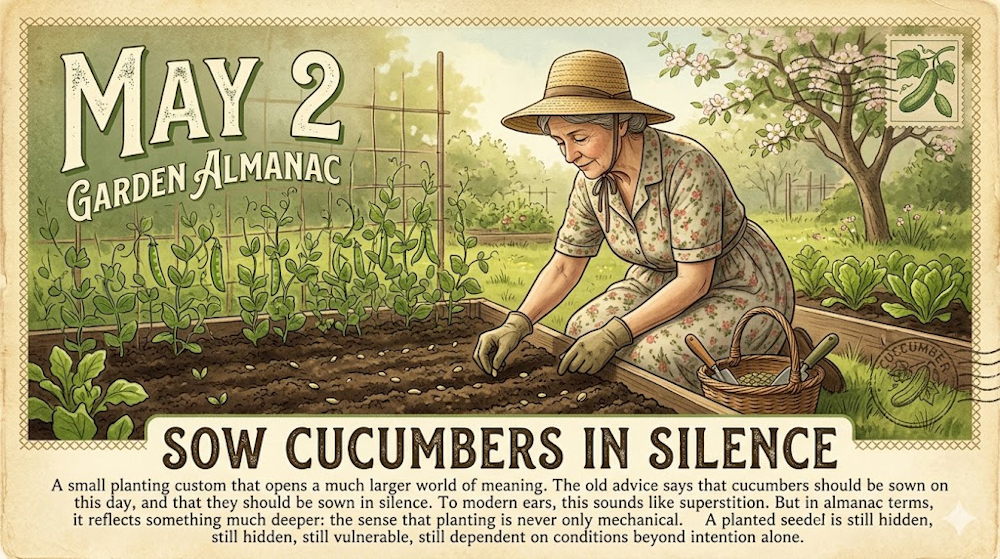

May 2 is one of those wonderfully specific almanac dates where a small planting custom opens a much larger world of meaning. The old advice says that cucumbers should be sown on this day, and that they should be sown in silence. Conversation was thought to interrupt success. Even gratitude for gifted seed was treated carefully, as if words themselves might disturb what had only just begun.
To modern ears, this sounds like superstition. But in almanac terms, it reflects something much deeper: the sense that planting is never only mechanical. It requires timing, attention, restraint, and a certain reverence for beginnings.
Why Silence Belongs to Sowing
Silence in planting customs often suggests more than magic. It points to concentration, seriousness, and respect. A seed placed in the ground is not yet a crop, only a fragile possibility. To sow in silence is to acknowledge that uncertainty.
Gardeners still understand this instinct, even without speaking of it in ritual terms. Some planting moments feel different from ordinary work. They ask for care rather than distraction, and for patience rather than confidence.
Cucumbers and the Logic of Warm Soil
This old date also makes practical sense. Cucumbers are warmth-loving plants. They do not welcome cold soil, and they respond poorly to backward weather. Early May has long been a natural threshold for thinking about such crops, because it sits near the point where spring begins to feel reliable enough for more tender sowing.
That does not mean every year behaves the same way. It means the tradition preserves a real horticultural intelligence: some seeds should wait for the season to mean what it says.
Words, Fortune, and the Fragility of Beginnings
The custom of not thanking someone for gifted seed belongs to a larger folk logic found in many planting cultures. Things not yet established should not be claimed too early. Promise is delicate. To speak as if success were already secured might seem to tempt failure.
Whether or not one believes this literally, the feeling is familiar. Every gardener knows the difference between hope and arrival. A planted seed is still hidden, still vulnerable, still dependent on conditions beyond intention alone.
Reading the Day in Practice
May 2 is a good day to think carefully about tender crops, soil warmth, moisture, and the atmosphere around sowing itself. It invites a slower pace. Check whether the ground is truly ready. Consider whether the season has settled enough. Plant not only with eagerness, but with tact.
In the Garden Almanac, this date belongs to quiet beginnings: the kind that do not announce themselves loudly, but may later fill an entire summer table.