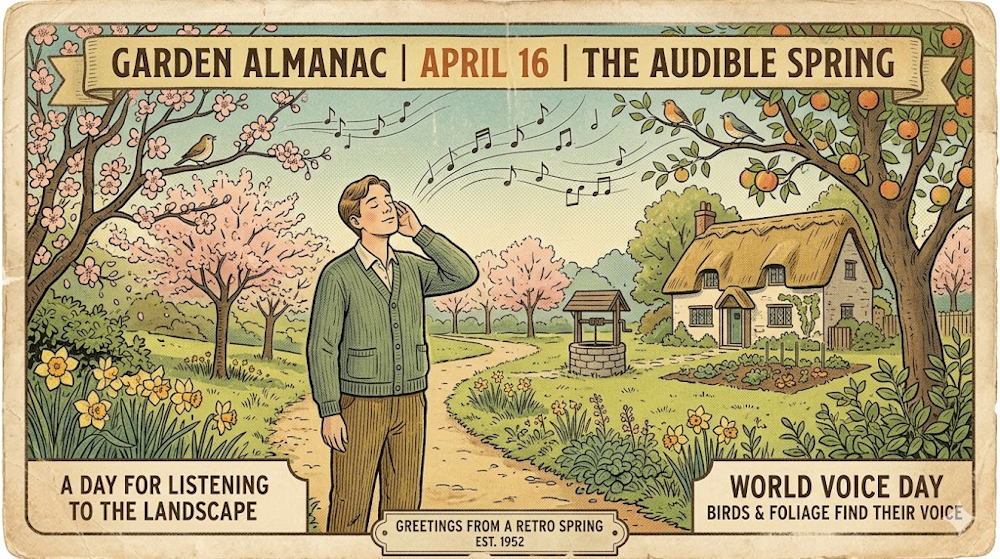

A Date Best Understood by Listening. April 16 is an unusually resonant date for a spring almanac because it invites attention not just to what can be seen, but to what can be heard. By this point in the season, spring is no longer only visible in buds and colour. It has entered the soundscape. Birdsong becomes more confident, wind moves differently through leaves, and the whole atmosphere feels less dormant and more articulate.
That makes April 16 a fitting day for thinking about voice, signal, memory, and how landscapes speak before they fully declare themselves.
World Voice Day and the Garden’s Own Language
April 16 is marked internationally as World Voice Day, a celebration of the human voice and the many ways it carries health, presence, and expression. In a garden almanac, this opens beautifully into a broader question: what does spring sound like?
A garden has its own language. It speaks in birdsong, rustling foliage, water movement, the hum of insects, and even in the changing quality of silence itself. One of the truest signs of spring is that silence grows more textured. The garden is no longer mute. It becomes conversational.
This is useful almanac knowledge. Seasons are not only seen in colour and measured in temperature. They are also heard in pattern, repetition, and intensifying life.
Saint Drogo and the Pastoral Ear
April 16 is also associated with Saint Drogo, remembered in Christian tradition as a patron of shepherds and herdsmen. That gives the date a pastoral dimension that fits naturally into a rural almanac.
Pastoral life depended heavily on listening. The experienced shepherd knew weather, movement, safety, and change not only by sight but by sound: the restlessness of animals, the quality of wind, the call of birds, the stillness before rain. This was not decoration. It was practical knowledge.
Gardeners inherit a quieter version of the same skill. A familiar garden teaches the ear over time. One hears when the place has awakened, when a dry spell has sharpened the air, when the birds have returned in earnest, or when the wind carries a warning rather than a blessing.
Memory in the Midst of Renewal
In Hungary, April 16 is also a day of remembrance for the victims of the Holocaust in Hungary. Even in a garden almanac, this matters. Renewal should not become amnesia. Spring is not valuable because it erases what came before, but because it shows that life can continue while memory remains intact.
This gives the date unusual depth. April 16 becomes a day of both voice and silence, of emergence and recollection. That tension belongs to spring more than it may first seem. The season carries joy, but also seriousness.
What To Notice In The Garden Today
April 16 is especially good for listening as carefully as one looks.
- Which sounds now define the garden that were absent a week ago?
- Where is birdsong strongest, and where does the garden still hold its breath?
- What is the wind saying about moisture, chill, or change?
- Which silence feels peaceful, and which feels expectant?
- What in the garden seems to be finding its voice?
- A good almanac date trains attention in more than one direction.
The Meaning Of April 16
April 16 gathers together voice, birdsong, pastoral knowledge, memory, and the slow articulation of spring. Through World Voice Day, Saint Drogo, and the quieter weight of remembrance, it becomes a day about listening well.
That is one of the season’s most overlooked lessons. Spring does not only bloom. It speaks.