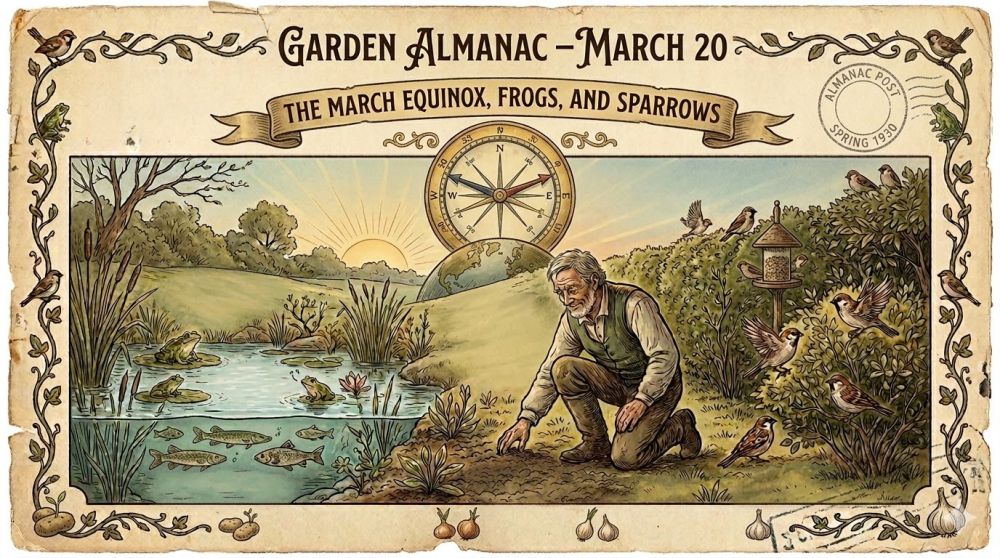

March 20 is one of the great hinge days of the year. In the Northern Hemisphere, it marks the March equinox and the beginning of astronomical spring, when day and night stand in near balance before the season tips decisively toward light. For gardeners, this is not just a fact of celestial geometry. It is the moment when the garden begins to feel different in the body before it is fully visible in the borders.
Before the garden fully declares spring, March 20 offers a quieter kind of revelation. It is a day that can be read in light, water, birdsong, and all the small changes that gather force before the season openly bursts into view.
A Day of Balance, a Season of Change
The equinox has long invited attention because it feels both exact and elusive. On paper, it is a point of balance. In practice, it is the start of momentum. Light lengthens, soil slowly warms, buds tighten and swell, and every living edge of the garden seems to lean a little more confidently toward growth.
This is why late March carries such power in seasonal writing across cultures. The shift is subtle but unmistakable. Nothing has fully arrived, yet very little is truly dormant anymore.
Water, Wetlands, and the First Movements of Spring
In Hungary, March 20 has also been observed as the Day of Native Fish since 2017, a date chosen because it falls at the very end of astronomical winter, when important changes are already under way in aquatic life. Pike spawning reaches its peak around this time, and other freshwater species soon follow with the first vulnerable stages of the new season.
That makes March 20 a useful reminder that spring does not begin only in flowerbeds and orchards. It begins in reed margins, ditches, ponds, marshy hollows, and half-hidden stretches of water where life stirs before many people notice it.
Frogs, Sparrows, and the Nearness of Life
The date is also linked with World Frog Day and World Sparrow Day, which together make an unexpectedly perfect garden pairing. Frogs belong to damp places, evening sound, and ecological balance. Sparrows belong to hedges, eaves, seedheads, and the ordinary intimacy of inhabited landscapes.
Neither is a grand symbol in the romantic sense. That is exactly why they matter. They remind us that a living garden is made not only of blossom and design, but of shelter, insects, water, seed, and small recurring presences that can easily vanish when a place becomes too tidy to be alive.
A Wider Sense of Renewal
March 20 is also Tunisia’s Independence Day, marking the country’s independence from France in 1956. That may seem far from the garden at first glance, yet it belongs naturally to the wider emotional register of the date. Around the equinox, many calendars hold ideas of return, emergence, release, and the recovery of one’s own rhythm.
A good almanac can notice these echoes without forcing them. Nature and history do not mirror one another neatly, but sometimes they share a mood.
What the Garden Asks Today
On a day like this, the garden asks less for grand action than for careful attention. Walk the beds. Look at the buds. Notice where moisture lingers, where birds return, where the ground has softened, and where wildness still has a chance to remain. The season is not yet secure, but it has unmistakably turned.
In the Garden Almanac, March 20 is the day when light stops merely promising spring and begins to build it.