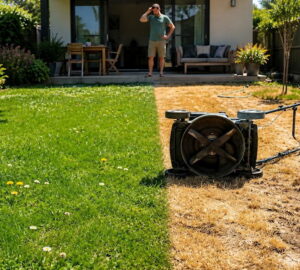




In early March, lawns appear dormant yet unsettled. Patches of dull grass, matted blades, and moss create the impression that intervention is urgent. However, spring lawn care depends less on calendar dates and more on soil conditions. Acting too early may cause more harm than benefit.

Understanding Turf Reactivation
Grass roots resume activity once soil temperatures consistently exceed 5–6 °C. Surface appearance may lag behind root activation. Working on saturated soil risks compaction and root damage. The key indicator is soil firmness — not air temperature.
Raking – Renewal or Disturbance?
Spring raking removes thatch and improves air exchange. Yet if performed on wet, cold soil, it may uproot viable shoots. Light raking becomes beneficial only when the surface has dried and new green growth is visible at the base. Timing determines whether raking revitalizes or weakens the turf.
Thatch and Moss Indicators
Excessive thatch often reflects imbalanced fertilization or poor aeration. Moss may indicate compaction, shade, or low pH. Mechanical removal alone does not resolve underlying causes.
Early Fertilization Considerations
Nitrogen application should coincide with active growth. Premature fertilization encourages soft tissue vulnerable to frost and disease. Soil warmth and visible growth are prerequisites.
Rolling – Conditional Use
Rolling may level minor frost heave but risks compaction if soil remains moist. It should be applied selectively and cautiously.
Strategic Patience
Healthy lawn recovery results from gradual activation aligned with soil readiness. Short delays often produce stronger seasonal performance than premature intervention.
Spring lawn care is not about urgency — it is about synchronization with soil and root physiology.