
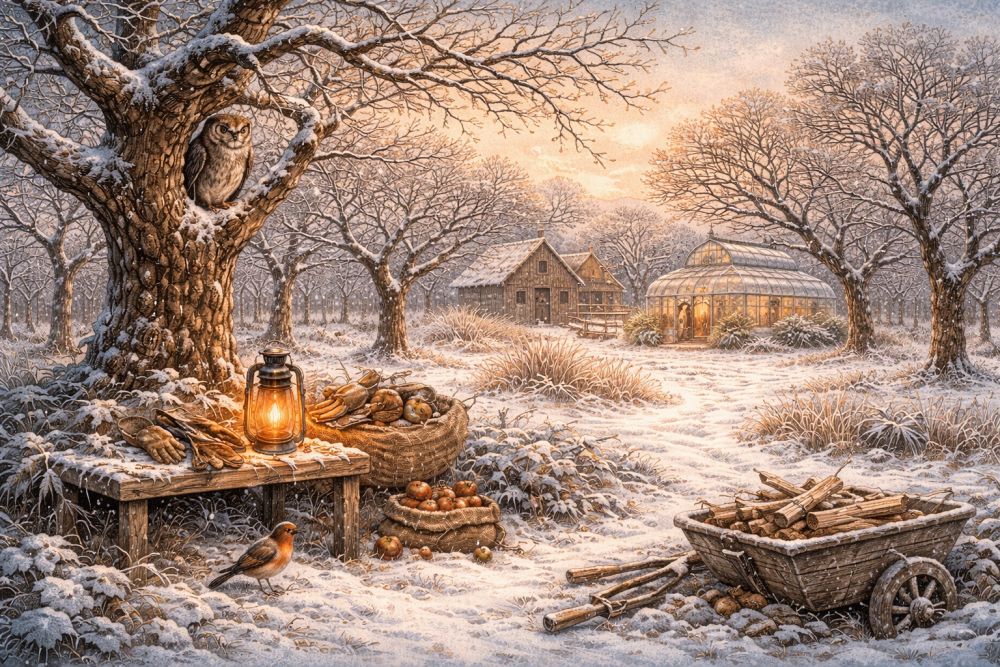

In old calendars, January 15 rarely carried the weight of a grand feast or a named holiday. And yet, across cultures and landscapes, it was quietly understood as a threshold day — a moment when winter stopped advancing and began, almost imperceptibly, to turn inward.
For gardeners, farmers, and observers of nature, this date marked something subtle but important: the sense that what happens now is no longer about growth above ground, but about decisions made beneath the surface.
A Day for Reading the Winter
In much of Central and Eastern Europe, mid-January was treated as a time of close observation. Weather on or around January 15 was watched carefully, not for immediate change, but for what it promised.
Clear skies were taken as a hopeful sign for seeds yet unsown. Persistent wind was thought to scatter the coming year’s luck. Moist air or gentle snowfall hinted at fertility — the quiet kind that builds slowly and lasts.
These beliefs were not superstition in isolation. They emerged from centuries of pattern-watching, when winter conditions often shaped spring floods, soil moisture, and the success of early crops.
When Trees Were Left Alone
A lesser-known but widespread belief appears in rural traditions from the Carpathian Basin to Alpine valleys: trees should not be cut, pruned, or disturbed around mid-January.
The reason given was poetic — that trees were “turned inward,” gathering strength for the coming year. To interfere was believed to weaken them, leading to poor fruiting or illness.
Modern plant science offers an unexpected echo. During deep winter dormancy, trees rely on stored reserves and hormonal balance. Disturbance during this phase can indeed increase stress, especially when followed by sudden temperature swings.
What folklore framed as respect, physiology now explains as survival.
Seeds, Counted but Untouched
January 15 was also a day of quiet reckoning. In farming households across Europe, stored grain and seed were often checked, counted, and re-packed during this period.
Importantly, seeds were not yet tested or planted. This was not a day for action, but for awareness — knowing what was available, what was scarce, and what decisions spring would require.
The practice reinforced an understanding still relevant today: planning is part of growing, even when the soil is frozen.
Echoes Beyond Europe
Similar ideas appear far beyond European traditions.
In East Asian seasonal philosophy, mid-January often aligns with the deepest expression of yin — the inward, conserving force of winter. From this point, the balance slowly begins to shift, though no visible change occurs for weeks.
Plants, in this worldview, are already preparing. Energy is stored, roots remain active, and life is reorganizing itself below ground. The garden may appear silent, but it is not idle.
The Garden’s Quiet Pivot
What unites these traditions is not a single myth or ritual, but a shared intuition: January 15 sits at winter’s inner hinge.
Growth has not begun. Cold still dominates. Yet something has changed. From this point on, winter is no longer deepening — it is being endured.
For gardeners, past and present, this day has never demanded work. It has asked for patience, observation, and restraint.
Why January 15 Still Matters
In a world that encourages constant activity, January 15 offers a different lesson. Not every stage of growth is visible. Not every important action involves movement.
The garden teaches that survival itself is a form of progress.
On this day, the most meaningful work remains unseen — happening in roots, soil organisms, and the quiet resilience of plants waiting for light.
And that understanding, passed down through calendars and customs across the world, is what makes January 15 a true entry in The Garden Almanac.