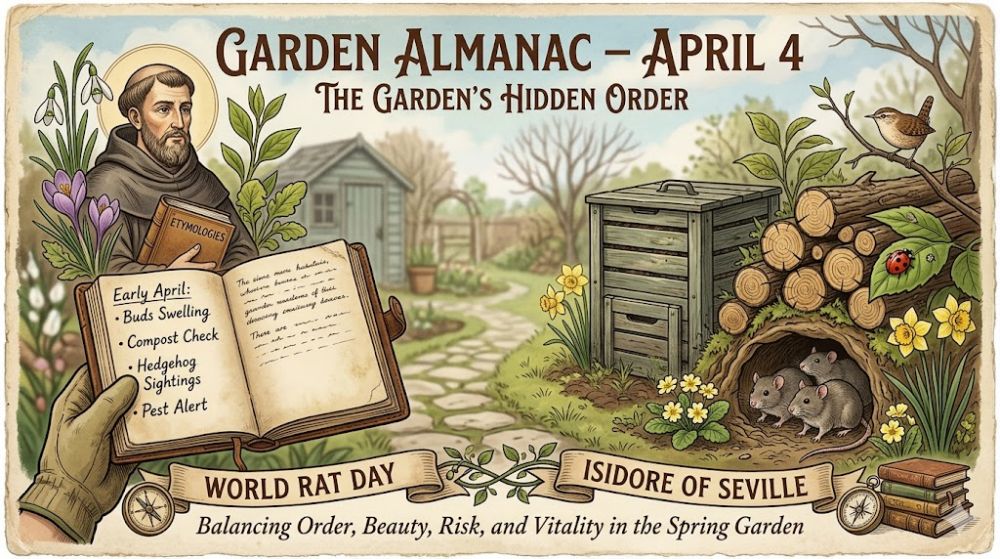

By early April, the garden has become visibly active, but it is still far from fully legible. Buds are swelling, birds are returning to familiar routes, insects are beginning to stir, and the soil is loosening into a new season. Yet some of the most important things happening now are not the obvious ones. They take place at the edges, under cover, behind structures, beneath surfaces, and in those overlooked corners gardeners tend to call untidy, awkward, or secondary.
That makes April 4 an unexpectedly rich almanac date. It carries the feast day of Isidore of Seville, remembered as a great compiler and organizer of knowledge, and it is also observed as World Rat Day, first established in 2002 to celebrate pet rats as companion animals. On the surface, these two associations seem unrelated. In a garden, however, they can be read together through one useful idea: not everything worth understanding is attractive at first glance, and not everything that shapes a living place does so in ways we immediately welcome.
Reading a Garden Beyond Its Beautiful Parts
A spring garden often invites selective attention. Blossom, birdsong, fresh green growth, and the first visible signs of abundance naturally draw the eye and the heart. But real gardens are never made only of charming things. They are also built out of decay, shelter, competition, vulnerability, concealment, and the constant negotiation between what supports life and what threatens it.
This is one reason gardening rewards a more complete form of perception. A border may look healthy while a problem is developing just beyond it. A compost area may serve as a biodiversity hub while also becoming attractive to unwanted visitors if managed carelessly. A quiet stack of timber may offer habitat to beneficial life, while a neglected storage zone may become a place where trouble settles in unnoticed.
To garden well is not simply to admire what is flourishing. It is to understand relationships: what is feeding what, what is sheltering what, what is signaling change, and what deserves attention before it becomes damage.
Isidore and the Desire to Make Sense of Things
Isidore of Seville is such a fitting figure for this day because he represents the impulse to gather scattered knowledge into order. His great encyclopedia, the Etymologies, tried to bring coherence to a wide range of subjects and remained influential for centuries. Gardeners do something similar, even if in a humbler and more local way.
A good gardener is always compiling an unwritten reference book. Which bed dries first after rain? Which wall creates the warmest pocket? Which tree attracts nesting activity? Which crop seems repeatedly vulnerable? Where do pests appear first? Which corners are genuinely wild and healthy, and which are simply unmanaged in ways that invite avoidable problems?
April is when these questions start to matter quickly. The season is accelerating, but not evenly. What seems minor one week can become decisive the next. Patterns noticed early can shape better decisions later.
The Uneasy Lesson of Hidden Neighbors
World Rat Day adds an unusual but valuable tension to the date. In a garden context, rats are not sentimental symbols. They are animals that can cause real problems, especially around stored food, compost, structures, edible crops, and hygiene. The Royal Horticultural Society notes that rats are common and adaptable mammals that may make homes underground or in compost, and it advises against using rat-infested compost on edible crops that will not be cooked.
That does not mean they need to become the whole story of the day. It simply means that the garden is most honestly understood when we admit that living systems contain discomfort as well as delight. Some forms of life support the garden visibly. Others exploit it opportunistically. Wisdom lies not in romanticizing or panicking, but in recognizing what is present and responding appropriately.
The Importance of Edges, Heaps, and Quiet Corners
One of the most useful habits for early April is to pay attention to the less glamorous parts of the garden. Compost areas, log piles, storage edges, hedge bases, fence lines, under-deck spaces, and hidden gaps behind sheds often tell the truth sooner than the ornamental center does.
These places can be excellent habitats. The RHS specifically recommends dead wood, log piles, dead hedges, and compost heaps as ways to create wildlife habitat and boost biodiversity. But these same zones also require stewardship. A garden’s rewilded corners are healthiest when they are intentional rather than abandoned.
That distinction matters. There is a real difference between a sheltered habitat and a neglected problem zone. A gardener who understands that difference can protect beneficial wildlife without inviting unnecessary trouble.
What This Day Suggests
April 4 is a good day to examine the garden as a whole system.
- Check compost areas for balance and cleanliness.
- Look into corners that are usually ignored.
- Notice which hidden spaces serve life well and which need intervention.
- Resist the urge to treat every sign of animal presence the same way.
- Let the day sharpen discernment rather than anxiety.
In the Garden Almanac, April 4 is not a day for pretending the garden is simple. It is a day for understanding that beauty, order, mess, risk, and vitality all overlap there. The more fully that complexity is seen, the better the garden can be tended.