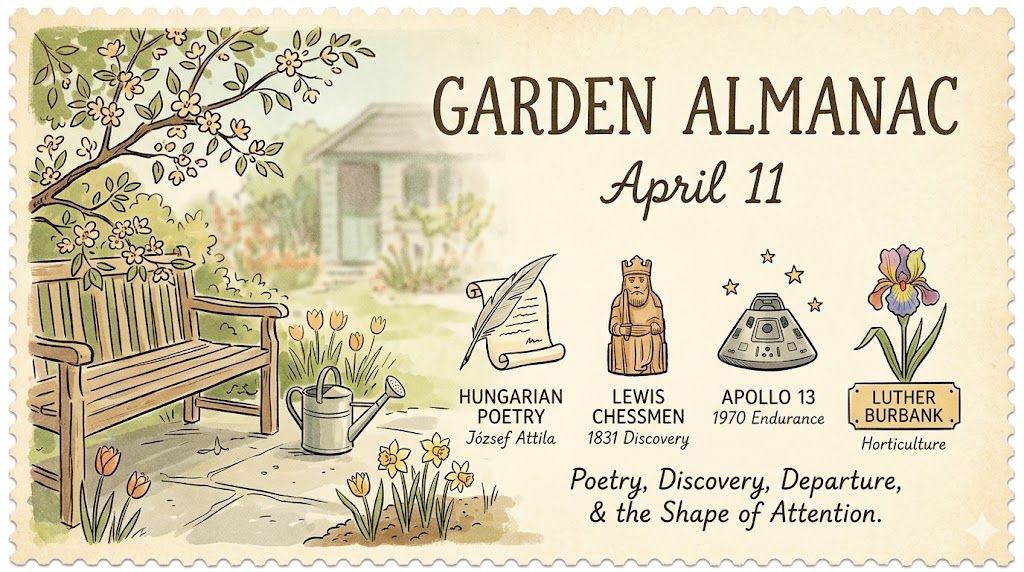

A Spring Date That Invites Meaning. April 11 is one of those dates that gathers strikingly different forms of human attention. In Hungary it is the Day of Hungarian Poetry, linked to the birth of József Attila. Internationally, it opens toward discovery, exploration, invention, trial, and horticultural legacy. It is a date that feels particularly at home in an almanac because it links language, memory, and practical life.
In the garden, early-to-mid April is also a season of sharpened attention. Spring is no longer merely anticipated. It is observable in detail. Buds become leaves, colour deepens, structure returns, and the year begins to reveal its direction. April 11 is therefore an excellent day for noticing how meaning often begins in close observation.
The Day of Hungarian Poetry
April 11 is observed in Hungary as the Day of Hungarian Poetry, held on the birthday of József Attila. This gives the date an unusual literary gravity. Poetry is one of the arts most closely tied to seasons, not only because it borrows imagery from nature, but because it depends on noticing transitions, textures, tones, and hidden correspondences.
That is why poetry belongs naturally in a garden almanac. Gardening and poetry both require discipline of attention. Each teaches that details matter, and that what appears small may hold the whole mood of the day.
The Lewis Chessmen on Display
One of the most memorable historical associations of April 11 is the first public exhibition in Edinburgh of the Lewis chessmen in 1831. These remarkable medieval carved pieces, discovered in the Hebrides, carry the atmosphere of a world half historical, half legendary. They are objects of patience, craft, memory, and survival.
This kind of discovery belongs beautifully in an almanac. It reminds us that the past does not disappear evenly. Some things remain buried until a season, a tide, or a chance encounter brings them back into view. Gardeners know this well. Every year the ground returns what seemed lost: bulbs, roots, forgotten seeds, old edges, last year’s intentions.
Apollo 13 and the Meaning of Endurance
On April 11, 1970, Apollo 13 launched from Kennedy Space Center. What began as a mission intended for the Moon became one of the most famous stories of crisis management and survival in the history of space exploration.
For an almanac, the significance lies not only in the technology, but in the theme of endurance under altered conditions. Spring itself often asks for this quality. Weather shifts, plans fail, seedlings suffer setbacks, and yet the season continues through adaptation rather than perfection. April 11 carries that lesson well: progress is not always the same as smooth success.
Luther Burbank and the Art of Plant Transformation
April 11 also recalls the death of Luther Burbank in 1926, one of the most influential horticulturists and plant breeders in modern history. His work with fruits, flowers, vegetables, and ornamental plants helped reshape what gardens and farms could become.
This gives April 11 a direct horticultural thread. Burbank represents the long dialogue between human curiosity and plant possibility. He belongs to the tradition of people who looked at living forms and asked not only what they were, but what they might become.
That question sits at the heart of every spring garden.
What To Notice In The Garden Today
April 11 is an especially good day for noticing both language and form.
- Which part of the garden already feels composed, almost like a finished sentence?
- Where is growth energetic but still unshaped?
- What has emerged this week that seemed absent only days ago?
- Which plant asks for intervention, and which asks simply to be observed?
- What in the garden today feels most deserving of a name?
An almanac date is never only about events elsewhere. It is also about what those events teach us to see where we stand.
The Meaning Of April 11
April 11 gathers together poetry, recovered history, endurance, and horticultural imagination. Through József Attila, the Lewis chessmen, Apollo 13, and Luther Burbank, it becomes a day about how humans pay attention — to words, to objects, to danger, to growth.
That is a fitting lesson for spring. The season does not merely unfold. It asks to be read.