
By November 17, many Northern Hemisphere gardens have entered their quiet season. Fallen leaves gather beneath bare branches, the last colourful flowers stand against the cold, and the soil begins its slow winter transformation. Yet this seemingly ordinary autumn date holds some remarkable stories about the natural world.
Today’s Garden Almanac travels from a canal that changed marine ecosystems to a botanist who helped explain familiar garden flowers, before following the first robotic explorer across the Moon’s dusty surface. Along the way, we discover why moving species can transform entire habitats, why plant names matter, and what makes the soil beneath our feet so extraordinary.
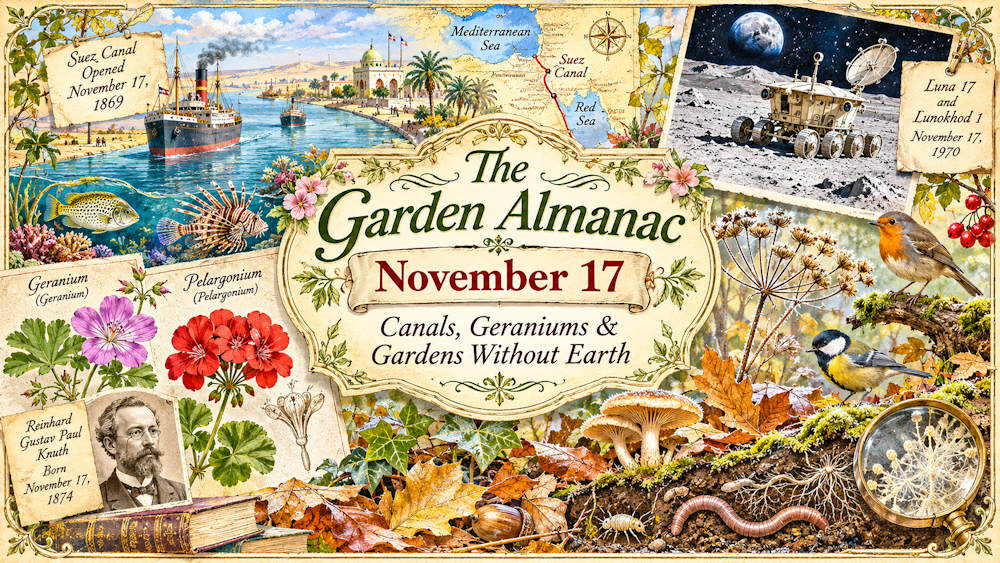
November 17, 1869 – The Canal That Opened a Door Between Two Seas
When the Suez Canal officially opened on November 17, 1869, the occasion was celebrated as a triumph of human engineering. After ten years of construction, ships could travel directly between the Mediterranean and the Red Sea without sailing around Africa. European royalty attended the spectacular inauguration in Egypt, and a procession of vessels passed through the new waterway. What nobody fully understood was that the canal had opened a passage for far more than ships.
The two seas had developed distinct marine ecosystems over immense periods of time. The canal created an artificial connection through which organisms could move between them. Over the following decades, fish, molluscs, crustaceans and other marine species gradually crossed from the Red Sea into the Mediterranean. Scientists now call this process Lessepsian migration, after Ferdinand de Lesseps, the canal’s principal promoter.
Some newcomers established themselves so successfully that they transformed local food webs. Red Sea rabbitfish, for example, can graze heavily on Mediterranean algae, reducing the underwater vegetation that provides food and shelter for native organisms. Warming seawater has made conditions increasingly favourable for many tropical newcomers. A waterway built to shorten commercial journeys has consequently become one of the world’s most striking examples of how human infrastructure can alter biodiversity.
This unexpected consequence has a direct parallel in gardening. Plants introduced for their beauty, rapid growth or usefulness can sometimes escape cultivation and spread into natural habitats. Japanese knotweed, for example, became a serious invasive problem in parts of Europe after its introduction as an ornamental plant. The important distinction is not simply whether a species comes from another country, but whether it spreads and causes ecological harm. Before planting an unfamiliar vigorous species, checking its behaviour and legal status locally can prevent problems that may take decades to resolve.
Garden Reminder – How Can You Prevent Invasive Plants from Spreading?
Late autumn offers a useful opportunity to inspect garden boundaries and manage unwanted growth before the following growing season.
- Check unfamiliar plants: Identify vigorous species before allowing them to spread or produce more seeds.
- Dispose of invasive material carefully: Some species regenerate from small root or stem fragments. Follow local disposal guidance rather than putting potentially viable material into ordinary garden compost.
- Choose suitable alternatives: Where possible, favour well-behaved plants adapted to local conditions, including native species that support local wildlife.
- Inspect shared boundaries: Look for spreading rhizomes, persistent seedlings and plants escaping into neighbouring land.
A responsible planting decision today can protect far more than the garden itself.
November 17, 1874 – The Botanist Behind the Geranium Mystery
A familiar red flower in a summer window box might seem an unlikely subject for scientific detective work. Yet the plants commonly called geraniums conceal a botanical distinction that still confuses gardeners. November 17 marks the birth of German botanist Reinhard Gustav Paul Knuth, who was born in Berlin in 1874 and became an important specialist in plant classification, particularly the geranium family.
Knuth studied the relationships, geographical distribution and adaptations of plants. His major 1912 treatment of the Geraniaceae family helped document a group that includes Geranium, Pelargonium and Erodium. Although these genera are related, they have different flower structures, growth habits and environmental requirements. The familiar balcony geranium is usually a Pelargonium, while many true Geranium species are hardy perennials that survive winter outdoors in temperate gardens.
The distinction becomes especially important in November. Most popular pelargoniums originate from warmer regions, particularly southern Africa, and need frost-free winter protection. Many hardy geraniums, meanwhile, can remain outdoors, their above-ground growth dying back while underground crowns and roots survive until spring. Knowing the botanical identity of a plant therefore reveals something useful about its natural habitat, seasonal behaviour and care requirements. A name on a plant label can be the beginning of understanding why one flower needs shelter while its close relative thrives through winter.
Garden Science – Why Do Some Geraniums Survive Frost While Others Cannot?
Winter hardiness depends partly on how plants protect their living tissues against freezing temperatures.
Many hardy perennial geraniums survive by keeping their growing points protected near or below the soil surface. During autumn, their metabolism changes and exposed foliage may die back while the plant remains alive underground.
Popular pelargoniums generally lack comparable frost tolerance. Freezing temperatures can damage their cells and growing tissues, particularly when ice formation disrupts cell membranes.
For gardeners, the practical difference is straightforward: protect pelargoniums in a bright, frost-free position, watering sparingly during winter, while leaving appropriately hardy geraniums outdoors in suitable, well-drained soil.
November 17, 1970 – The First Robot to Explore Another World’s Ground
On November 17, 1970, the Soviet spacecraft Luna 17 landed on the Moon in the region known as Mare Imbrium, or the Sea of Rains. Shortly afterwards, an eight-wheeled vehicle named Lunokhod 1 rolled down a ramp onto the lunar surface. It became the first robotic rover to explore the surface of another celestial body, controlled remotely by a team on Earth.
Lunokhod 1 was equipped with cameras and scientific instruments for investigating the Moon’s surface. During approximately eleven months of operation, it travelled nearly ten kilometres, transmitted thousands of images and examined the physical and chemical characteristics of lunar material. Its journey revealed details about a landscape covered not with familiar earthly soil, but with regolith – fragmented rock and dust produced largely through countless impacts and other space-weathering processes.
That difference becomes fascinating from a gardener’s perspective. Earth’s soil is much more than broken rock. It contains mineral particles, organic matter, water, air and communities of microorganisms that participate in nutrient cycling and decomposition. Lunar regolith contains minerals, but lacks the living biological system that develops naturally in terrestrial soil. Scientists studying the possibility of growing plants beyond Earth must therefore consider not only mineral nutrients, but also water availability, root conditions, potentially harmful compounds and the biological processes that make productive growing environments possible. A simple handful of healthy garden soil represents a complex ecosystem that the Moon does not naturally possess.
Wildlife Note – What Happens Beneath Fallen Leaves?
The living communities that make Earth’s soil so special remain active in many gardens during late autumn.
Earthworms, springtails, mites, fungi and bacteria help break down organic material and recycle nutrients. Their activity generally slows as temperatures fall, but decomposition can continue whenever moisture and temperature conditions allow.
Leaving some healthy fallen leaves beneath shrubs or in quiet border areas provides organic material and shelter for small organisms. As the leaves gradually decompose, nutrients return to the soil and contribute to the next growing season.
A layer of leaves may look motionless, but beneath it an entire community is helping maintain the garden’s fertility.
What to Observe Right Now – The Garden Before Winter
November is an ideal time to notice details that disappear beneath the abundance of summer foliage.
- Soil texture: Compare a bed rich in organic matter with an exposed, compacted area. Notice differences in crumb structure, drainage and earthworm activity.
- Overwintering plants: Look for the low-growing rosettes, buds and protected crowns that allow hardy perennials to survive winter.
- Seed movement: Watch how wind, birds and animals disperse seeds from plants that have completed their flowering season.
- Autumn fungi: After damp weather, observe mushrooms and other visible signs of fungal activity around decaying wood and leaf litter, without disturbing or consuming unidentified species.
These observations offer a closer look at the processes that keep a garden alive long after its most colourful season has ended.
Looking Ahead
November 17 reminds us that the living world is shaped by connections we do not always notice. A canal can change the inhabitants of a sea, a botanical name can reveal a plant’s needs, and a robotic journey across the Moon can make ordinary garden soil seem extraordinary. As winter approaches, gardeners can put these insights into practice by choosing plants carefully, protecting vulnerable species and caring for the organisms beneath the soil surface. The more closely we understand these relationships, the better prepared we are to create resilient, diverse and thriving gardens for the seasons ahead.