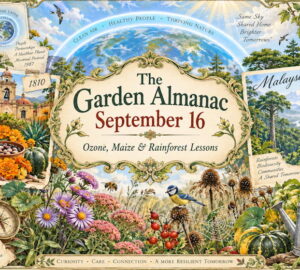
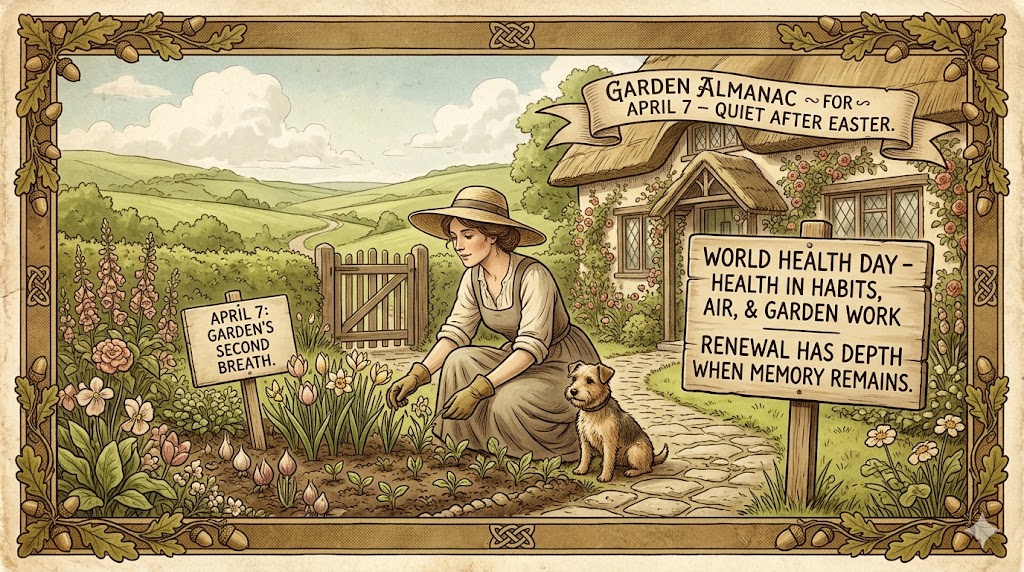

April 7 often arrives without drama, yet it carries an unusual weight. In 2026, it falls on the Tuesday after Easter, a moment when celebration has just passed but spring is still unfolding at full strength. The garden is no longer preparing for the season. It is already inside it.
This is the kind of day when the world seems to split into two rhythms at once: the wide, public rhythm of history and remembrance, and the small, private rhythm of soil, leaves, light and routine. April 7 holds both.
World Health Day and the Old Truth of Garden Work
April 7 is World Health Day, observed on the anniversary of the founding of the World Health Organization in 1948. In a modern sense, it is a global reminder to protect health through knowledge, science and access to care. In an older, quieter sense, it also points toward something gardeners have always known: health is built in habits, air, motion, food, rest and daily attention.
Spring gardening sits exactly at that crossroads. It asks the body to move, bend, carry, lift and slow down. It sharpens observation. It creates appetite, patience and a practical sense of proportion. A garden does not cure everything, but it has a way of restoring rhythm, and rhythm is often where recovery begins.
That is why April 7 fits so naturally into a garden almanac. It is not only a date on the calendar. It is a reminder that human wellbeing and the living world have never been separate stories.
A Date Marked by Memory and Resolve
April 7 is also observed by the United Nations as the International Day of Reflection on the 1994 Genocide against the Tutsi in Rwanda. That gives the day a solemn dimension. Not every calendar date should be cheerful. Some deserve stillness.
In an almanac, such moments matter because they keep time honest. A year is not made only of blossom, seed and harvest. It also carries memory, grief and the duty to remember clearly. Even in spring, not every day is light. April 7 reminds us that renewal has depth only when memory remains intact.
A Hungarian Spring Turning Point
For Hungary, April 7 also recalls the formation of the Batthyány government in 1848, one of the defining moments of a transformational spring. The date therefore speaks not only of nature awakening, but of civic momentum, public hope and the human urge to reshape the future when the season turns.
This pairing feels especially fitting in early April. Spring has always been the season of visible change. Buds swell, roads dry, fields open, and people begin again with unusual conviction. The political and the seasonal often move with the same emotional charge: a sense that the year can still be altered.
David Fairchild and the Journey of Useful Plants
April 7 is also the birthday of botanist and plant explorer David Fairchild, a figure whose work helped reshape modern agriculture through the movement of useful plants across borders and climates. He belongs to that remarkable class of people who changed the world not by conquering land, but by noticing what could grow where.
For gardeners, this is a beautiful thought for the day. So many crops, fruits and ornamental plants we now think of as ordinary once travelled vast distances in the minds, notebooks and seed collections of curious people. A garden is often more global than it looks.
What Early April Still Teaches
Traditional weather lore across Europe treated early April with respect. The greenery may have begun, but trust had to be earned. A warm spell could still be followed by a sharp morning chill. An eager gardener could still be humbled by one careless night.
That caution remains useful. April 7 is a fine day for sowing, checking structure, thinning, cleaning and preparing beds, but it is also a day for restraint. Tender growth still needs watching. Moisture matters. Ventilation matters. Not every sunny afternoon means safety.
This is the season when the wise gardener works with confidence in one hand and caution in the other.
What To Notice In The Garden Today
April 7 is especially good for noticing small but decisive signs.
- Which seedlings are truly established, and which are only pretending?
- Are fruit trees opening evenly, or did the cold catch some buds?
- Is the soil warming only at the surface, or deeper down as well?
- Where is water lingering, and where is it already vanishing too fast?
- Which plant is giving the clearest sign that spring has fully taken hold?
An almanac day is not only for doing. It is for reading the garden accurately.
The Meaning Of April 7
April 7 gathers together themes that rarely share one frame so neatly: health, memory, science, history, renewal and cultivation. It can be read globally or intimately, politically or seasonally, solemnly or hopefully.
In the garden, it becomes something simple and exact. Life is moving again, but it still depends on care. Recovery is possible, but never automatic. Growth is visible, but never complete.
That may be the truest lesson of the day: spring is not only about emergence. It is about stewardship.