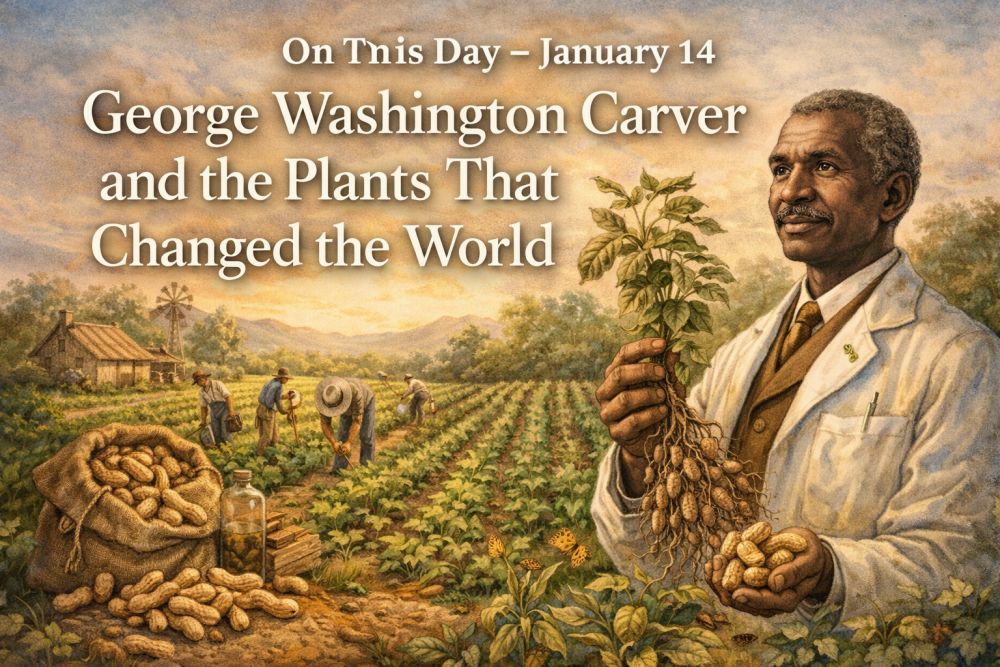

January 14 marks the birth of George Washington Carver, a scientist whose work quietly reshaped how humanity understands plants, soil, and sustainability. Long before words like regenerative agriculture or soil health became fashionable, Carver was already proving that plants could restore exhausted land, support communities, and create resilient food systems.
Born into slavery around 1864 in Missouri, Carver’s early life was shaped by loss, poverty, and exclusion. Yet his curiosity for the natural world proved unstoppable. Plants became his teachers, his tools, and eventually his way of speaking to the world.
Plants as Partners, Not Resources
At a time when cotton monoculture was draining Southern soils into lifeless dust, Carver proposed a radical idea: let plants heal the land. He encouraged farmers to rotate crops, especially with legumes like peanuts, cowpeas, and sweet potatoes. These plants replenished nitrogen in the soil, reduced erosion, and brought life back to exhausted fields.
This wasn’t abstract science. It was practical, deeply human work. Carver traveled rural roads teaching farmers how to work with nature rather than against it. He believed soil was a living system and that plants were collaborators in long-term abundance.
The Peanut Was Never the Point
Carver is often remembered as “the peanut scientist,” credited with hundreds of peanut-based products. But this reputation misses the deeper truth. The peanut was simply a symbol — proof that overlooked plants could become powerful allies.
His real legacy lies in showing how biodiversity protects both land and livelihoods. By diversifying crops, farmers reduced risk, improved nutrition, and became less dependent on fragile single-crop economies.
A Global Lesson Rooted in Nature
Although Carver worked in the American South, his ideas resonate globally. From small gardens to large farms, the principles he championed remain essential:
- Healthy soil is the foundation of healthy plants
- Diversity strengthens ecosystems
- Sustainable growing is a long-term relationship, not a short-term fix
These ideas now sit at the heart of modern ecological gardening, permaculture, and climate-resilient agriculture.
Why George Washington Carver Still Matters Today
In an era of climate uncertainty, depleted soils, and increasing pressure on food systems, Carver’s philosophy feels strikingly current. He didn’t see plants as commodities, but as partners capable of renewal.
On this day, January 14, his story reminds us that some of the most powerful environmental solutions are not new technologies, but old wisdom rediscovered — rooted in observation, patience, and respect for the natural world.
Carver once wrote that nature was his “best teacher.” More than a century later, his lesson still grows.
Curious to Explore Further?
How can plants actively improve soil health? Why do legumes play such a critical role in sustainable gardening? And what can today’s gardeners learn from Carver’s field-based experiments?
These questions continue to shape the way we grow — quietly, persistently, just like the plants themselves.