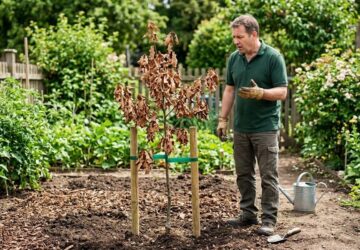

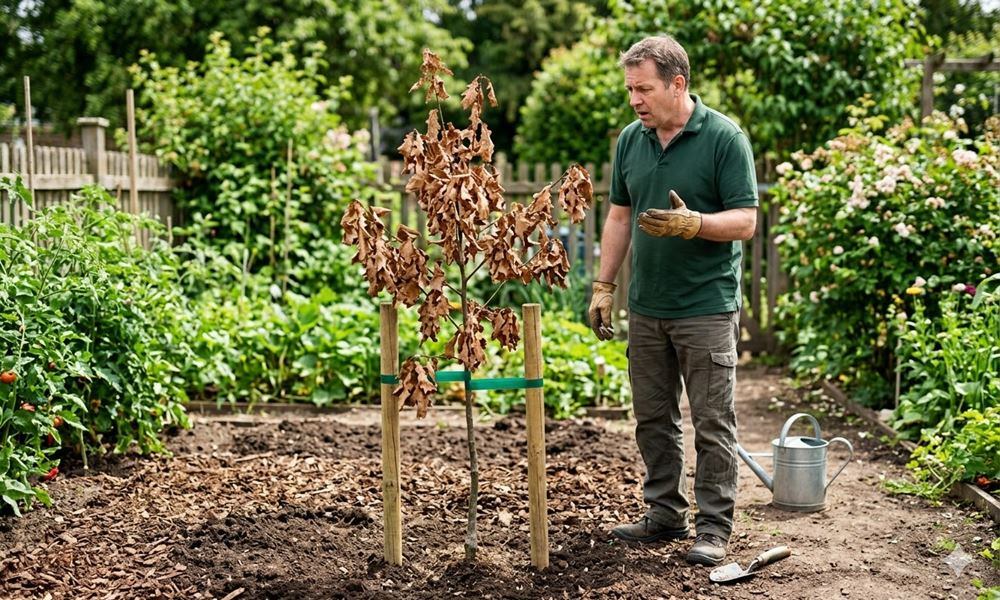

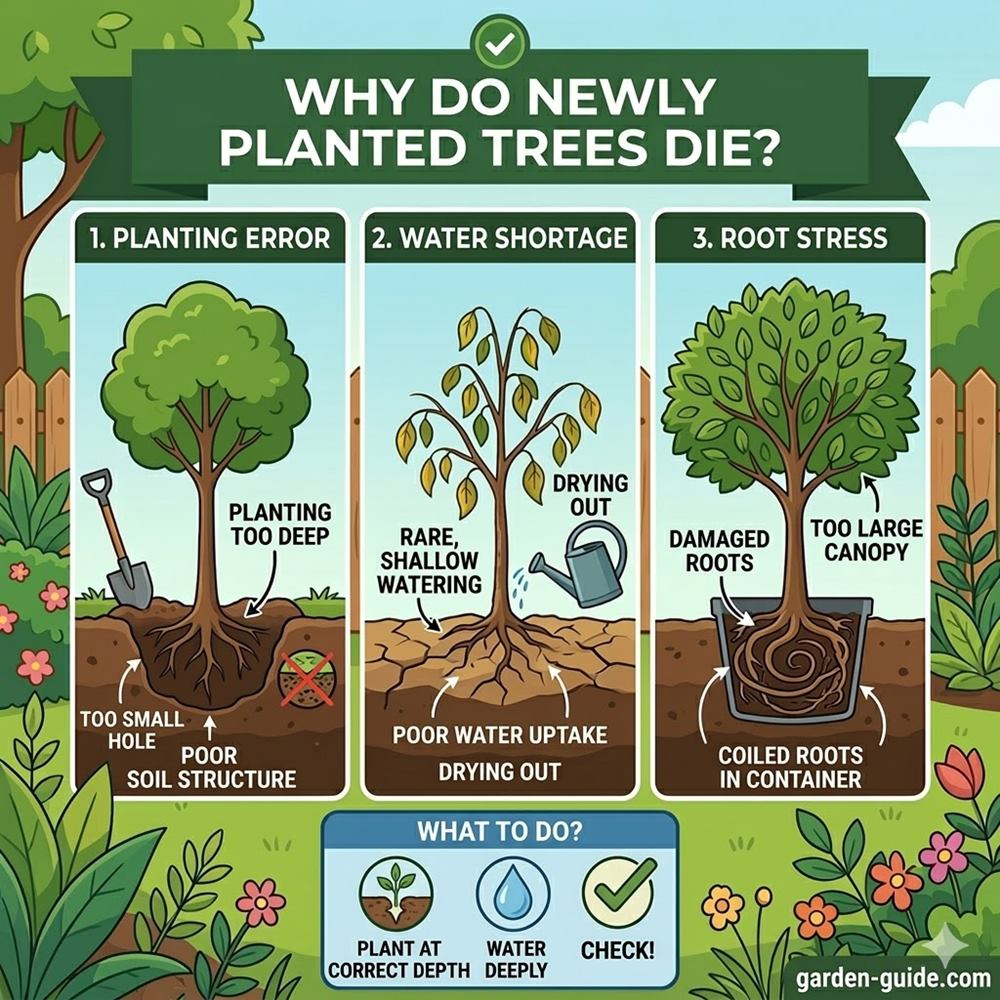
A newly planted tree often represents hope in the garden: future shade, fruit, structure, and long-term beauty. Yet many young trees fail within their first season. Leaves wilt, shoots stall, and by late spring or early summer the tree seems unable to establish. This is rarely a mystery. In most cases, newly planted trees decline because of three interacting problems: planting mistakes, water shortage, and root stress.
Planting Mistakes Begin on Day One
Improper planting depth is one of the most common errors. When the root flare ends up below soil level, the trunk base may remain too moist and poorly aerated. This can damage bark tissues and compromise root development.
Another frequent issue is an undersized planting hole. If roots are placed into a narrow or compacted space, they struggle to expand into the surrounding soil. In difficult urban or built-up soils, this problem becomes even more serious.
The soil itself may also be unsuitable: compacted clay, construction debris, or drought-prone sandy material all create poor establishment conditions.
Water Shortage Is Frequently Underestimated
Freshly planted trees do not yet have an extensive root system. Their ability to absorb water remains limited during the first weeks and months. Many gardeners water thoroughly on planting day and then assume the job is done. In reality, the greatest water demand often comes later, as leaves expand and transpiration increases.
Common signs of water stress include:
- drooping leaves,
- drying shoot tips,
- premature leaf drop,
- stalled growth.
Young trees usually benefit more from deep, thorough watering at intervals than from light, frequent surface sprinkling.
Root Stress Decides Establishment
Every transplanted tree experiences root stress. It has been lifted, transported, and introduced into a new soil and climate. Damaged, circling, or compacted roots may struggle to reconnect with their environment.
Root stress becomes especially severe when:
- the root ball breaks apart,
- roots are damaged,
- circling container roots are not loosened,
- the canopy demands more water than the roots can supply.
A root-stressed tree may not collapse immediately. It may simply fail to grow, remain weak, and gradually decline.
Container Trees Are Not Automatically Safer
Container-grown trees are often assumed to establish more easily, but this is only true if the root system is healthy. Tight root spirals inside the container can prevent outward growth after planting. If roots continue circling instead of extending into surrounding soil, long-term establishment and stability may suffer.
Mulch, Support and Patience
A mulch layer over the root zone helps conserve soil moisture and reduce temperature fluctuation. Proper staking can stabilize the trunk while roots establish. Regular observation remains essential, especially during warm or windy weather.
Mulch should not be piled against the trunk itself, because constant moisture at the bark can create further problems.
When Is a Tree Truly Established?
A tree is not considered safely established simply because it survives the first week after planting. Many trees temporarily rely on stored energy. Real success becomes visible when new shoots grow steadily, leaves remain firm, and development continues without interruption. The first full growing season is often the decisive period. Newly planted trees do not survive because they were planted beautifully. They survive because they are supported properly after planting.
The Core Lesson
Tree death after planting is rarely caused by one dramatic failure. More often it results from several manageable stresses accumulating at the same time. And that is precisely why it is preventable. Strong establishment depends not on flashy techniques, but on getting the basics right from the very beginning.