

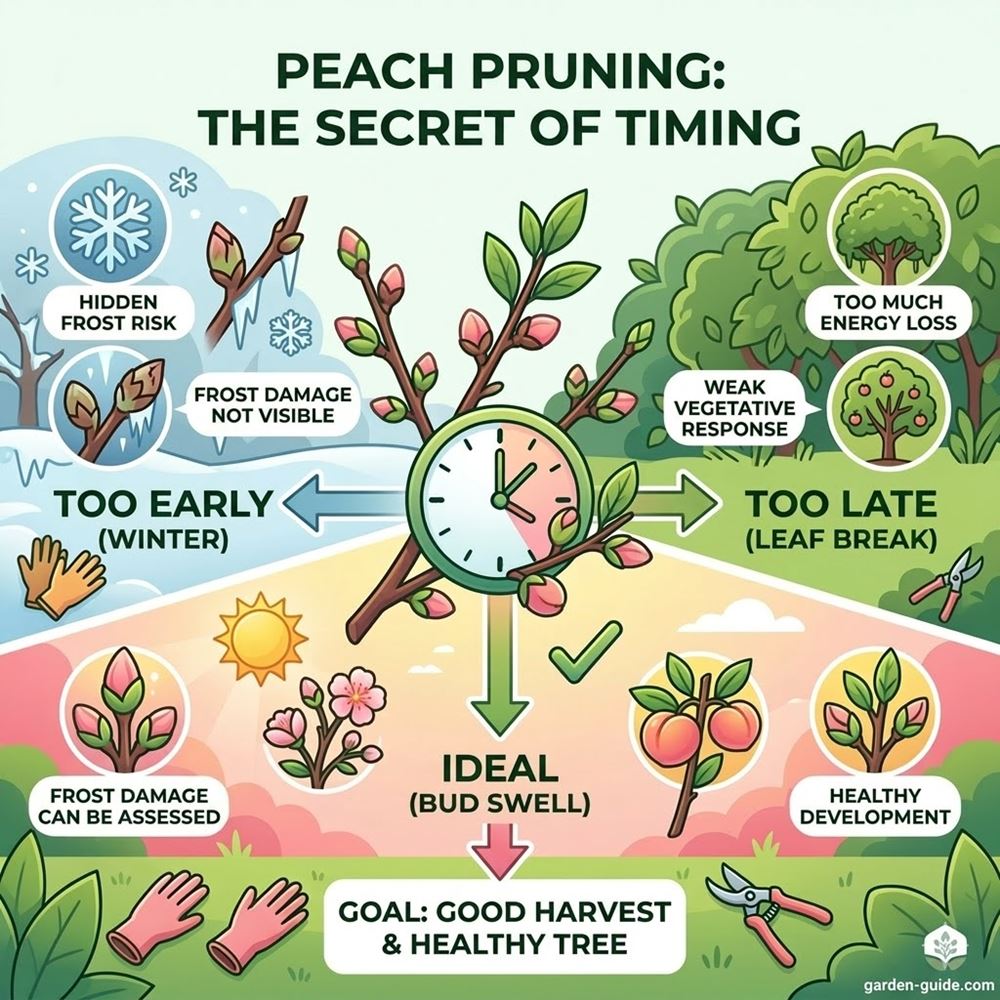
Pruning peach trees is one of the most timing-sensitive tasks in the garden orchard. The difficulty is not only in how to cut, but in knowing when to do it. If pruning is done too early, frost damage may later reshape the tree’s productive potential. If it is done too late, the tree may already have committed substantial energy to growth, and hard pruning can push it into excessive vegetative response.
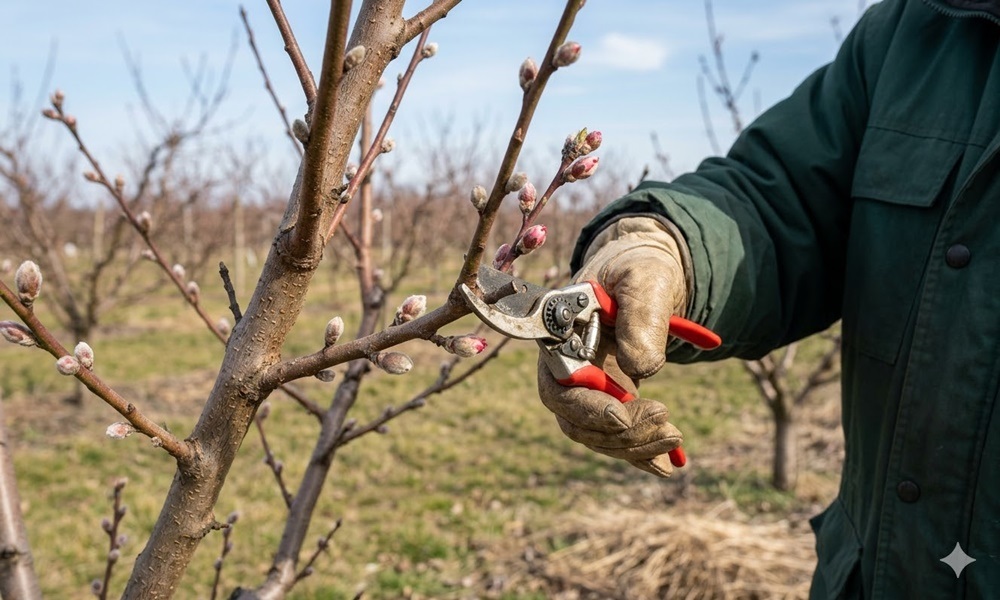
Peach, Prunus persica, differs from many other fruit trees because it bears primarily on one-year-old shoots. This means that the gardener is not just thinning wood, but deciding which current-season fruiting framework remains in place.
Why Timing Matters So Much
Peach trees react quickly in spring. Buds swell early, tissues become active fast, and the tree transitions out of dormancy sooner than many growers would prefer. Because flower buds can be damaged by late frosts, pruning before their condition is visible may lead to poor decisions.
Pruning too early can result in:
- misjudging winter damage,
- leaving too few viable fruiting shoots,
- increasing exposure to later frost-related loss.
Pruning too late can result in:
- stronger vegetative regrowth,
- unnecessary energy loss,
- poorer structural balance.
Bud Swell as a Practical Guide
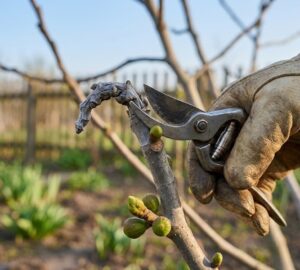
The commonly recommended period is around bud swell, before full leaf emergence. At this stage, buds are enlarged and easier to evaluate, but the tree has not yet fully accelerated into shoot growth.
This is the moment when growers can better assess:
- which shoots overwintered well,
- how dense the flower buds are,
- where frost injury occurred,
- how crowded the canopy really is.
Bud swell provides information. Earlier pruning relies more on guesswork.
Frost Risk and Why Many Gardeners Delay
Frost risk plays a major role in peach pruning strategy. Heavy early pruning reduces the number of retained buds before it is clear how many survived winter. In frost-prone gardens, waiting longer allows a more informed balance between fruit potential and structural pruning.
For this reason many experienced growers prefer to delay peach pruning until the tree reveals more about its spring condition.
What to Evaluate Before Cutting
Good pruning begins with observation. The gardener should examine:
- the strength of one-year-old shoots,
- flower bud density,
- branch direction,
- canopy congestion,
- dead or damaged wood.
Moderately strong, well-ripened one-year shoots usually provide the best fruiting framework. Weak shoots are often poor producers, while excessively vigorous shoots tend to favor vegetative growth over fruit balance.
The Main Pruning Principle in Peach
Peach pruning is fundamentally about renewing fruiting wood. Since the tree bears mainly on last year’s shoots, the grower must maintain a regular supply of properly positioned young wood.
That means:
- thinning crowded shoots,
- removing inward-growing branches,
- shortening poorly directed or overly long shoots,
- gradually replacing ageing fruiting sections with younger ones.
The canopy should be open enough for light and air, but not stripped so severely that the tree is destabilized.
Open-Center Training and Light
Peach trees are often trained to an open-center structure in home gardens. This improves light penetration and air movement, both of which are essential for fruit quality, shoot maturation and disease reduction. An open center is not just aesthetic. It supports:
- better light distribution,
- easier maintenance,
- improved spray coverage,
- stronger renewal wood.
What Happens Without Proper Pruning?
Unpruned peach trees quickly become dense and unbalanced. Fruiting shifts outward, interior wood weakens, and fruit size often declines. Dense canopies also increase disease pressure and complicate harvest.
What If Pruning Is Late?
If the buds are strongly advanced but the tree is not yet fully leafed out, a lighter corrective pruning can still be done. The focus should shift toward essential thinning and removal of damaged or badly placed shoots. Once active growth is fully underway, drastic pruning is usually less helpful than restrained correction followed by later canopy management.
The biggest mistake is often not late pruning itself, but panicked over-pruning after realizing the season has advanced.
The Core Principle
Peach pruning works best when the tree’s condition is readable but growth has not yet fully accelerated. That usually means the bud-swell period, adjusted to the local climate and frost pattern.
In peach, pruning is never just about what is removed. It is equally about what is intentionally preserved for light, balance and fruiting in the coming season.