


There is a particular kind of morning in early spring — the sort when the borders are still half-asleep, the lawn is undecided about being green, and the trees stand bare and architectural against a pale sky. Then, almost overnight, a magnolia opens. And everything changes. Magnolias do not fade politely into the background. They don’t “blend”. They perform. One tree in bloom can shift the entire mood of a garden from hesitant to theatrical.
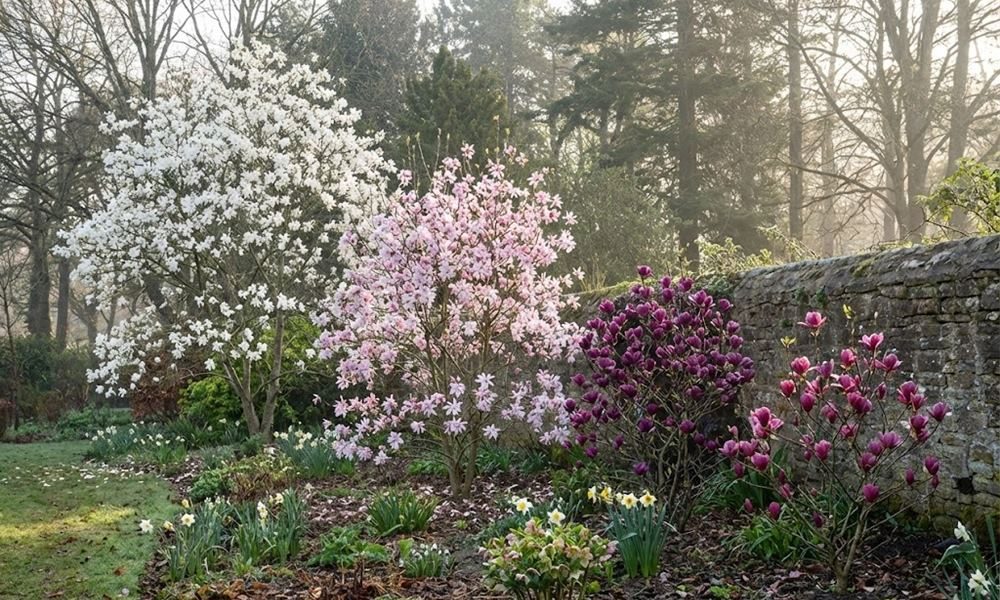
The genus Magnolia is wonderfully ancient — over 90 million years old. These flowers evolved before bees took centre stage in pollination, which explains their thick, almost waxy petals built to withstand beetles clambering across them. Named after French botanist Pierre Magnol, they became treasured specimens in European estate gardens, while in China and Japan they have long symbolised purity, nobility and quiet strength. Here are four magnolias with four very different personalities — from grand statement trees to compact stars for smaller plots.
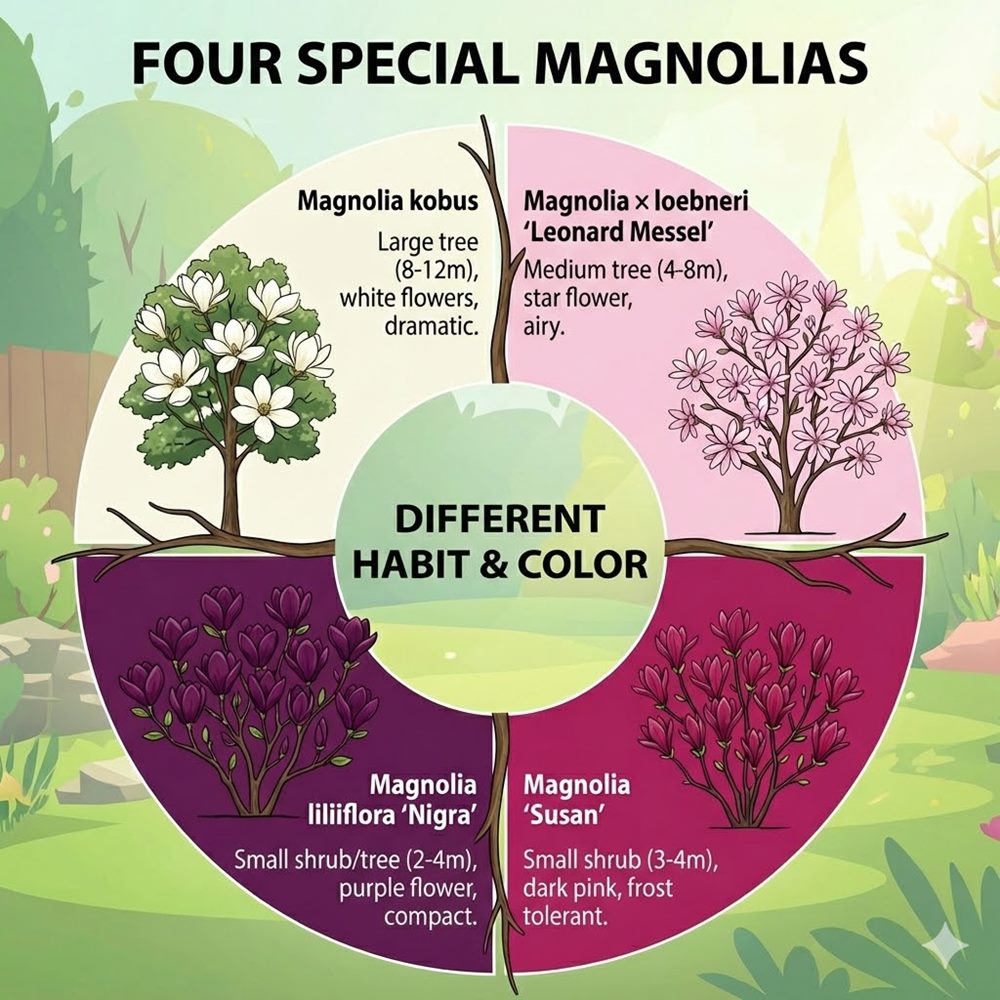
The Generous Classic – Magnolia kobus
If you close your eyes and picture a traditional magnolia in full bloom, chances are you’re imagining Magnolia kobus. This is the dignified one. The tree that takes its time, then rewards you handsomely.
Growing 8–12 metres tall, it forms a broad, balanced crown that feels established even when relatively young. Its pure white, lightly fragrant flowers appear before the leaves, suspended on bare branches like porcelain cups against the sky.
It belongs in a garden with breathing space — somewhere it can mature into its full architectural presence.
What it appreciates:
Sun or light partial shade. Well-drained, slightly acidic soil. It dislikes waterlogging and heavy disturbance around its roots. Late frosts may damage early flowers, but the tree itself is reliably hardy.
Propagation is possible from seed (with necessary cold stratification), though most nursery specimens are grafted for consistency.
Compact but Dramatic – Magnolia liliiflora ’Nigra’
Not every garden can host a tree-sized magnolia — and that’s where ’Nigra’ shines. Growing to a manageable 2–4 metres, it brings rich colour and presence without demanding a country estate.
Its tulip-shaped flowers are deep purple on the outside and softer within. In backlit sunshine, they seem almost luminous. Blooming later — often late April into May — it sidesteps some of the spring frost anxiety.
It feels intimate. Best enjoyed up close, near a terrace or front path where the detail can be admired.
Ideal conditions:
A sheltered, sunny position protected from strong winds. Humus-rich, slightly acidic soil keeps foliage healthy and flowering generous.
To maintain its distinctive colour and form, it is usually propagated by cuttings or grafting.
The Romantic In-Between – Magnolia × loebneri ’Leonard Messel’
A meeting of M. kobus and M. stellata, this hybrid strikes a beautiful balance. Airy, star-shaped flowers in soft pink tones open before the leaves, creating a cloud-like effect along the branches.
At 4–8 metres, it fits comfortably into medium-sized gardens — substantial, but not overwhelming.
There is something almost painterly about it, especially when planted where evening light filters through the petals.
What helps it thrive:
Bright exposure, moist yet well-drained soil, and a mulch layer to protect its shallow roots. As a hybrid, it is propagated by grafting.
The Late but Sensible Choice – Magnolia ’Susan’
Part of the American-bred “Little Girl” series, ’Susan’ was selected specifically for slightly later flowering and improved frost resilience. In practical terms? Fewer disappointments after cold snaps.
Its slender, deep pink petals form elegant goblet-shaped blooms that open from late April into early May. Mature height is typically 3–4 metres, making it a natural fit for family gardens and urban plots.
Give it sunshine, loose slightly acidic soil, and a little patience while it establishes. Once settled, it is wonderfully dependable.
Choosing the Right Magnolia – Think Scale First, Colour Second
It’s tempting to choose purely by flower colour, but proportion is everything in garden design.
Small gardens:
’Susan’ or ’Nigra’ offer drama without crowding the space.
Medium gardens:
’Leonard Messel’ delivers elegance and seasonal theatre without becoming overpowering.
Large landscapes:
Magnolia kobus earns its place as a true specimen tree.
One final design note: magnolias shine brightest against calm backdrops — a clipped hedge, a dark evergreen screen, or simply open sky. Give them visual breathing room and they will reward you.
Mistakes Worth Avoiding
Even magnificent plants have their preferences.
Planting into strongly alkaline soil can lead to chlorosis and weak growth. Waterlogged ground suffocates roots. Digging repeatedly around the base disturbs their shallow root systems. Pruning at the wrong time removes next year’s flower buds. And perhaps most common of all — expecting instant maturity.
Magnolias are not quick-fix plants. They are long-term companions. But once established, they return every spring with a performance that feels both ancient and entirely fresh.