

March 19 carries a wider seasonal resonance than a single local tradition. Across the Northern Hemisphere, this is one of those charged late-March days when people begin reading the world more closely: the air shifts, the birds return, the ground softens, and every sign seems to hint that spring is near, though not yet secure.
A Day of Signs and Forecasts
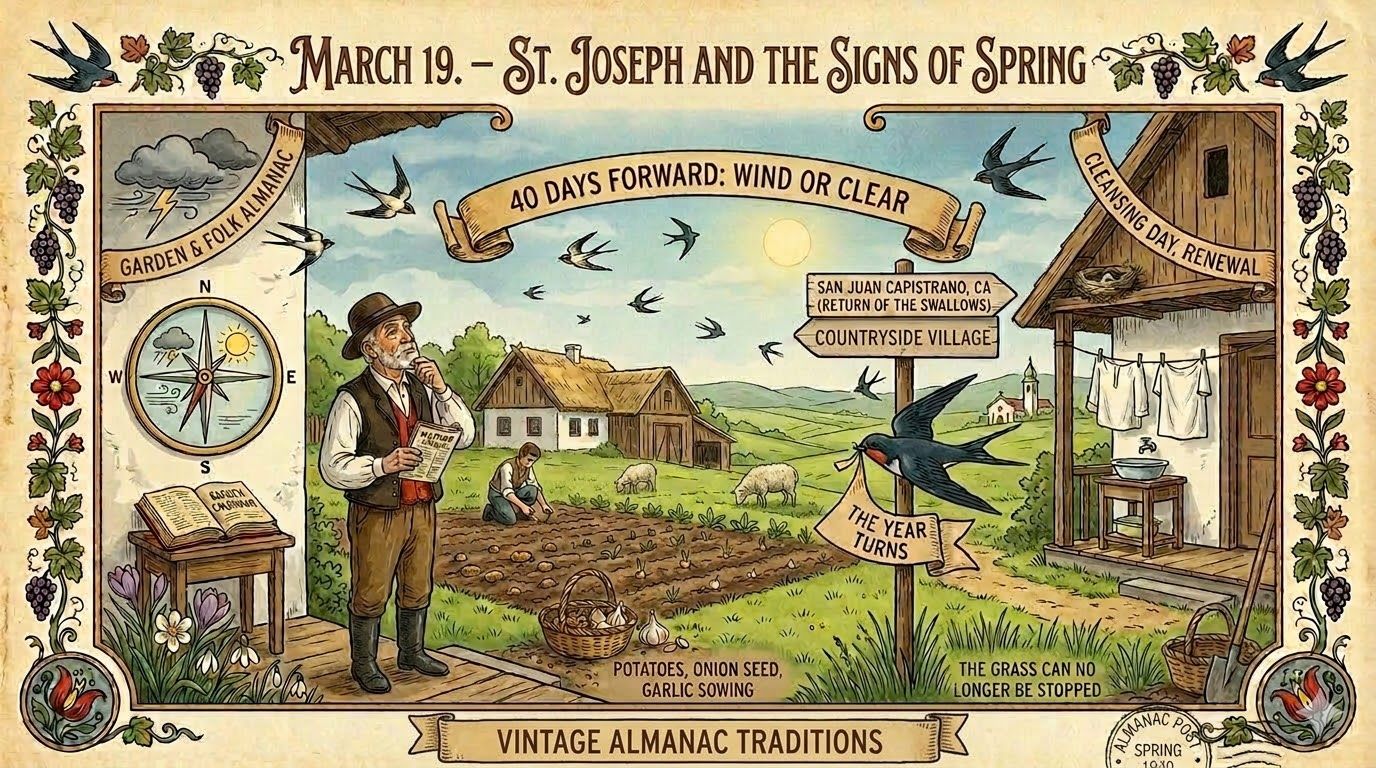
In Hungarian folk tradition, March 19 is associated with Saint Joseph and with weather lore that reaches far beyond the day itself. The day was believed to foreshadow the next forty days, while also offering hints about harvest prospects, summer heat, and even misfortune. Wind on this day was taken seriously; clear weather, by contrast, promised warmth ahead.
What matters here is not only the prediction itself, but the old habit of reading a whole season from a single threshold day. This kind of thinking appears in many rural traditions: a date becomes meaningful because it gathers weather, work, fear, and hope into one attentive pause.
The Return of the Swallows
One of the loveliest associations of March 19 is the return of the swallows. In Hungarian tradition, they are said to arrive on Joseph’s Day, making them natural heralds of spring. The image is not merely ornamental. Swallows signal movement in the air, awakening insect life, and the reopening of the season around homes, barns, orchards, and fields.
That makes an intriguing bridge to a much wider observance: in San Juan Capistrano, California, March 19 is still associated with the famous “Return of the Swallows,” celebrated on Saint Joseph’s Day as a sign of renewal and the coming of spring. Across very different landscapes, the swallow carries the same message — the year is turning.
What the Garden Asks for Now
For the garden, March 19 is a day of readiness rather than certainty. Traditional household wisdom places the planting of potatoes, onion seed, and garlic around this time, but always with close attention to the actual condition of the soil. If the ground is workable, not waterlogged, and no longer bitterly cold, the first decisive moves of the season can begin.
This is also the moment when green growth starts to feel irreversible. Folk sayings capture that beautifully: after Joseph’s Day, the grass is no longer thought to be stoppable. Whether taken literally or not, the meaning is clear enough for gardeners everywhere — once late March arrives, the garden is no longer waiting quietly. It is gathering force.
Renewal at Every Scale
March 19 was not only a day for reading the fields and the weather, but also for restoring order at home and in the body. In some traditions it was considered a cleansing day, marked by bathing and putting on clean linen. That, too, belongs naturally in a garden calendar: spring is not only about sowing and pruning, but about renewal in the broadest sense.
In the Garden Almanac, March 19 becomes a day of observation, restraint, and awakening — when birds, wind, soil, and household custom all seem to lean toward the same quiet conclusion: spring is close enough to feel, but still mysterious enough to deserve respect.