
By mid-March, the garden is no longer merely waiting. Light has lengthened, the ground has softened, buds have tightened with intention, and the gardener’s gestures begin to change. This is not yet the season of full display, but it is already the season of reading signs.
March 16 carries an intriguing mix of observances and associations. In a wider international frame, it can be read as a day of quiet protection, preservation and preparation: playful folklore around grapes and harvest, older feast-day traditions, and even the idea of knowledge being carefully carried forward. Together these create a fitting almanac mood for early spring, when so much of the season still exists as promise rather than proof.
The vine still looks silent
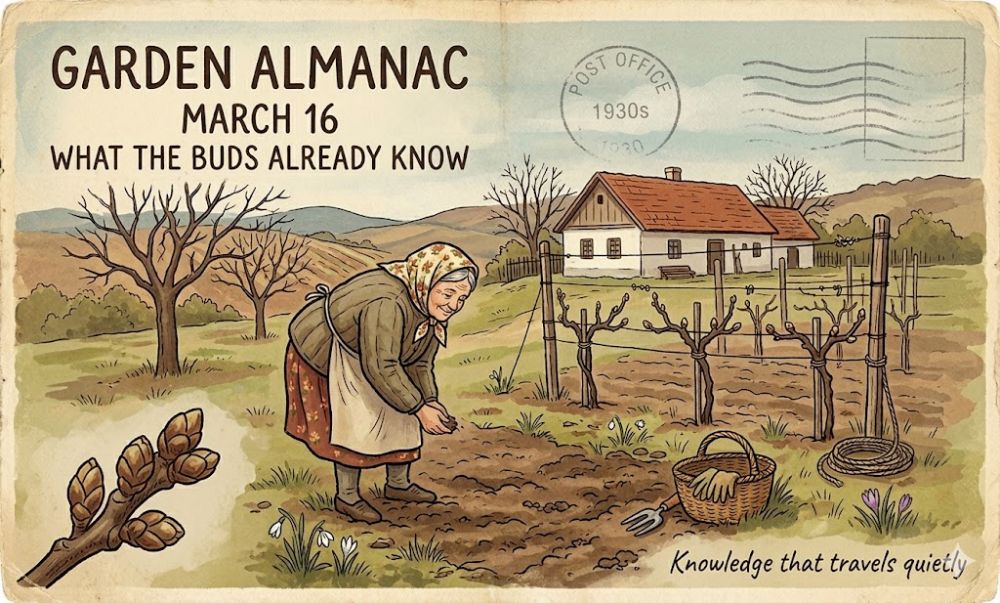
The vine is one of early spring’s most revealing plants. In mid-March it may still appear restrained, even bare, yet much is already at stake: pruning decisions, bud condition, structural care, soil attention, patience with late cold. The season’s abundance is nowhere to be seen, but the groundwork for it has already begun.
That is why this day lends itself so naturally to a vineyard or orchard reading, even beyond any one local custom. It speaks to a serious truth gardeners know well: the harvest is cared for long before it arrives.
Knowledge that travels quietly
Early gardening wisdom is often preserved in surprisingly humble ways. Not always in formal manuals, but in pencilled notes, inherited habits, remembered timing, and those small seasonal sayings that turn out to be right more often than expected. Mid-March belongs to that kind of knowledge.
It is the time when one remembers which tree always breaks bud first, which corner of the garden holds the cold, which stretch of soil dries late, and where patience is worth more than eagerness. An almanac, after all, is not only a record of dates. It is a house for accumulated attention.
Not the season of haste
March 16 is not a day for rushing the garden forward. It is a day for noticing. Which shrubs are stirring earliest? Which bed has dried enough? Which vine is still holding tight? Where does warmth linger, and where does the season remain cautious? The gardener who pays attention now is often rewarded later with a steadier season.
This is especially true in orchards, borders and vine-covered places, where a few mild days can tempt both plant and person too quickly. A return of cold can still interrupt what has begun. Good spring gardening at this stage is less about forcing growth than about accompanying it wisely.
The landscape before leaf-out
Environmentally, this is also a revealing part of the year. The ground is active, birds are louder, the first insect stirrings appear, and the structure of the garden is still visible before leaves soften every line. That visibility is a gift. One can still read hedge shapes, branch architecture, the movement of light, the proportions of beds, and the places where intervention should later be lighter or bolder.
Spring here is persuasive not because it is loud, but because it is certain in small ways. A tightening bud, a different scent in the air, a shift in the colour of the soil, a longer evening — these are enough.
What this day still says in the garden
One of the loveliest truths of mid-March is that a season often begins while almost nothing is yet visible. The bud is closed, the row is bare, the vine still looks quiet, and yet timing, care and decision are already shaping what is to come.
So perhaps March 16 belongs in the almanac as a day of restrained alertness. Not a day of full flowering, but of inward readiness. And sometimes that kind of readiness tells us more than any visible abundance.