

January 31 is not an empty, abstract day in the calendar. It sits at a crowded crossroads of traditions, quietly holding together Christian remembrance, older seasonal thinking, and the first real signs that the natural year is turning — even if winter still looks firmly in charge.
A day of names and quiet figures
In the Christian calendar, January 31 gathers an unusually long list of saints and remembered figures. Among them is John Bosco, the 19th‑century Italian priest and educator whose work with young people made him one of the best‑known figures of this day. His feast gives January 31 a theme of care, patience, and long‑term nurturing — ideas that resonate strongly with the season itself.
Alongside him appear lesser‑known but symbolically fitting names: Geminianus, associated with protection and endurance; Marcella of Rome, remembered for her ascetic life and learning; Wilgils, the hermit father of Saint Willibrord, who withdrew from society to live simply near the North Sea coast. These are not saints of spectacle, but of restraint, study, and quiet persistence.
Eastern Orthodox liturgical calendars also mark January 31, reinforcing the sense that this day belongs to continuity rather than climax — a shared moment of remembrance across traditions, without a single dominant story.
Imbolc’s threshold: the night before change
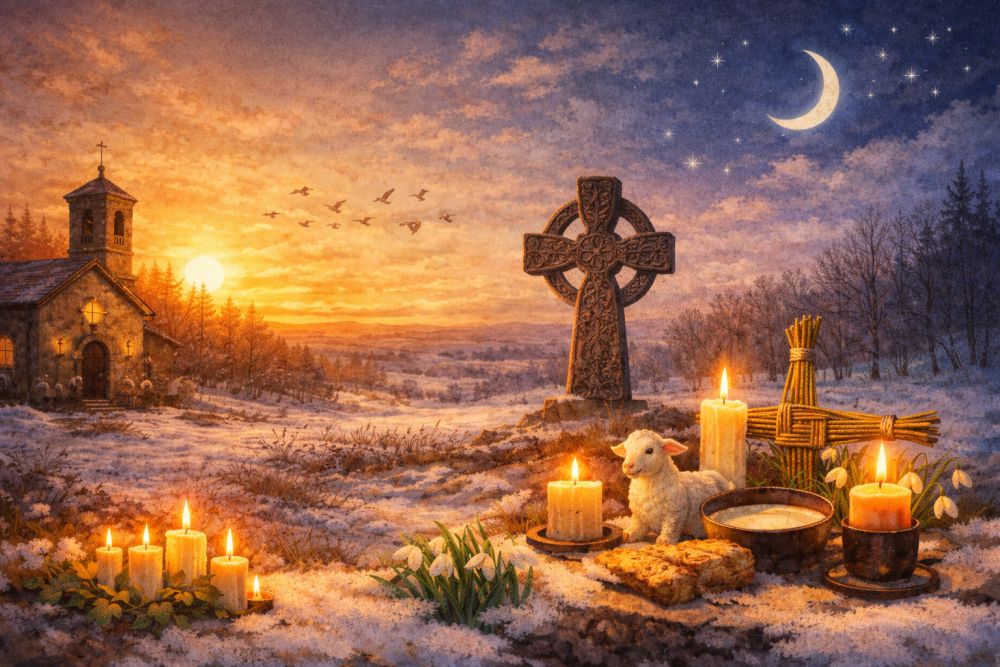
January 31 is also Imbolc Eve in the older Celtic calendar. Imbolc itself begins at sundown and unfolds on February 1–2, marking the first festival of the returning light. Traditionally associated with lactating ewes, cleansing, and the awakening of the land, Imbolc was never about visible growth, but about potential becoming active.
The eve mattered. It was the moment of readiness — when winter was still present, but no longer unquestioned. Fires were prepared, thresholds were cleaned, and attention shifted from survival to renewal. In this sense, January 31 belongs less to winter’s strength and more to winter’s limits.
Light before warmth
By this date, daylight has increased noticeably since the winter solstice. In Central Europe, afternoons are visibly longer, even if temperatures remain low. Traditional almanacs and rural calendars treated this as a reliable marker: light always returns before heat, and before growth.
This made the end of January an important observational point. Farmers and gardeners watched how snow behaved in sunlight, how frost lingered or released, and how animals responded to the lengthening day. None of this meant spring was near — but it confirmed that the cycle had shifted direction.
A hinge in the season
January 31 is best understood as a hinge. On one side lies the closed, conserving logic of mid‑winter. On the other stands the slow, uncertain opening toward spring. Buds remain sealed, soil is still cold, and growth is invisible — yet internally, dormancy is no longer absolute.
This is why many traditions treated this period with restraint rather than celebration. The change was real, but fragile. To rush it was considered unwise.
What January 31 carries forward
Across saints’ calendars, folk tradition, and seasonal observation, January 31 consistently points to the same idea: meaningful change begins quietly. It arrives through light, attention, and patience — not through sudden warmth or visible transformation.
The day ends with winter still intact. But it no longer ends unquestioned.