

February 3 often passes quietly, yet across cultures it marks a subtle but important moment in the seasonal calendar. It is a day shaped by thresholds — between winter and spring, enclosure and opening, holding on and letting go — themes that speak directly to gardens and the natural world at this time of year.
Saint Blaise and the Language of Weather
In much of Europe, February 3 is associated with Saint Blaise, a figure surrounded by folk belief and weather lore. Traditionally, this day was watched closely for wind, cold, and sudden shifts in air. Sharp winds or clear skies were read not as forecasts of warmth, but as signals about how winter intended to behave in its final weeks.
For gardeners, wind matters as much as temperature. Drying winds can deepen frost damage, while still, heavy air can preserve soil moisture and protect dormant plants. Saint Blaise’s day belongs to this observational logic: not prediction, but attention.
Northern Roots and Endurance
Other figures remembered on February 3, such as Ansgar, the missionary of the far North, carry associations of endurance, adaptation, and working within harsh climates. These qualities resonate strongly with winter landscapes, where survival depends on structure rather than growth.
In the garden, this is the period when woody plants rely entirely on what was built the previous year: strong tissue, well-set buds, and protected roots. Nothing new is added — everything depends on what already exists.
Setsubun: Clearing Before the Season Turns
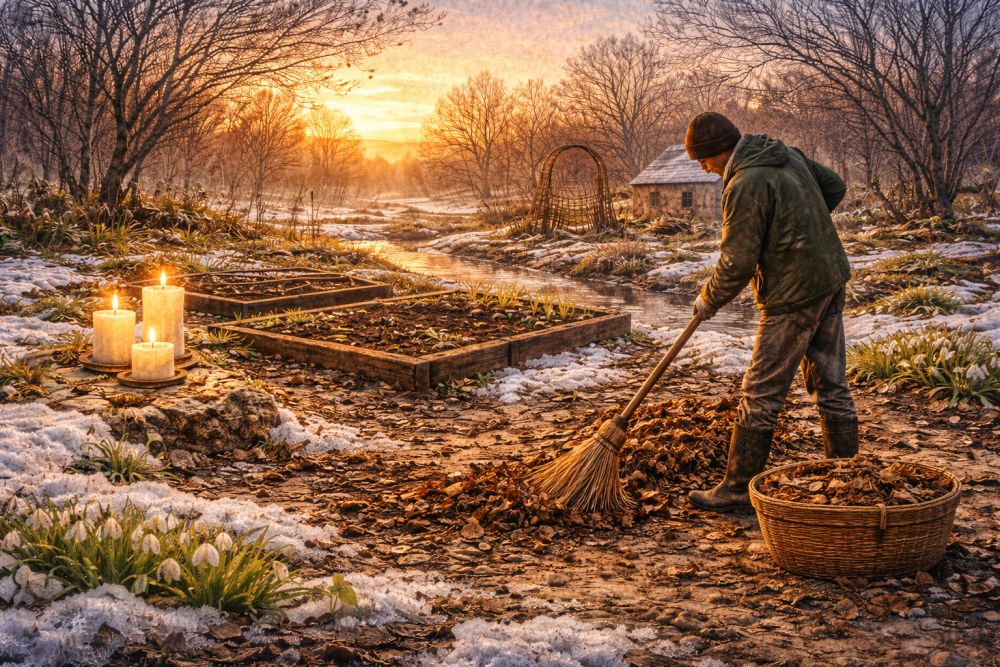
Beyond Europe, February 3 is often linked to Setsubun in Japan, the traditional marker of the seasonal divide between winter and spring. Setsubun is not a celebration of growth, but of clearing: sweeping away what no longer belongs before the new season begins.
The logic is familiar to gardeners everywhere. Before sowing or planting comes removal — of debris, disease, and lingering imbalance. Setsubun expresses, in cultural form, the same principle winter gardens follow naturally.
Timing, Not Action
February 3 can also coincide with the earliest possible approach of the pre‑Lenten period, reminding traditional calendars that timing matters more than speed. Acting too early, whether in ritual or in the garden, risks undoing careful preparation.
This is a day for restraint. The soil is not ready. The light is improving, but uneven. The task is not to hurry, but to prepare mentally and structurally for what follows.
What February 3 Reminds Us
February 3 teaches that seasonal change begins with clearing, not planting. It asks us to watch wind and weather, to respect what winter still holds, and to recognize that readiness often looks like stillness.
In the garden, as in the calendar, the space for spring is being made — quietly, and on purpose.