
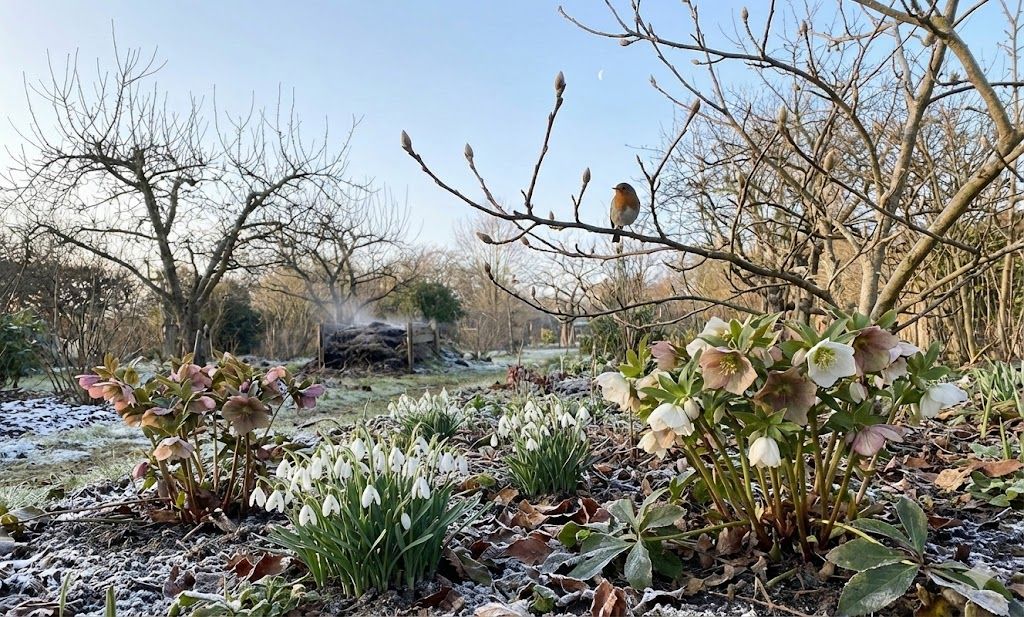

By mid‑February, something subtle shifts. The air may still carry winter’s edge, but the light has changed. On this day, the garden does not erupt into color — it inhales.
Early Bloomers and Swelling Buds
Across temperate regions, early bloomers such as snowdrops (Galanthus nivalis), winter aconite (Eranthis hyemalis), and hellebores (Helleborus) respond not to warmth, but to increasing daylight. February 17 falls at a point in the season when fruit tree buds are visibly fuller, especially on apricot and almond in milder climates. Beneath the surface, soil organisms stir whenever frost loosens its grip.
Gardeners often use this period to inspect bark for winter damage, check stored dahlia tubers, and begin chitting early potatoes indoors.
On This Day in Seasonal Tradition – Quirinalia
In ancient Rome, February 17 was the festival of Quirinalia, dedicated to Quirinus. Held near the end of the old Roman year, it formed part of a cycle of purification rites. February itself derives from februa, meaning cleansing. In seasonal terms, it marked closure before renewal — a fitting reflection of what gardens are doing now: finishing winter, preparing for growth.
Lunar Rhythms and the 2026 New Moon
February 17 frequently falls close to a new moon — and in 2026, it coincides exactly. In lunar gardening traditions, the new moon favors planning, pruning, compost turning, and soil preparation rather than sowing. Energy is believed to concentrate below ground, making it a symbolic “root phase.”
In the Hindu calendar, this date can align with the new moon of the month of Phalguna, a time associated with spiritual cleansing before the exuberance of Holi. Across cultures, the instinct is similar: restore balance before expansion.
A Day for Kindness – Even in the Garden
February 17 is also observed internationally as Random Acts of Kindness Day. In a garden context, kindness can be ecological: refilling bird feeders during late‑winter scarcity, leaving stems standing for overwintering insects, or choosing peat‑free compost. Small actions, cumulative impact.
Monastic Gardens and the Seven Founders
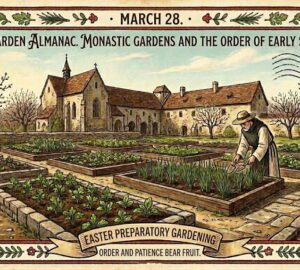
February 17 is also the feast day of the Seven Founders of the Servite Order (13th century). Medieval religious communities were often skilled gardeners, cultivating physic gardens, orchards, and enclosed cloisters designed for contemplation. Their rhythm of prayer and manual labor shaped Europe’s horticultural heritage — preserving plant knowledge through the centuries.
In that sense, this day quietly echoes an old principle: tending the soil is both practical and reflective work.
Watching the Turning Point
Climatologically, mid‑February often marks a measurable increase in daylight across Europe and North America — nearly two additional hours compared to the winter solstice. It is not yet spring, but it is no longer deep winter.
February 17 reminds us that seasonal change is rarely dramatic. It is incremental, almost invisible. Yet the balance has already begun to tilt. Light is gaining. Roots are preparing. The garden knows before we do.