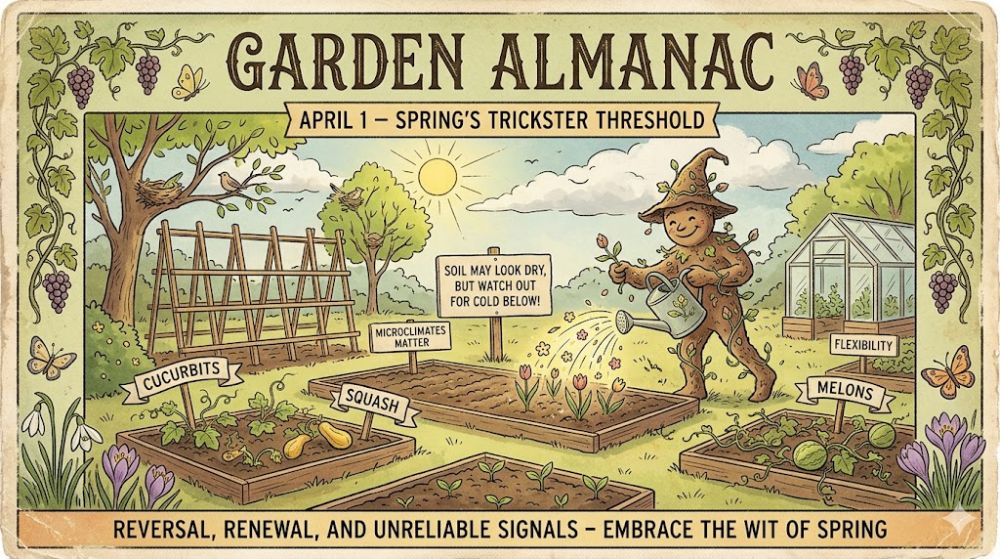

April 1 carries a strange kind of seasonal energy. In many cultures it is linked with jokes, reversals, trickery, and playful deception, yet beneath that lightness there is often an older intuition at work: early spring is a time when the world itself can be misleading.
A warm afternoon may suggest stability that does not yet exist. A bright morning may be followed by a cutting night. A bed that looks ready may still be cold underneath. New growth appears, but not all of it is safe.
That is why April 1 fits the garden so well. It is not merely a day of human prank-making. It is also a reminder that spring often arrives in a teasing, uneven way. The season flashes promise before it offers certainty. It invites gardeners forward, then asks whether they are paying enough attention to proceed wisely.
A Day of Reversal, Renewal, and Unreliable Signals
The deeper history of April Fools’ Day is uncertain. Scholars and popular histories alike agree that its exact origin is not known, though many connect it to older spring festivals, calendar reforms, seasonal misdirection, or customs linked to shifting ideas of the new year. That uncertainty suits the date perfectly. April 1 is a day whose own story refuses to stand entirely still.
For gardeners, this uncertainty feels familiar. Early April is often the season of mixed messages. Soil can look dry on the surface and stay cold below. Buds can swell before conditions are truly secure. Seeds can tempt the hand before temperatures justify the gamble. In that sense, the traditional humor of the day reflects something already present in the natural world: appearances are not always false, but they are not always complete.
What This Day Can Mean in the Garden
If late March often teaches caution, April 1 adds another layer: flexibility. This is not necessarily the day to trust the season blindly, but it can be an excellent day to prepare for what is coming next.
It is a good time to notice where warmth gathers first. Sheltered walls, raised beds, greenhouse edges, south-facing corners, and protected containers may already be moving into a different rhythm from the colder, slower parts of the garden. Microclimates matter enormously now. The same garden can contain both confidence and hesitation at once.
This is also a useful moment to think about crops and plants that sprawl, climb, or run. In many traditional systems, early April was associated with the beginning of real attention to vining plants and warm-season growers: melons, cucurbits, gourds, cucumbers, squash, and similar crops that ask not only for warmth, but for timing. Even where direct sowing is still too early, the day can serve as a threshold for preparation: choosing sites, improving soil, setting supports, planning spacing, or beginning seedlings under protection.
The Value of Not Taking the Date Too Literally
Traditional garden days are most useful when understood as seasonal markers rather than rigid commands. April 1 does not mean the same thing everywhere. In one climate it may signal the opening of serious spring work; in another it may still be far too early for tender crops outdoors. What matters is not obedience to the date, but sensitivity to what the date is trying to notice.
And what April 1 notices especially well is instability. The gardener who respects that instability usually makes better decisions. Covers are kept close. Tender plants are not rushed. Wet soil is not forced into readiness. Warm spells are welcomed, but not overinterpreted. This is the kind of restraint that often leads to a stronger garden later.
The Humor of the Season
There is also something worth preserving in the spirit of the day. Gardening can become overly managerial if one forgets how playful spring really is. A season that changes by the hour, surprises the eye, tricks the forecast, and overturns neat plans is not only frustrating — it is also alive. April 1 gives permission to recognize that vitality.
A gardener does not need to play practical jokes to understand the meaning of the day. It is enough to notice how often spring itself behaves like a mischievous host: offering signs, withholding certainty, encouraging hope, and testing judgment. Few lessons are more useful.
Where the Month Truly Begins
Because it stands so near the start of April, this day has an outsized influence in the imagination. It feels like a beginning, even when the season remains incomplete. That makes it an ideal almanac day. It asks for readiness without haste, planning without rigidity, and delight without naivety.
In the Garden Almanac, April 1 can be read as the threshold where the year turns from early promise toward active growth. The old jokes remain, the uncertain origin remains, the spring weather remains capricious — and the garden, somewhere beneath all of it, begins to reveal what kind of season it may become.